- V
- GF
- NS
- DF
- View Recipe Key
Pistachio Pesto with Basil and Lemon
Pistachio Pesto with Basil and Lemon

This vibrant Pistachio Pesto blends fresh basil, pistachios, Parmigiano-Reggiano, garlic, and lemon into a rich, bright sauce. Make it in minutes, then spoon it over pasta, pizza, vegetables, or your favorite summer dishes.
This post contains affiliate links. Full disclosure is at the bottom of the article.
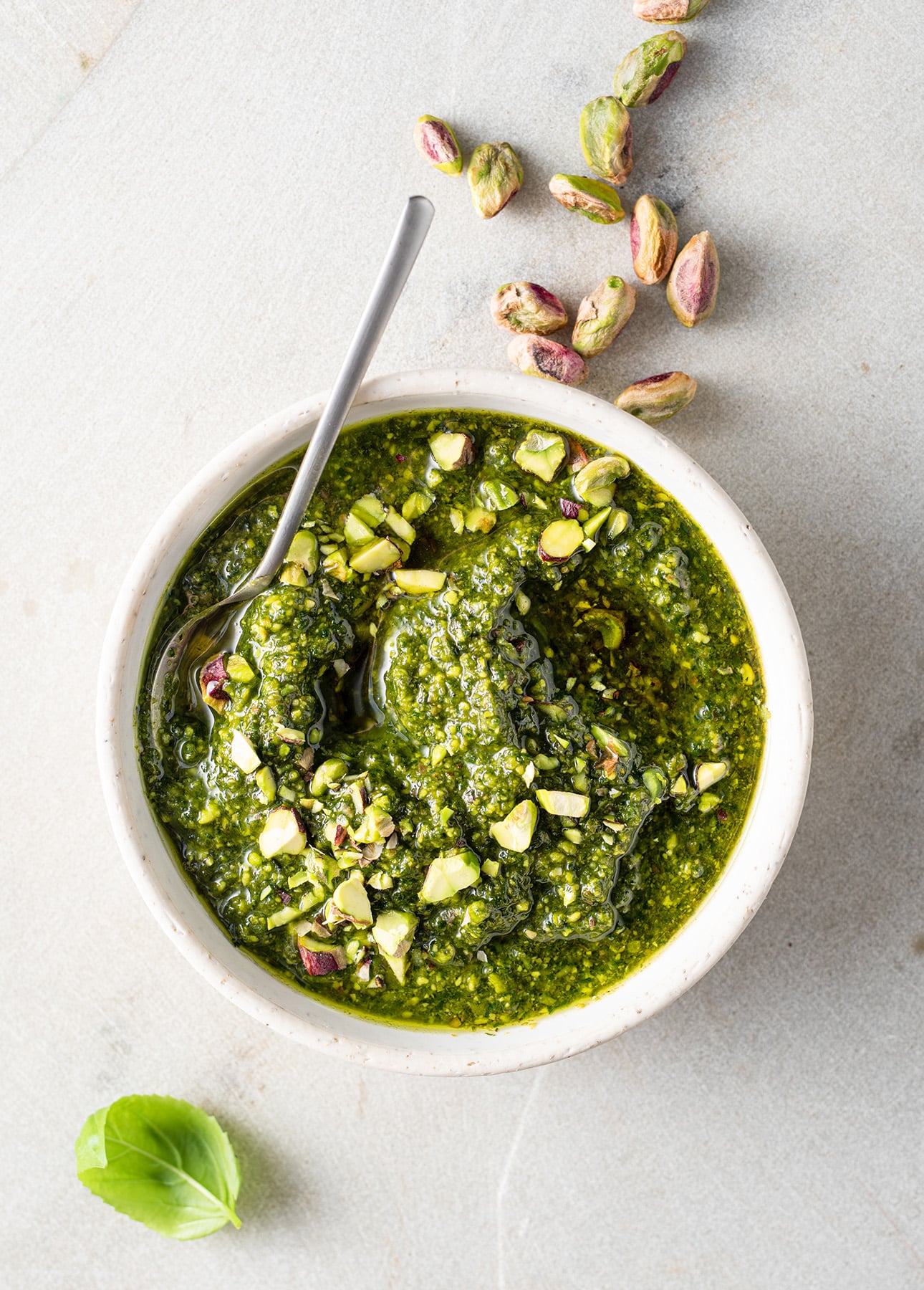
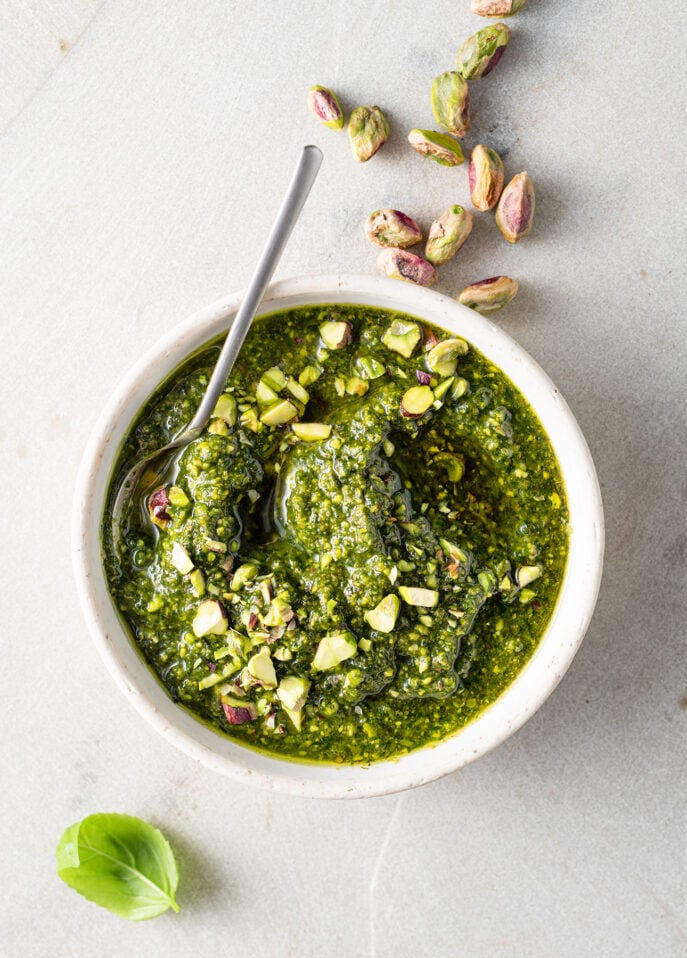
This pistachio pesto is everything I want from a summer sauce: intensely green, wonderfully aromatic, and rich without being heavy. Generous handfuls of fresh basil are blended with pistachios, Parmigiano-Reggiano, garlic, lemon, and extra-virgin olive oil until the mixture is fine but still textured. The pistachios bring a gentle sweetness and plenty of character, while lemon keeps the whole thing bright.
I originally developed this pistachio pesto recipe to dress my Caprese Pasta Salad. It worked so well with tomatoes and fresh mozzarella that the pesto became every bit as important as the salad itself—and far too useful to remain tucked inside another recipe.
What I especially like about this version is that it remains very much a basil pesto. Some pistachio pestos lean almost entirely on the nuts, but here I use about five cups of fresh basil, so the sauce stays fresh and herbaceous. Pistachios replace traditional pine nuts, giving the pesto a rounder, slightly sweeter nuttiness that pairs beautifully with Parmigiano-Reggiano.

I also use both the zest and juice of half a lemon. The zest gives the pesto a fragrant citrus lift, while the juice brings enough brightness to balance the cheese, nuts, garlic, and olive oil. The lemon doesn’t make the pesto lemony so much as make all the other flavors clearer.
Although the traditional way to make pesto is with a mortar and pestle, I use a food processor here. A blender can work in a pinch, but a food processor makes it easier to blend the pistachios and basil evenly while still leaving plenty of texture.

Once you’ve made a jar, you’ll find plenty of reasons to use it. Toss it with pasta, spoon it onto pizza, spread it onto crostini, add it to vegetables, or use it anywhere you would normally reach for basil pesto. It keeps well and freezes beautifully, too, which makes it an especially good way to put an abundance of fresh basil to work.
Quick Summary
- What it is: A fresh basil pesto made with pistachios instead of pine nuts, plus Parmigiano-Reggiano, garlic, lemon, and extra-virgin olive oil.
- Texture: Fine and cohesive, but still visibly textured rather than completely puréed.
- Flavor: Herbaceous, nutty, savory, and fresh, with just enough lemon to brighten the richer ingredients.
- Best uses: Pasta, pizza, Caprese salad, crostini, grilled or roasted vegetables, and more.
- Make ahead: Refrigerate for up to one week with a thin layer of olive oil over the surface, or freeze for up to three months.
What Is Pistachio Pesto?
Pistachio pesto is a variation on traditional basil pesto that uses pistachios in place of pine nuts. There are many ways to make it: some versions emphasize the pistachios, while others—like mine—use plenty of fresh basil and treat the nuts as an especially flavorful swap.
This easy recipe combines fresh basil, shelled pistachios, Parmigiano-Reggiano (Parmesan cheese), garlic, lemon zest and juice, salt, pepper, and extra-virgin olive oil. Everything comes together in the food processor in just a few minutes.
The pistachios make the pesto a little richer and give it a subtle sweetness that works especially well with basil and lemon. It is still unmistakably pesto, though, which means you can use it almost anywhere you would use a classic basil version.
If you’re in the mood to experiment with other pesto combinations, my Kale and Walnut Pesto Risotto shows how well the basic pesto formula adapts to different greens and nuts.

Helpful Tips for Making Pistachio Pesto
Measure the basil lightly—or better yet, weigh it
Fresh basil is surprisingly difficult to measure accurately by volume. Five cups can mean very different things depending on how firmly the leaves are packed into the measuring cup.
For that reason, my recipe gives you both measurements: 4½ oz of fresh basil leaves, or about 5 cups lightly packed. If you own a kitchen scale, the weight is the most reliable way to reproduce the recipe exactly.
If you’re measuring by cups, place the leaves in the measuring cup without firmly compressing them. You want a generous amount of basil, but not five tightly packed bricks of it.
Start with fresh, dry basil
Basil is the backbone of this pistachio pesto, so use fresh, aromatic leaves. Remove any badly bruised or blackened leaves before starting. As with any sauce built around fresh herbs, quality matters: the better and more aromatic your basil, the more flavorful the finished pesto will be.
If you wash the basil, dry it thoroughly before adding it to the food processor. Excess water can dilute the pesto and make its texture looser than intended.
This is also an excellent recipe to make when you suddenly find yourself with much more basil than you know what to do with: those five cups shrink remarkably quickly once they hit the food processor.

Choose unsalted pistachios
Unsalted pistachios make seasoning much easier because Parmigiano-Reggiano contributes its own saltiness.
Both raw and roasted pistachios can work, but they produce slightly different results. Raw pistachios keep the flavor gentler and the color brighter, while roasted pistachios give the pesto a deeper, toastier nut flavor.
If your pistachios are already salted, reduce the salt in the recipe considerably and adjust only after the pesto has been processed and tasted.
You don’t need to peel the pistachios
Some pistachio pesto recipes call for blanching and peeling the nuts to produce an especially bright green, smooth sauce. You can certainly do that if presentation is your priority, but it isn’t necessary for this recipe.
I prefer to leave the pistachios as they are. Not only does it streamline the process, but the pistachios’ thin purple-green skins disappear into the pesto, contributing to its naturally speckled appearance.

Don’t skip the lemon zest and juice!
The lemon is doing two different jobs here.
The finely grated zest contributes fragrance without adding liquid, while the juice cuts through the richness of the olive oil, cheese, and pistachios. Together, they make the pesto taste fresher without turning it into a lemon sauce.
Finely zest the lemon before juicing it—it’s much easier than trying to zest a squeezed half!
Use finely grated Parmigiano-Reggiano
Finely grated Parmigiano-Reggiano distributes more evenly through the pesto and gives it savory depth without leaving noticeable pieces of cheese behind.
Parmigiano is my preference here because its nutty flavor works naturally with pistachios. If you substitute Pecorino Romano, keep in mind that it is sharper and saltier, so taste carefully before adding the full amount of salt called for in the recipe.

Scrape down the food processor several times
The easiest way to get an even pesto isn’t necessarily to process it longer—it’s to stop and scrape.
Basil leaves and pieces of pistachio tend to work their way up the sides of the bowl, while the mixture close to the blade becomes finer. Stop the food processor a few times, scrape everything back toward the blade, then continue processing.
This lets you reach a fine, consistent texture without turning the pesto into a completely smooth purée.

Aim for a fine but textured consistency
The pesto should hold together easily on a spoon, but you should still be able to see tiny flecks of basil and pistachio.
Think sauce rather than nut butter. A little texture gives pistachio pesto much more character, especially when you use it as a finishing sauce on pizza, crostini, vegetables, or fresh mozzarella.
Pro Tip: Don’t thin the entire batch simply because you plan to use some of it with pasta. Keep the pesto concentrated in the jar and adjust the consistency for each recipe as you use it.

Loosen pistachio pesto with pasta water for pasta
When using pistachio pesto for pasta, resist the temptation to keep adding olive oil until it becomes pourable. Hot pasta cooking water loosens the pesto while helping it form a silky coating around the pasta.
An example: In my Caprese Pasta Salad, I mix ½ cup pistachio pesto with ¼ cup hot pasta cooking water before tossing it with the pasta.
Start with less water when dressing hot pasta and add more a spoonful at a time until the sauce coats it easily. Different pasta shapes and quantities will require slightly different amounts.
For more pasta inspiration, browse my collection of Easy Authentic Italian Pasta Dishes.
Adjust the consistency to how you’re serving it
One advantage of keeping the pesto fairly thick is that you can adapt it to whatever you’re making.
For pasta, loosen it with hot pasta cooking water.
For a drizzle or salad dressing, whisk in a little olive oil and, if needed, a splash of lemon juice.
For crostini or pizza, use it straight from the jar so it stays concentrated and doesn’t make the bread or dough soggy.
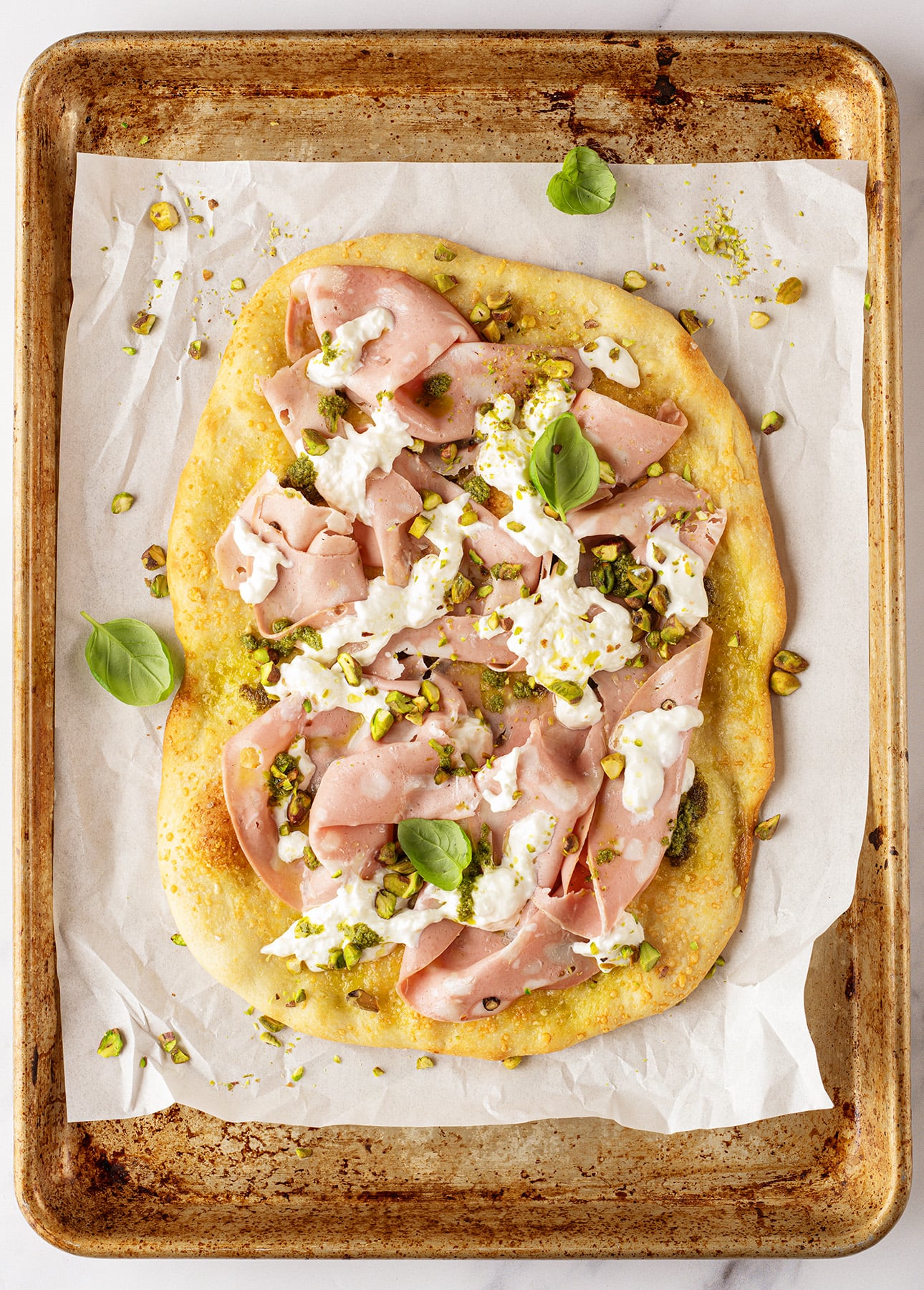
I especially love it on my Mortadella, Burrata, and Pistachio Pizza, where the savory pesto plays against creamy burrata and thin slices of mortadella.
Substitution tips
- Parmigiano-Reggiano can be replaced with Grana Padano for a slightly milder result, or with Pecorino Romano if you prefer a sharper, saltier pesto.
- If your basil supply is a little short, you can replace a small portion with baby arugula or flat-leaf parsley, but I wouldn’t replace all of the basil in this particular recipe. The generous basil flavor is one of the things that distinguishes it from more pistachio-heavy pestos.
- Plenty of other pesto variations use walnuts, almonds, or pecans, but replacing the pistachios changes the character of this recipe. If pistachios are what brought you here, I’d keep them!
For a recipe that uses a classic basil pesto, check out my Heirloom Tomato Crostata with Homemade Pesto.
Make-ahead tips
Pistachio pesto is ideal for making ahead. Transfer it to a glass jar or airtight container, smooth the surface, and pour a thin layer of extra-virgin olive oil over the top before sealing.
That layer limits the pesto’s exposure to air and helps protect its bright color while it sits in the refrigerator.
Stored this way, the pesto will keep in the fridge for up to one week.
Freeze pistachio pesto for longer storage
For longer storage, freeze pistachio pesto for up to three months.
Small portions are especially useful. Spoon the pesto into an ice cube tray—about 1 tablespoon per compartment works well for a small tray—or into small freezer-safe containers. Once the pesto cubes are solid, transfer them to a freezer bag or airtight container.
Thaw only as much as you need. Once defrosted, stir the pesto well and adjust the consistency with a little olive oil, water, or pasta cooking water depending on how you plan to use it.
How to Use Pistachio Pesto
The obvious answer is pasta—and it’s an excellent one—but a jar of pistachio pesto is much more versatile than that.
Toss it with short or long pasta, using reserved pasta water to turn it into a silky sauce. Spoon it over fresh tomatoes and mozzarella, or use it as the dressing for my Caprese Pasta Salad. Spread a thin layer over pizza before or after baking, depending on the toppings.
It also works beautifully spooned over roasted or grilled vegetables, especially zucchini, eggplant, asparagus, potatoes, and tomatoes. Swirl a spoonful into soup just before serving, or spoon it over grilled fish and seafood. Add a little to a sandwich, spread it onto crostini, or serve it with fresh mozzarella or burrata.
For something very simple, spoon a little pistachio pesto over warm focaccia and finish with good olive oil and a few crushed pistachios. Because the sauce already contains cheese, nuts, herbs, garlic, and seasoning, you don’t need much else.
FAQ
Is pistachio pesto the same as pistachio cream?
No. Pistachio pesto is a savory sauce made with pistachios, herbs, cheese, garlic, olive oil, and salt.
Pistachio cream is generally a sweet spread made from pistachios, sugar, and additional fats or dairy. It’s used more like Nutella—in pastries, desserts, or simply spread onto bread.
The names can be confusing when you’re shopping for Italian pistachio products, so check the ingredient list before buying. For savory dishes such as my Mortadella, Burrata, and Pistachio Pizza, you want pistachio pesto, not sweet pistachio cream.
Do I need to peel pistachios for pistachio pesto?
No. Blanching and peeling pistachios can give pesto a brighter green color and a slightly smoother texture, but the extra step isn’t necessary.
I use shelled pistachios as-is. Once processed with all that fresh basil, their skins add to the pesto’s naturally rustic texture.
Is pistachio pesto Sicilian?
Pistachio pesto is strongly associated with Italian cooking, and many versions put the pistachios at the center of the sauce, using little or no basil.
My recipe is a basil-forward pistachio pesto: it follows the familiar structure of basil pesto but replaces pine nuts with pistachios and adds fresh lemon. I prefer to describe it for what it is rather than claim there is a single definitive formula for pistachio pesto.
Pistachio Pesto with Basil and Lemon Recipe
Ingredients
- 4 ½ oz fresh basil leaves, lightly packed (about 5 cups, lightly packed)
- 2 ½ oz shelled pistachio nuts
- 2 cloves garlic, peeled and coarsely chopped
- ¾ tsp kosher salt, or fine sea salt
- ½ lemon, finely grated zest and juice
- 2 ½ oz finely grated Parmigiano-Reggiano cheese
- Freshly ground black pepper
- ¾ cup extra-virgin olive oil
Instructions
- Add all ingredients to a food processor. Process to a fine consistency, scraping down the sides of the bowl several times.
- If you're not using the pesto right away, transfer it to a glass jar or an airtight container and cover the surface with a thin layer of extra-virgin olive oil to help prevent browning.
- SERVING: Use Pistachio Pesto with pasta, pizza, crostini, sandwiches, grilled or roasted vegetables, or fresh mozzarella. For pasta, loosen the pesto with a little hot pasta cooking water before tossing.
- STORAGE: Refrigerate the Pistachio Pesto in a glass jar or an airtight container for up to 1 week. After each use, smooth the surface and add a fresh thin layer of extra-virgin olive oil to help prevent browning. Freeze for up to 3 months.
Did you make this?
Tell me how you liked it! Leave a comment or take a picture and tag it with @foodnouveau on Instagram.
This site is a participant in the Amazon Associates Program, an affiliate advertising program designed to provide a means for the site to earn fees by linking to Amazon and affiliated sites.
If you click on an affiliate link, I may earn advertising or referral fees if you make a purchase through such links, at no extra cost to you. This helps me create new content for the blog–so thank you! Learn more about advertising on this site by reading my Disclosure Policy.
Author: Marie Asselin
WHAT DID YOU THINK OF THIS RECIPE?
Rate + Review