- V
- GF
- NS
- DF
- View Recipe Key
Pistachio Gelato (with Homemade Pistachio Paste)
Pistachio Gelato (with Homemade Pistachio Paste)

This creamy pistachio gelato is made with real pistachios, whole milk, heavy cream, and a smooth homemade pistachio paste for a naturally nutty flavor and silky consistency. It’s a dreamy Italian frozen dessert that’s absolutely worth making from scratch.

This post contains affiliate links. Full disclosure is at the bottom of the article.
This pistachio gelato recipe is made with real pistachios, blended into a smooth homemade pistachio paste, then folded into a creamy Sicilian-style gelato base. The result is dense, silky, naturally nutty, and deeply flavorful—the way great Italian pistachio gelato should be.
There’s something special about pistachio gelato. It’s easily one of the top flavors people crave. The downside? Pistachio gelato is probably the most faked gelato flavor out there, and that’s because quality pistachios are expensive. Sadly, this leads many shops to take shortcuts. Often, what passes for pistachio gelato relies on ingredients like inexpensive almond extract to mimic nuttiness, artificial green dyes to achieve a color that real pistachios rarely achieve so vividly on their own, or even bulking out the product with less expensive nuts.
I’ll never forget the first time I had authentic pistachio gelato in Sicily. It was served tucked into a soft brioche bun, as gelato often is there, and it completely changed my idea of what pistachio gelato could be. It wasn’t bright green. It wasn’t overly sweet. It didn’t taste artificial. It was pale, creamy, and intensely pistachio-forward in a quiet, elegant way. You just don’t forget a flavor like that! It reminded me that authentic Italian gelato doesn’t need artificial color or overpowering flavor to be memorable; when made with high-quality ingredients, pistachio gelato is creamy, nutty, delicate, and beautifully balanced.
Irresistible Sicilian pistachio gelato served in a brioche, at I Dolci di Nonna Vicenza, in Catania, Sicily.

That experience is what inspired this homemade pistachio gelato recipe. The secret is simple: start with real pistachios and turn them into a fresh pistachio paste. It takes a little more time than opening a jar, but the flavor is so much better—and you get to control the sweetness, texture, and color.

I recommend using high-quality raw, unsalted pistachios for the purest flavor. While legendary Sicilian Bronte pistachios are the ultimate dream for their unique profile, any good-quality raw pistachio will yield fantastic results when you prepare them yourself.
While raw pistachios are certainly an investment, crafting your own paste gives you complete control over the quality, freshness, and roast level. This often results in a far superior flavor profile than even pricey store-bought pastes, making every penny count towards incredible taste.
My pistachio gelato recipe provides detailed instructions for creating that luxurious, vibrant paste and then shows you exactly how to incorporate it into your gelato base for a truly sublime result.
This recipe works with my classic gelato base, but I especially recommend using my Sicilian-style gelato base. Because it’s thickened with cornstarch, it lets the pistachio flavor come through more clearly.
Get ready to churn: my pistachio gelato recipe will guide you step by step through crafting a vibrant, luxurious pistachio paste and then turning it into the most luxurious gelato you’ve ever made.

Watch My Pistachio Gelato Video
In this video, I show you how to make pistachio gelato from start to finish: blanching and peeling the pistachios, blending them into a smooth homemade pistachio paste, combining the paste with the gelato base, and churning the mixture until dense and creamy.
This recipe uses the same gelato-making principles I teach in my full gelato masterclass, but this video focuses specifically on pistachio gelato so you can see exactly what each step should look like.
New to homemade gelato? Start with my detailed guide to How to Make Gelato for a deeper look at bases, texture, churning, storing, and serving.
Quick Recipe Summary (TL;DR)
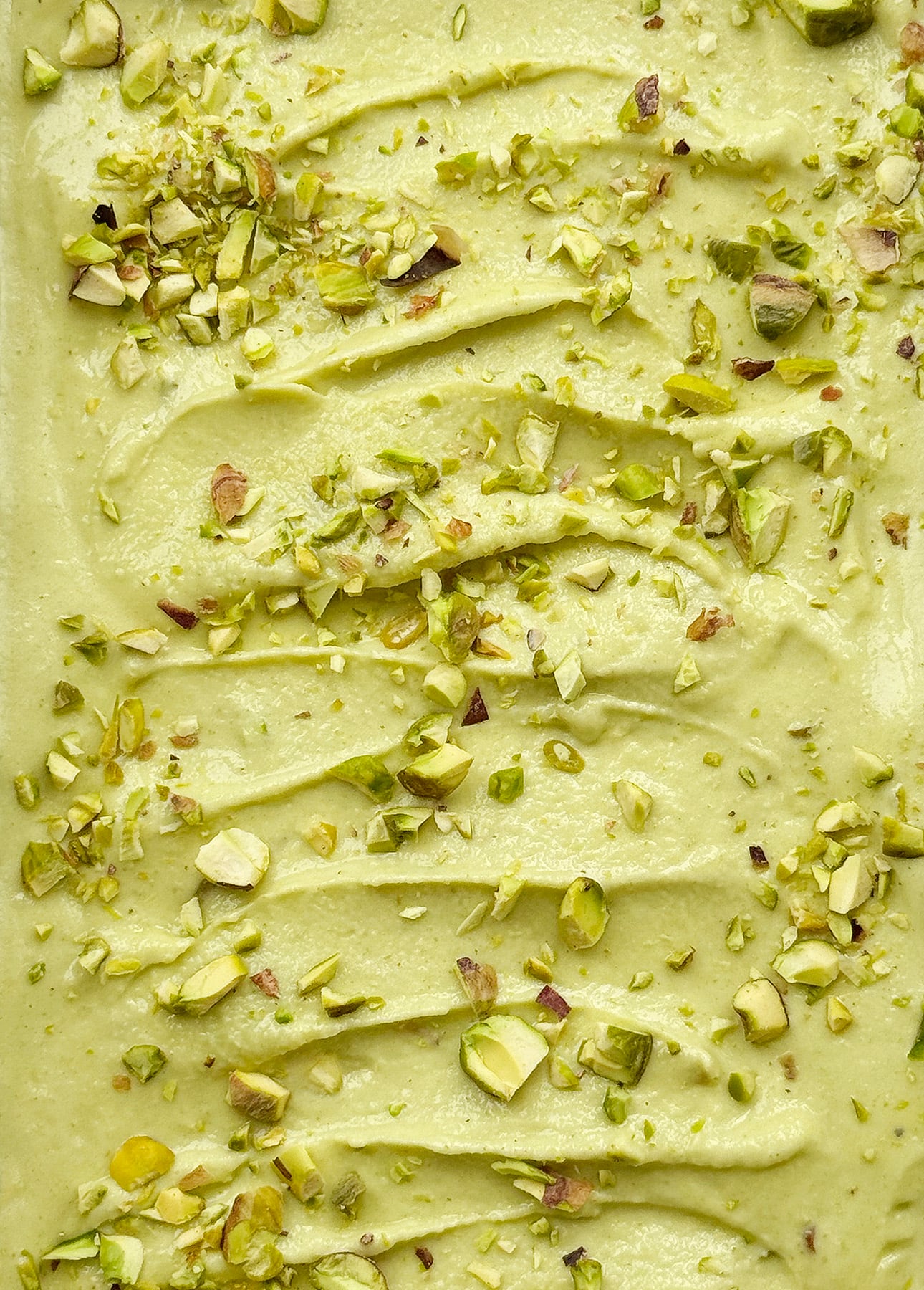
The secret to homemade pistachio gelato with a deep, natural flavor is using real pistachios to make a smooth pistachio paste. For the cleanest pistachio flavor, use a Sicilian-style gelato base, chill it overnight, churn until soft-serve texture, then freeze until firm. Real pistachio gelato should look naturally muted, not neon green.
Helpful Tips for Making Pistachio Gelato
These important tips will help you get the best flavor, color, and consistency from just a few basic ingredients.
Use raw, unsalted pistachios for the best color and flavor
Raw, unsalted pistachios are the best choice for making my homemade pistachio gelato because they give you the cleanest flavor and most natural color. Since this recipe uses only a few basic ingredients, the quality of the pistachios really matters.
Roasted unsalted pistachios can work, but they will create a darker gelato with a toastier flavor. This isn’t necessarily bad, but it will taste different from classic Italian pistachio gelato. Avoid salted pistachios, as they can throw off the recipe’s balance.
Use the freshest, highest-quality ingredients you can here, especially the pistachios. Pistachio gelato has a delicate flavor, so stale or bland pistachios will produce a mild-tasting gelato. Taste the pistachios before using them: they should taste fresh, sweet, and nutty.

Blanch and peel the pistachios for a smoother paste and gelato texture
In my recipe, peeling the pistachios is optional, but taking the extra time to do so gives pistachio gelato a smoother texture and a cleaner, more natural green color.
Peeling pistachios is easy: blanch them briefly in boiling water, drain them, then pinch each pistachio between your fingers to slip off the skin. It’s a bit tedious, yes, but it makes a visible difference in the finished gelato. I like to do this while listening to a podcast; just like peeling chickpeas for smoother hummus, I see it as a quiet, mindful act in the kitchen.
That said, leaving the skins on is perfectly fine if you don’t mind a darker color and a slightly more rustic texture. The gelato will still be delicious, but it may look more beige-green or khaki than pale green.

Make the pistachio paste as smooth as your equipment allows
The smoother the pistachio paste, the silkier the final consistency of your gelato will be. A food processor will make a good pistachio paste, but a high-speed blender or immersion blender can help refine the texture even further.
Don’t worry if the paste doesn’t become perfectly silky. Homemade pistachio paste will often retain tiny bits of pistachio unless you have very powerful equipment. That’s normal.
Pro Tip: After making the pistachio paste in a food processor, whisk it into the chilled gelato base, then pass the mixture through a high-speed blender or immersion blender , if you have these tools in your kitchen. This helps refine the final texture even more.

Use my Sicilian-style gelato base for the cleanest pistachio flavor
You can use any of my gelato bases for this recipe, but I especially recommend my Sicilian-style gelato base for pistachio gelato.
My Sicilian-style gelato base starts with whole milk and heavy cream, then thickens mostly with cornstarch, which gives it a smooth, creamy consistency while keeping the flavor clean enough to let the pistachio shine. I do like to add an optional egg yolk to the base, as shown in the video: it adds just enough richness and helps improve the texture without turning the base into a full custard.
My classic custard-style gelato base works too, but its richer egg profile can soften the delicate pistachio flavor.
For an egg-free pistachio gelato, simply skip the optional egg yolk in the Sicilian-style base and substitute additional cornstarch. You’ll find specific instructions to do this in my base recipe. For a dairy-free version, use my vegan gelato base.
Taste the gelato before churning
Pistachio flavor is naturally soft and delicate, even when you use high-quality ingredients. A good pistachio gelato should taste creamy, nutty, and elegant—not aggressively pistachio-flavored in an artificial way.
Before you churn, taste the cold pistachio gelato base. This is your last easy chance to adjust the flavor.
If the pistachio flavor seems too mild, the first thing to consider is the quality of the pistachios. Fresh, flavorful pistachios will give you a deeper, more intense flavor without relying on extract. If you want, you can add a tiny amount of pistachio extract, but go slowly. Extracts are powerful and can quickly overpower the natural pistachio flavor.
The base should taste slightly sweeter and a bit more intense than you want the finished gelato to be. Frozen desserts taste less sweet and less fragrant once frozen.
Don’t expect bright green pistachio gelato
Real pistachio gelato is usually muted green, beige-green, or even slightly khaki. A vivid green color usually comes from food coloring, not pistachios.
If you use raw, peeled pistachios, your gelato will look greener. If you use roasted pistachios or leave the skins on, the gelato will be darker. Both versions can be delicious, but neither should look neon green unless coloring has been added.
This is one of the easiest ways to recognize natural pistachio gelato: the flavor should be more impressive than the color.

Chill the pistachio gelato base overnight
I recommend chilling the pistachio gelato base for at least 4 hours, and preferably overnight, before churning.
This resting time improves both flavor and texture. The pistachio paste has time to fully infuse the base, and the mixture cools and stabilizes before it goes into the ice cream maker. A very cold base churns faster, which helps create a smoother texture with fewer ice crystals.
If you want to speed up the process, you can chill the gelato base in an ice bath. To do so, fill a large bowl with ice and cold water, then set the bowl of warm gelato base inside it. Make sure the water comes up around the sides of the bowl without spilling into the base. Stir the mixture occasionally so it cools evenly.
The base is cold enough when it feels thoroughly chilled, not just cool around the edges. If you want to be precise, check it with an instant-read thermometer: it should be about 40°F / 4°C before churning. You can churn it right away once it reaches that temperature, or transfer it to the refrigerator and chill it longer for even better flavor.
If your ice cream maker uses a freezer bowl, make sure the bowl is completely frozen before you start churning. A partially frozen bowl will not freeze the gelato properly and can lead to an icy texture.
Churn until soft-serve texture, then freeze until firm
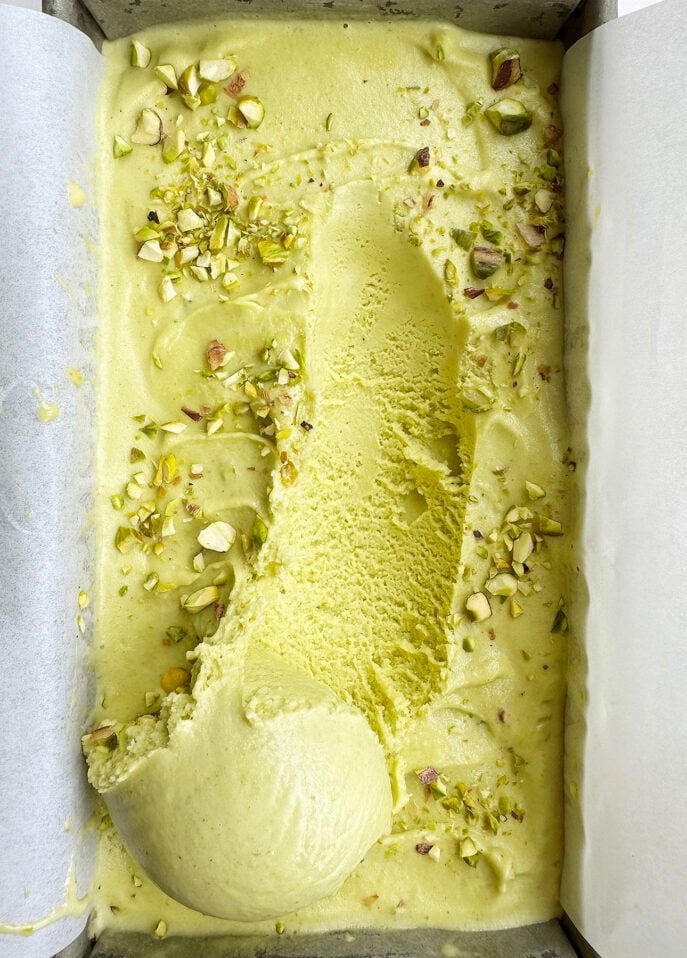
Stop churning when the pistachio gelato is thick, creamy, and about the texture of soft serve. It will firm up in the freezer.
Churning time depends on your ice cream maker, the temperature of your base, and the temperature of your kitchen. Don’t rely only on the clock. Watch the texture instead.
Once churned, transfer the gelato to an airtight container, smooth the surface, and freeze until scoopable.

Store pistachio gelato tightly and enjoy within 2 weeks
Homemade pistachio gelato is best within 2 weeks. It remains edible longer, but the texture gradually becomes icier in a standard home freezer.
To preserve the smoothest texture, store the gelato in an airtight container. You can press parchment paper or plastic wrap directly against the surface before closing the lid. This helps reduce ice crystals.
Let the gelato soften before scooping rather than microwaving it. A gentle rest at room temperature gives you a creamier texture.
Serve pistachio gelato slightly softened
Take pistachio gelato out of the freezer 10 to 20 minutes before serving so it can soften to the ideal gelato texture and allow you to get that perfect scoop.
Gelato is meant to be served slightly warmer than ice cream. When it’s too hard, the flavor is muted, and the texture is less creamy. Once it softens slightly, the pistachio flavor becomes more fragrant, and the texture turns silky.
For a Sicilian-inspired treat, serve pistachio gelato in a soft brioche bun. You can also scoop it into bowls and finish it with chopped pistachios, a drizzle of melted dark chocolate, or a few flakes of sea salt.

Make the most of your homemade pistachio paste
Your reward for making pistachio paste from scratch is a truly luxurious and versatile ingredient! Its intense, pure pistachio flavor is incredible in this gelato, but don’t let that be the end of its potential. Once you taste how much better homemade is compared to most store-bought options, you’ll be looking for ways to use it.
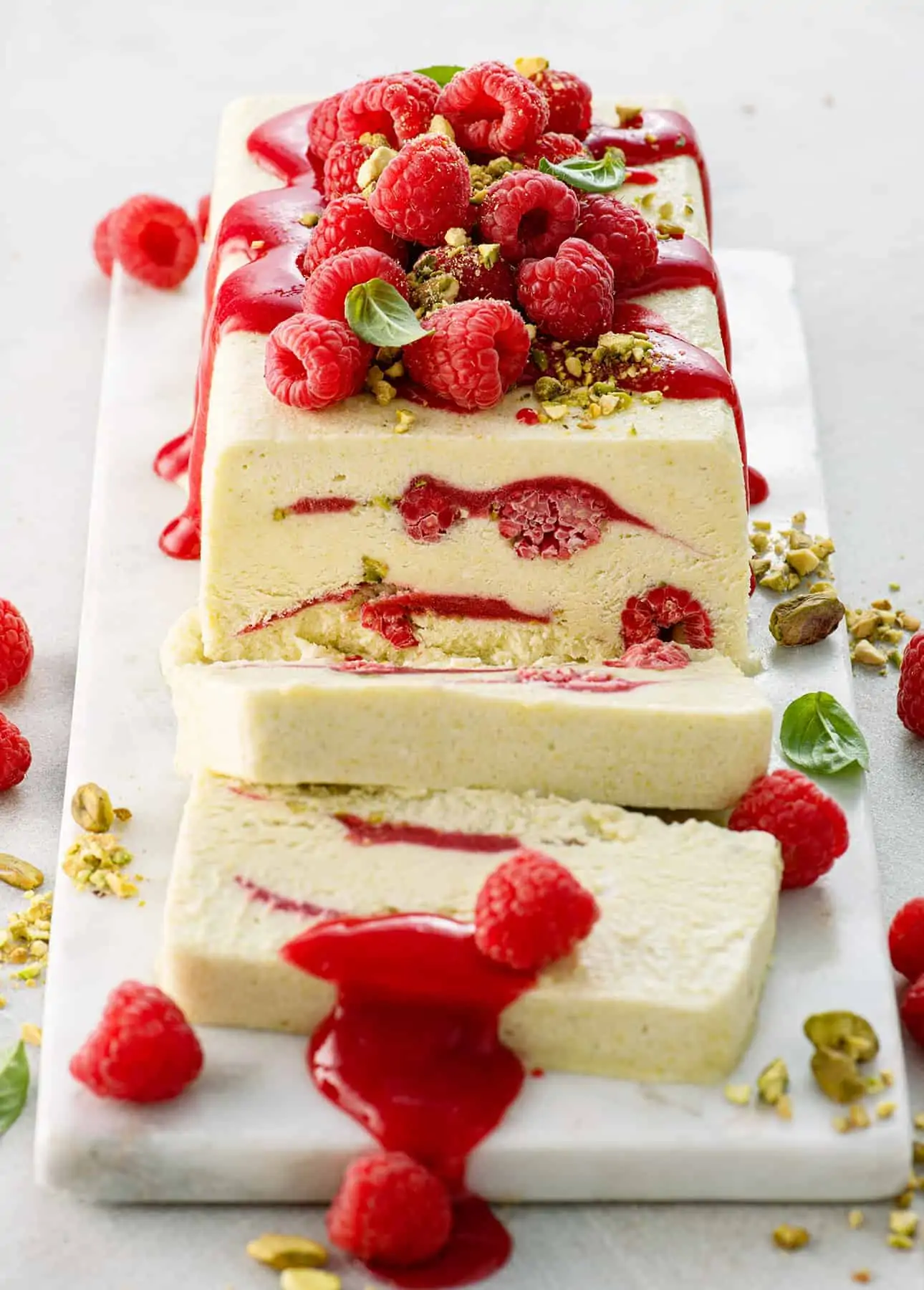
Think outside the ice cream machine. Fold homemade pistachio paste into light-as-air semifreddo, swirl spoonfuls into brownie or blondie batter before baking, whisk it into pastry cream for eclairs or fruit tarts, fold it gently into freshly whipped cream for a quick mousse, add nutty depth to financiers or other small cakes, or even enrich a batch of buttercream frosting.
Raspberry Pistachio Semifreddo, made with homemade pistachio paste.
Got leftover paste? Lucky you! Store it in an airtight container in the refrigerator, where it should keep well for about 2 weeks. For longer storage, you can freeze pistachio paste–consider freezing it in small, usable portions (a silicon ice cube tray works great for this!) for several months.
Pistachio Gelato FAQ
What is pistachio gelato made of?
Pistachio gelato is usually made with milk, sugar, pistachio paste, and a thickener such as egg yolks or cornstarch. This recipe uses homemade pistachio paste for a deep, natural pistachio flavor.
Is pistachio gelato the same as pistachio ice cream?
Not exactly. Gelato usually contains more milk and less cream than ice cream, and it is churned with less air, resulting in a denser texture. Gelato is also served slightly warmer than ice cream, so the flavor comes through more clearly.
For a deeper look at the difference, see my full guide to How to Make Gelato.
Can I make pistachio gelato without eggs?
Yes. My Sicilian-style gelato base, which I use in the recipe below, is thickened mainly with cornstarch and includes just one optional egg yolk for extra richness and a slightly smoother texture.
I do recommend using the egg yolk for this pistachio gelato, as shown in the video, because it improves the texture without turning the base into a full custard. But if you want to make egg-free pistachio gelato, simply skip the optional egg yolk in the Sicilian-style base and substitute additional cornstarch. You’ll find specific instructions to do this in my base recipe. The cornstarch will still thicken the base, and the pistachio flavor will remain clean and clear.

Can I use store-bought pistachio paste?
Yes, but use pure pistachio paste, not sweet pistachio cream.
For one batch of Sicilian-style gelato base, start with 1/4 cup (50 g) of pure pistachio paste. Taste the base before churning, then add a little more if needed. Depending on the strength of the paste, you can add up to 2 additional tablespoons (25 g).
This is much less than the amount of homemade pistachio paste used in this recipe because commercial pistachio paste is usually much more concentrated. My homemade version is blended with part of the gelato base to help the pistachios grind smoothly and incorporate evenly, adding volume as well as flavor. Pure store-bought pistachio paste is denser, richer, and more intense, so a smaller amount goes a long way.
What’s the difference between pistachio paste and pistachio cream?
Pistachio paste is usually concentrated and made mostly or entirely from pistachios. Pistachio cream is sweet and can contain sugar, milk powder, oils, or other ingredients.
For pistachio gelato, pure pistachio paste gives the cleanest flavor. Pistachio cream can work, but it will produce a sweeter, less intensely nutty gelato.
Should I use raw or roasted pistachios?
Raw, unsalted pistachios are best for the freshest flavor and greenest color. Roasted unsalted pistachios can work, but the gelato will be darker and the flavor will be toastier.
Avoid salted pistachios, which can make the gelato taste unbalanced.

Why isn’t my pistachio gelato bright green?
Real pistachio gelato is not usually bright green. Natural pistachio color ranges from pale green to beige-green or khaki, depending on the pistachios, whether they were peeled, and whether they were raw or roasted.
Bright green pistachio gelato usually contains food coloring, and my recipe isn’t going for that.

Why doesn’t my pistachio gelato taste strongly of pistachio?
Pistachio flavor is naturally soft and delicate. A good pistachio gelato should taste creamy, nutty, and elegant—not aggressively pistachio-flavored in an artificial way.
The quality of the pistachios you use matters. Use fresh, flavorful pistachios that taste great eaten raw, choose my Sicilian-style gelato base for a cleaner flavor, and taste the cold base before churning.
If the flavor still seems mild, add a tiny amount of pistachio extract. Add only a few drops at a time, then taste again.
Do I need an ice cream maker to make pistachio gelato?
For the best texture, yes. An ice cream maker freezes the base while churning it, which creates the dense, smooth texture associated with gelato.
No-churn versions can be tasty frozen desserts, but they won’t have the same texture as churned gelato.
How long does homemade pistachio gelato keep?
Homemade pistachio gelato is best within 2 weeks. It can be kept longer, but the texture will gradually become harder and icier in a home freezer.
For best results, store it in an airtight container with parchment paper or plastic wrap pressed directly against the surface.

Additional Resource: A Guide to Making Italian Ice Cream at Home
If you’ve never made gelato before, don’t miss my detailed guide to making Italian ice cream at home. The guide contains ALL the information and tips I’ve gathered through 20 years of gelato-making. You’ll learn what sets gelato apart from American-style ice cream, the difference between a classic gelato base and a Sicilian-style gelato base, why you do need an ice cream maker to make the best Italian ice cream, and get access all of my colorful gelato recipes in a single spot. Happy churning!

Watch My Video Masterclass
Want to dive deeper into homemade gelato before you start? My Gelato Video Masterclass walks you through the essential techniques behind every great batch, from choosing the right base to churning, freezing, and serving gelato at its creamiest. Watch it first to better understand the method, then use the recipe below to make this pistachio version with confidence.
More Gelato Recipes
Once you’ve made pistachio gelato from scratch, try another homemade gelato recipe. All my gelato recipes use the same core techniques, so each batch helps you get more comfortable with texture, churning, and serving.

Pistachio Gelato Recipe
Ingredients
For the Gelato Base
- 1 batch Sicilian-Style Gelato Base (recommended), or Classic Gelato Base
For the Pistachio Paste
- 1 ½ cups raw shelled unsalted pistachio nuts
- ½ cup granulated sugar
Instructions
- For the gelato base: Make the gelato base of your choice, then strain it into a bowl or airtight container.
- Cool to room temperature, then refrigerate overnight. The gelato base must be very cold before churning: this will produce the smoothest, silkiest texture.
- To speed up the cooling process, you can chill the gelato base over an ice bath. Fill a large bowl with ice and cold water, then set the bowl of warm gelato base inside it, making sure no water gets into the base. Stir occasionally until the base is thoroughly chilled. For best results, refrigerate until very cold before churning.
- To make the pistachio paste: Bring a small saucepan of water to a boil. Add the shelled pistachio nuts and simmer for two minutes. This blanches the nuts and makes them easier to peel and grind later on.
- Drain the pistachios, then rinse them under cold water to cool completely.Dry the nuts with paper towels. If the nuts still have their skins on, I strongly recommend peeling them for the best texture and color.To peel a pistachio, simply pinch it between your fingers: the skin should come right off. This step takes a bit of work, but it’s worth it.
- Put the blanched and peeled nuts in the bowl of a high-speed blender or food processor, then add the sugar. Pulse until the nuts are finely ground, stopping from time to time to scrape down the sides of the container or bowl.
- Add 1 cup (250 ml) of the cold gelato base and process until the mixture is as smooth and creamy as your appliance will make it. Some tiny pistachio bits will remain, and that’s ok.
- To make the pistachio gelato: Whisk the pistachio paste into the remaining cold gelato base. For the smoothest texture, blend the full mixture once more with a high-speed blender or a stick blender.
- Pour the mixture into the bowl of an ice cream maker. Freeze according to the manufacturer’s instructions. Stop the machine when the gelato is frozen but still soft and creamy.
- STORAGE: Transfer the pistachio gelato to an airtight container and freeze until firm, about two hours.Pistachio gelato is at its creamiest and best if enjoyed within 2 weeks. Past that, some ice crystals will inevitably start forming, especially if the gelato is kept in the freezer section of a regular fridge, as opposed to a chest freezer, and the texture won’t be quite as smooth. The gelato will still be perfectly edible for up to 2 months, but my advice is: enjoy it as quickly as possible after churning.
- SERVING: Always take pistachio gelato out to room temperature 20 minutes before serving to make it easier to scoop. This will also allow you to enjoy the treat at its ideal temperature and texture.
Video
Notes
Did you make this?
Tell me how you liked it! Leave a comment or take a picture and tag it with @foodnouveau on Instagram.
This site participates in the Amazon Associates Program, an affiliate advertising program designed to provide a means for the site to earn fees by linking to Amazon and affiliated sites. If you click on an affiliate link, I may earn advertising or referral fees if you purchase through such links at no extra cost to you. This helps me create new content for the blog–so thank you! Learn more about advertising on this site by reading my Disclosure Policy.
Author: Marie Asselin
I already night italian pistachio paste. How much paste do I use for this recipe?
Hi Steven! If you’re using pure Italian pistachio paste (not sweet pistachio cream), start with 50 g (about ¼ cup). Taste the cold base before churning, then add up to 25 g (2 tbsp) more if you want a stronger pistachio flavor.
Pistachio paste varies a lot in intensity, so tasting is the best guide. Just keep in mind that pistachio gelato has a naturally soft, delicate flavor—it won’t be as bold as chocolate or coffee.
Hello! I really enjoy your recipes. I made your pistachio gelato recipe (using the classic gelato base) but mine doesn’t really taste like pistachio. It just tastes like custard. Any suggestions on what I may have done wrong or what I could do to improve the flavor? Thank you so much!
Hi Tracia! Pistachio is quite a gentle flavor to begin with so the intensity of the flavor you’ll get when making homemade pistachio paste–and pistachio gelato–highly depends on the quality of the nuts you’re using. Pistachios are pricey but if you’re treating yourself to this homemade gelato, it’s worth hunting for top-quality nuts, such as Sicilian pistachios. If you can’t find them, you can boost the flavor a little by adding a drop or two of pistachio extract. Be careful not to use too much or it’s going to overpower the flavor of the gelato. I recommend tasting the custard before churning it. If you think the flavor needs a bit of a tweak, you can work on it now before your precious custard gets into the churner!
I hope these tips will help, Tracia!
This only lasts for 2 weeks once churned in the freezer? Surely it lasts longer than that?
Homemade gelato is at its best if you enjoy it within 2 weeks. Past that, ice crystals start to form, especially if the gelato is kept in the freezer section of a standard fridge (as opposed to a chest freezer, for example), which means the texture isn’t as smooth as when it’s freshly churned. Gelato certainly is still good past the 2-week mark! But my advice is to enjoy it as quickly as possible after churning 😉
Hello! Can I ask how best to store the Pistachio paste once made? How long will it keep for? Thanks!
Hello Frances! You can store the pistachio paste in an airtight container and refrigerate it for up to 5 days. Just make sure to choose a container that stores the pistachio paste as tightly as possible to make it last as long as possible.
Hello, first of all i love your recipes, I want to ask you about the sugar in this recipe, do i need to also add the sugar marked in the base recipe or only with pistachio putee?
Hello Roberto! You do need to make either the Sicilian-Style Gelato Base or Classic Gelato Base using the amount of sugar indicated in either of the recipes, then separately make the pistachio paste using the additional sugar quantity indicated in the recipe above. I hope this helps!
Hello, looking forward to making this ice cream.
I’ve cheated a little and have managed to get some pistachio paste from Italy. How many grams of the pistachio paste would you use in the in the sicilian gelato base?
Thank you
Since store-bought pistachio paste is super concentrated, I would recommend mixing in 1/4 cup (50 g) pistachio paste right before churning. Taste it before you churn to see whether the pistachio flavor is to your liking. You could add up to 2 tbsp more, if you’d like the flavor to be slightly more assertive, but keep in mind that pistachio will always be a smooth, gently flavor, much like vanilla is.
I hope this helps!
I notice that besides cups and teaspoons, etc, you give ingredients in ml. I assume this means millilitres. These are all volumes. Is there any reason you do not list quantities by weight, like ounces or grams? That would be especially helpful as most people these days have good digital food scales. Thanks.
Hi Ed! I agree with you that metric measurements are handy and more precise. I live in North America and I’ve been raised using volume measurements in the kitchen, and this is what most North American still use today. However, as a professional recipe developer, I do use metric measurements on a daily basis! I just completely updated my site and I’m currently in the process of updating all hundreds of my recipes to include metric measurements. It’s a long process but I’ll get there! Thanks for your comment and patience as I go through this transition! :)
Hello Marie! My question is Pistachios should be Raw or just unsalted?
Thank you, Iryna
Hello Iryna! I recommend using raw pistachios because they’re easier to peel and the green color is more intense. If you only have unsalted, roasted pistachios on hand though, feel free to use them! The pistachio gelato will be delicious just the same.
Bookmarked this for the pistachio paste! I’ve always wanted to make my own! And congrats on the Saveur finalist spot – well, well, deserved XO
Thank you Mardi–pistachio paste is so versatile, and the flavor is just incredible.