- V
- GF
- NS
- DF
- View Recipe Key
French Savory Cake with Ham, Cheese, and Olives
French Savory Cake with Ham, Cheese, and Olives

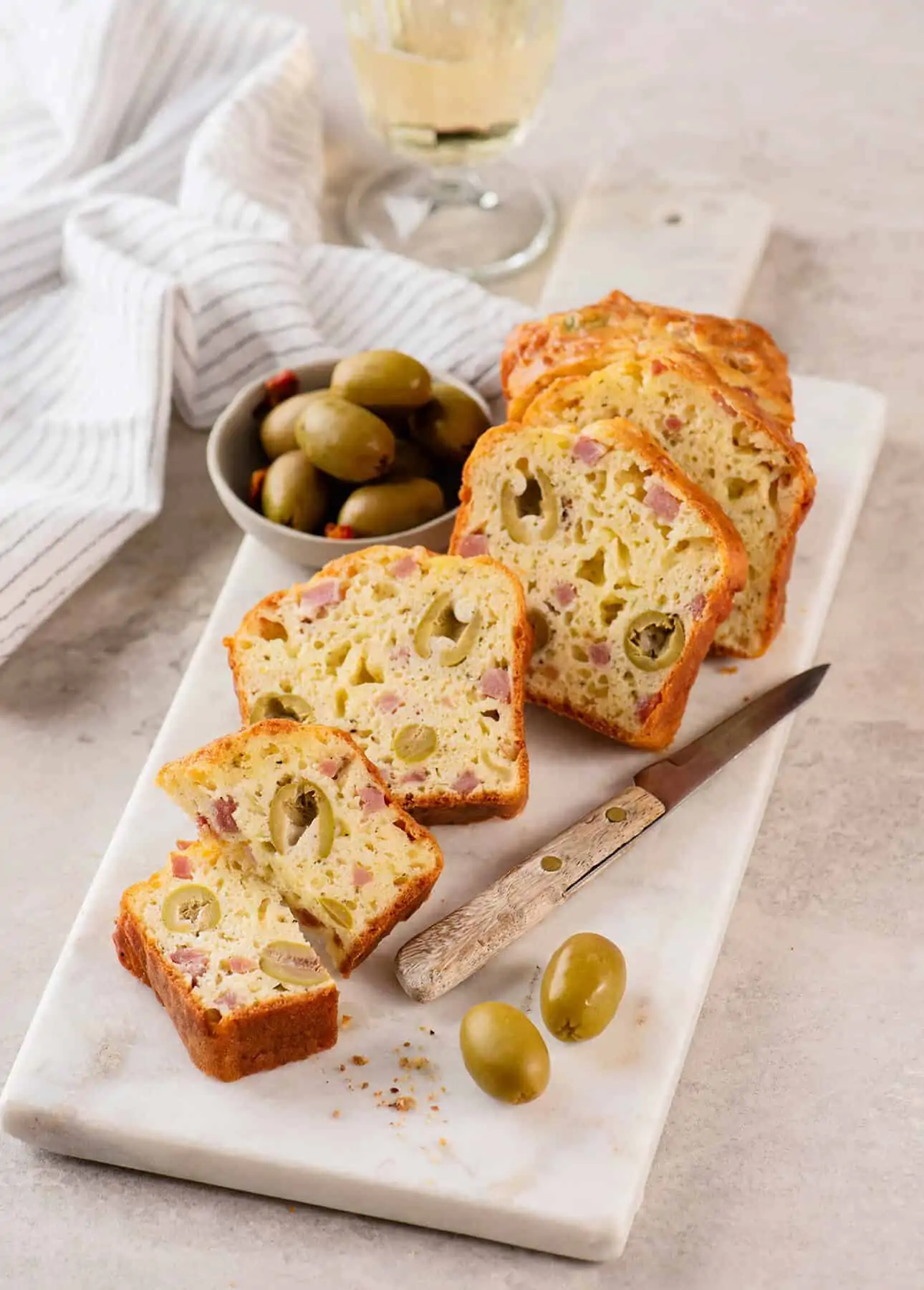
This French savory cake is filled with scrumptious, savory ingredients: salty ham, aged cheese, and briny olives. A must for a francophile happy hour!
This post contains affiliate links. Full disclosure is at the bottom of the article.
Cakes salés, or savory cakes, are an apéro staple in France. These easy savory loaves are usually sliced and served alongside other small bites, such as olives, cured meats, cheese, and something crunchy, with a glass of bubbly wine or rosé.
French savory cake can be made in countless ways, but I like mine cheesy and filled with ingredients that bring a mix of flavors and textures. I’ve been making a simple ham and cheese savory cake for years, but for my cookbook, French Appetizers, I created a more luxurious version with caramelized fennel, lemon, and Comté cheese. That recipe caught the eye of the Washington Post, which mentioned my book and included a version of my recipe in their article.
What Is French Savory Cake (Cake Salé)?
Cake salé literally means “savory cake.” Unlike a sweet loaf cake, it’s made with ingredients such as cheese, herbs, vegetables, olives, and sometimes ham or other cured meats.
The texture falls somewhere between a tender quick bread and a dense, moist cake. It isn’t meant to rise dramatically or have the airy crumb of sandwich bread. Instead, a good savory cake should be tender, flavorful, and sturdy enough to slice and eat by hand.
In France, cake salé is especially popular for l’apéro, but it’s also practical for picnics, brunches, buffets, and casual lunches because it travels well and tastes great warm or at room temperature.
The French Savory Cake featured in my cookbook, French Appetizers:

How to Customize a Savory Cake
One of the best things about savory cake is how adaptable it is. You can use almost any flavorful cheese and pair it with ham, bacon, olives, fresh or dried herbs, caramelized vegetables, sun-dried tomatoes, nuts, or other add-ins you love. The trick is restraint. Too many additions can weigh down the batter and make the flavors compete with one another.
A simple formula is to choose one cheese, one protein, and one or two mix-ins.
For this version, I use Gruyère or Comté for nutty cheesiness, ham for a salty, savory element, and olives for a briny bite.
You can easily adapt that formula. Try aged cheddar instead of Gruyère, swap the ham for bacon, or use roasted vegetables, herbs, or nuts as your mix-ins. For a meat-free savory cake, simply omit the ham and replace it with a vegetable filling such as cooked asparagus or chopped spinach.

How to Serve French Savory Cake
For a traditional French-style apéro or cocktail hour, cut the cake into slices or small pieces and serve it with olives, charcuterie, cheese, crackers, and a glass of wine.
If you’re putting together a larger homemade apéro spread, savory madeleines, pissaladière, and fried olives all work beautifully alongside it.
Savory cake is also easy to pack for a picnic, and a slice with a crisp green salad makes a simple lunch. Because it’s just as good at room temperature as it is warm, there’s no need to worry about serving it straight from the oven.

Make-Ahead, Storage, and Freezing
French savory cake is a great make-ahead recipe because its flavor continues to develop as it rests. In fact, it’s often even better the next day.
Let the cake cool completely before wrapping it tightly. It can be refrigerated for up to 1 week.
You can also freeze the whole cake or individual slices for up to 1 month. Wrap them well and store them in an airtight freezer bag or container to prevent the cake from drying out.
Serve the cake at room temperature, or warm it in a 300°F (150°C) oven for about 10 minutes before serving.
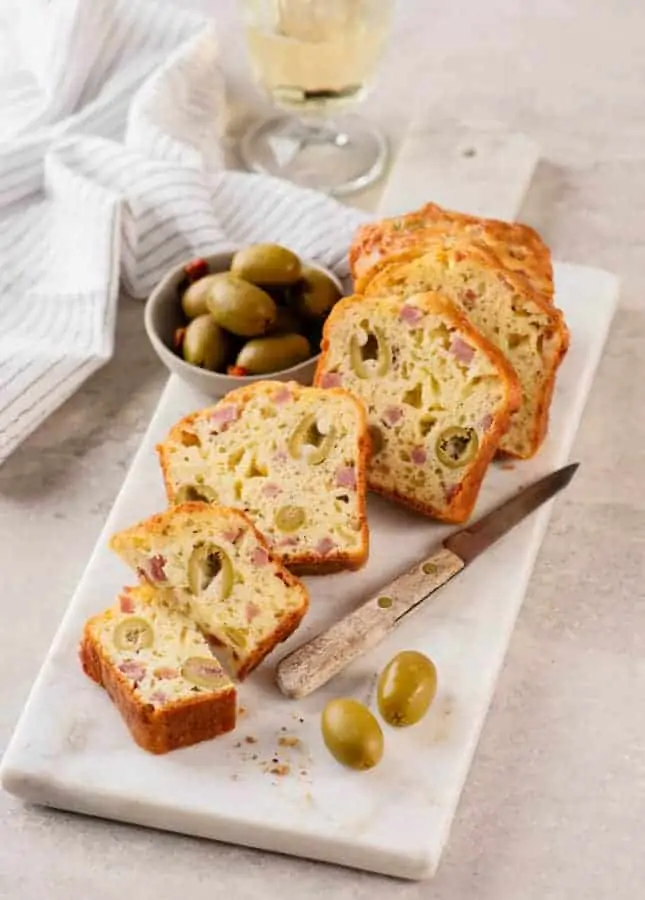
French Savory Cake (Cake Salé) with Ham, Cheese, and Olives
Ingredients
- 1 ½ cups all-purpose flour
- 2 tsp baking powder
- ½ tsp Herbes de Provence
- ½ tsp kosher salt or fine sea salt
- ½ tsp freshly ground black pepper
- 4 eggs
- ½ cup plain yogurt
- ¼ cup extra-virgin olive oil
- 1 cup grated Comté, Gruyère, or aged cheddar cheese (4 oz)
- ¾ cup diced cooked ham (3.5 oz)
- ¾ cup pitted green or black olives (3 oz)
Instructions
- Preheat the oven to 350°F (175°C). Grease a 9 x 5-in (23 x 12 cm) loaf pan. Line the bottom and the two long sides of the pan with a sling of parchment paper.
- In a large mixing bowl, whisk together the flour, baking powder, herbes de Provence, salt, and pepper.
- In a second bowl, whisk together the eggs, yogurt, and olive oil until smooth.
- Pour the wet ingredients over the dry ingredients and stir with a spatula just until combined. Avoid overmixing. Fold in the cheese, ham, and olives.
- Transfer the batter to the prepared loaf pan and smooth the surface.
- Bake until the cake is puffed and golden and a toothpick inserted in the center comes out clean, about 45 minutes.
- Let the cake cool in the pan for 15 minutes. Run a knife around the edges if necessary, then use the parchment sling to lift the cake out of the pan. Transfer to a wire rack and let cool completely.
- Slice and serve at room temperature, or warm in a 300°F (150°C) oven for about 10 minutes before serving.
- MAKE-AHEAD AND STORAGE: This French savory cake is even better after it has had time to rest. Let it cool completely, wrap tightly, and refrigerate for up to 1 week. It can also be frozen for up to 1 month.
Notes
Did you make this?
Tell me how you liked it! Leave a comment or take a picture and tag it with @foodnouveau on Instagram.
This site participates in the Amazon Associates Program, an affiliate advertising program designed to provide a means for the site to earn fees by linking to Amazon and affiliated sites.
If you click on an affiliate link, I may earn advertising or referral fees if you make a purchase through such links, at no extra cost to you. This helps me create new content for the blog–so thank you! Learn more about advertising on this site by reading my Disclosure Policy.
Author: Marie Asselin
I spent 20 minutes trying to actually read the ingredient list, but a pop up ad covered the content with no “x” to delete it. I would really like to bake this olive bread, really really….
Is there anyway I can find the ingredient list elsewhere?
Hi Deborah, I’m so sorry you’re having trouble with the ad popups, I will look into that. The ingredient list is in the recipe card at the bottom of the post, and the print option should give you a clean version without anything covering the content. Here’s the print link: https://foodnouveau.com/wprm_print/french-savory-cake-with-ham-cheese-and-olives
I’ll also email you a copy of the recipe so you can bake it more easily. I hope you enjoy the cake!
Oh goodness! I haven’t made one of these in such a long time! Thanks for the reminder. Yours is beautiful!
Thank you so much, Mimi! It’s one of those classic recipes that’s easy to forget about, but so good to bring back. I’m glad this reminded you of it!
was wondering about the yoghurt ?, i did not use it is it for flavour or moisture content. i added sundries tomatoes which gave it a flavour plus moisture in the mix, can you explain why the yoghurt.
Hi Kathy! The yogurt adds moisture and tenderness, and it also gives the cake a slightly softer crumb. It’s not mainly there for flavor. Sun-dried tomatoes do add some moisture too, especially if packed in oil, but they won’t quite replace the same tenderizing effect. That said, if your cake turned out well without it, no harm done!
Hi Marie, I’ve jsut made this but it didn’t really rise very much. Is this because i just threw everythgin in together and whipped it up w a fork–instead of doign waht you said. would this ahve made the difference. I havent tasted it yet, I’m sure it will taste good but i was hoping for a normal loaf height
Any advice?
Yes, that could absolutely be the reason. This cake doesn’t rise dramatically to begin with, but if everything was just thrown together and mixed with a fork, the batter may not have been evenly combined enough to give you the best lift.
For this recipe, it helps to whisk the eggs and wet ingredients together well first, then fold in the dry ingredients just until combined. That gives the baking powder a better chance to work evenly throughout the batter. Also make sure your baking powder is fresh—that’s another common reason for a low loaf.
The good news is that if it tastes good, you’re still in good shape. French savory cakes are usually a bit dense and moist rather than super tall and fluffy.
I have just taken this out of the oven. I am leaning French and on Tuesday, we are having an end of term party and we are all bringing a French dish, I thought this would be perfect. It looks and smells lovely.
I’m sure the cake will be a hit!
I used to make this delicious olives cake all the time somehow lost the recipe I am so happy I found it
Happy you found your way back to it, too Katia!
can you make this with gluten free flour?
Yes! Make sure to use a “ready-to-use” gluten-free all-purpose flour blend. These come will all the components you need for it to behave exactly as regular all-purpose flour does. You can also make your own mix! I hope this cake will work out well for you.
Do you think it would be ok to use plain Greek yoghurt? What brand are you referring to when you say plain regulat yoghurt? There’s too ma y options these days!
Thank you
Hi there! Plain Greek yogurt would in theory work just as good as regular yogurt. The difference is that Greek yogurt is much thicker than regular yogurt, which would result in a very thick batter. If using Greek yogurt, I’d 3 parts yogurt for 1 part milk just to make it easier to mix into the batter. Hope this helps!
I found this page while searching for a cake salė recipe I made a while back, and lost. It called for buttermilk and butter. I never found it, so I made this oil bread instead. I subbed thick cultured buttermilk for the yogurt, and jarred, roasted red peppers (whole, diced) for the ham. I also added some chunky olive tapenade, for brightness (a scant quarter cup). I used Comte cheese, and the peppercorns I ground were mixed with dried lemon peel. My olives were the grilled, green olives sold by Trader Joe’s. The result was very good, but a tad oily right out of the oven. I think it will taste better tomorrow. I still need to do some tweaking on this meat-free version, but this is a very good, basic recipe. The next time I make it, I will try adding capers instead of the tapenade. I have a feeling roast carrots would work, too.
Hi Pat! This cake definitely benefits from an overnight rests. It gets so much better! All your substitution and filling ideas sound extremely tasty. Happy you’re enjoying this irresistible savory cake!
Hi there. What can I use instead of ham? Something veg/vegan?
Hi Dasha! You could use chopped up veggie sausage, or quite simply omit the ham and substitute it with another vegetable, such as sliced asparagus or chopped baby spinach!