- V
- GF
- NS
- DF
- View Recipe Key
Cherry Clafoutis with Brown Butter
Cherry Clafoutis with Brown Butter

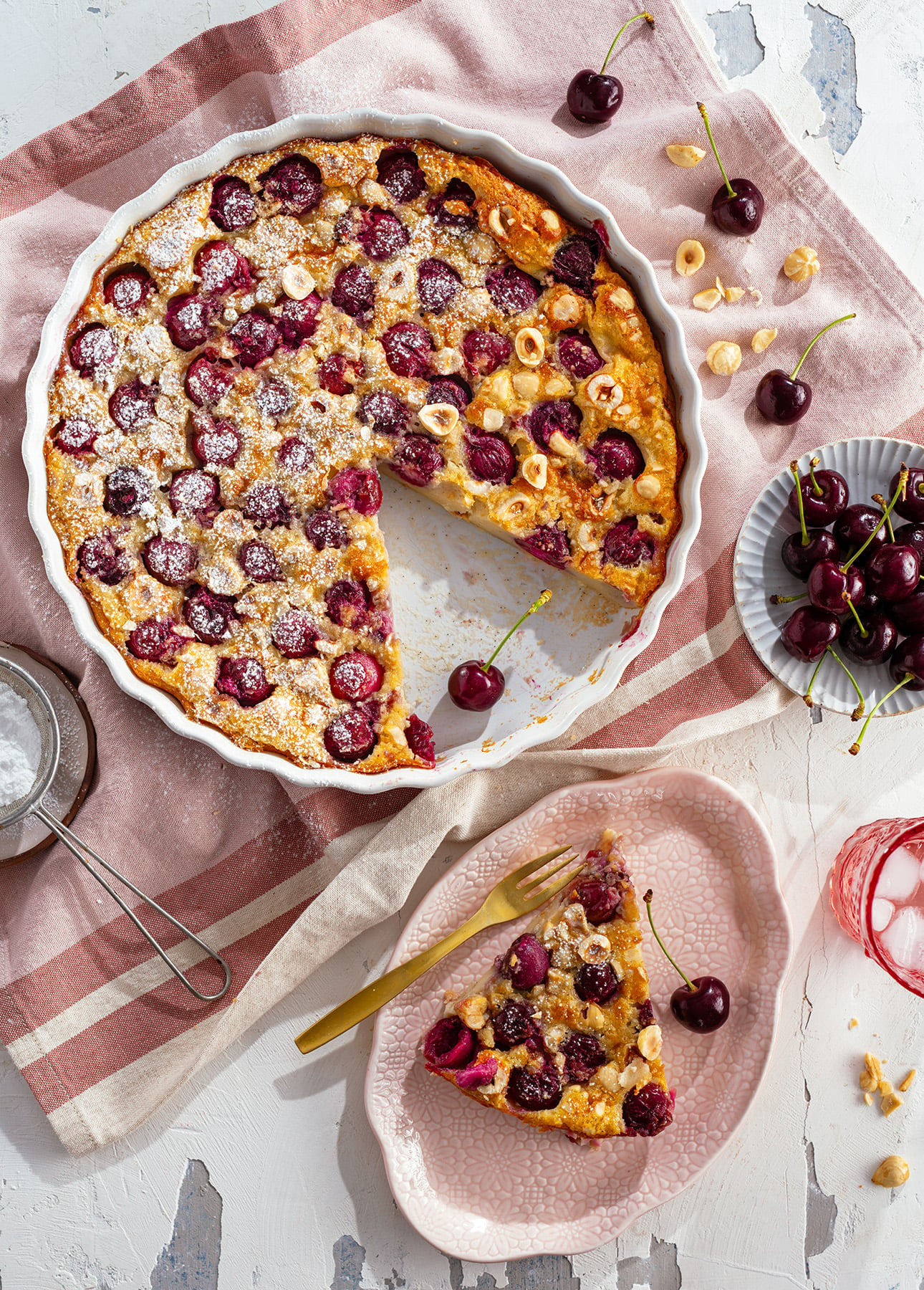
This cherry clafoutis recipe pairs juicy summer cherries with a lightly sweet, custardy batter, nutty brown butter, maple syrup, and optional toasted hazelnuts. Serve it warm or at room temperature for dessert, brunch, or breakfast.
This post contains affiliate links. Full disclosure is at the bottom of the article.
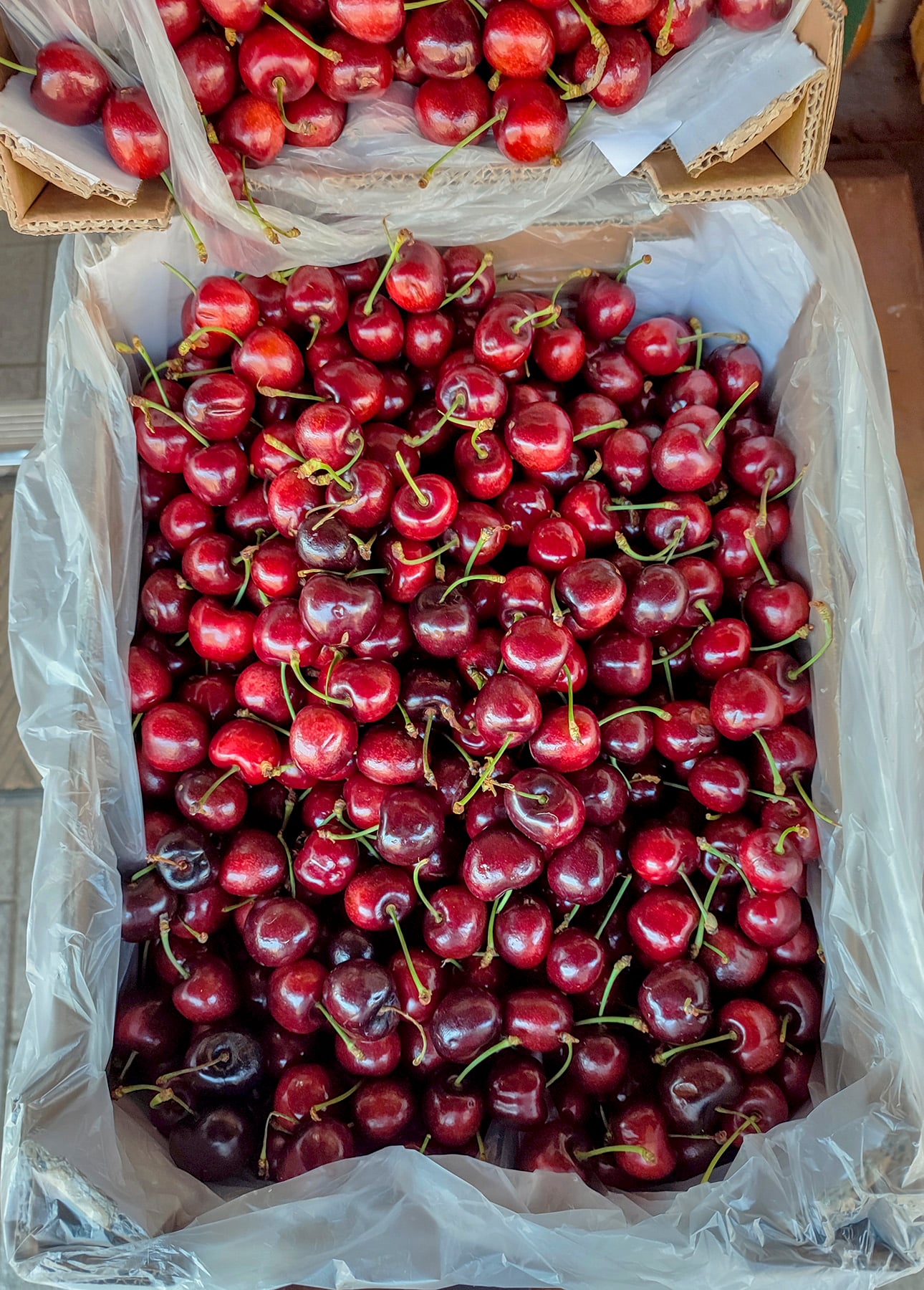
When I lived in Paris, weekly market shopping was simply part of the rhythm of life. I usually went with an idea of what I needed, but what I actually wanted to cook that week was often decided once I got there. In early summer, baskets overflowing with glossy cherries made those decisions particularly easy—and cherry clafoutis was exactly the sort of simple, fruit-forward dessert I would want to make when I got home.

Clafoutis has always appealed to me for that reason. There’s no pastry to roll, no elaborate assembly, and very little standing between the fruit and the finished dessert. Cherries are covered with a simple batter that bakes around them until puffed and golden, with a soft, custardy center and juicy fruit throughout.
I’ve played with the format before. My Chocolate Clafoutis pairs chocolate with cherries and blackberries, while my Brown Butter, Hazelnut, and Cherry Clafoutis Bars turn those same flavors into something sturdier and portable. For this cherry clafoutis recipe, I wanted to come back to the classic dessert while adding a few restrained touches of my own.
The most important addition I’ve made, flavor-wise, is brown butter. Browning the butter before adding it to the batter creates a warm, toasted flavor that pairs especially well with cherries. I also like using maple syrup in place of granulated sugar, and I sometimes scatter roasted hazelnuts over the top for a little crunch. None of these additions overwhelms the fruit; they simply add a little more depth to an otherwise very simple dessert.
And this really is a lightly sweet dessert. There is only 1/4 cup of maple syrup or sugar in the whole clafoutis, so although I love serving it after dinner, it’s equally at home on a breakfast or brunch table. Think of it in the same spirit as crêpes or a Dutch baby: special enough for the weekend, but not overwhelmingly sweet.

QUICK SUMMARY: Cherry clafoutis is a simple French baked dessert made by surrounding cherries with a lightly sweetened, custardy batter. My version adds brown butter for extra depth, with maple syrup and optional toasted hazelnuts complementing the cherries.
What is cherry clafoutis?
Cherry clafoutis, or clafoutis aux cerises, is a French dessert from the Limousin region. Cherries are arranged in a baking dish and covered with a thin batter made primarily from eggs, milk, all-purpose flour, and sugar, which sets around the fruit as it bakes.
The texture falls somewhere between a baked custard and a very tender cake, though I think it’s closer to custard. The edges become golden and slightly firmer while the center remains soft and delicate.
The French pronunciation is roughly clah-foo-TEE. You’ll sometimes see the dessert spelled clafouti in English-language recipes, but clafoutis (with a final s you shouldn’t pronounce) is the French spelling.
Traditional cherry clafoutis is often made with unpitted cherries. Cherry pits are said to contribute a subtle almond-like aroma during baking, but I prefer to pit the cherries. It makes the dessert much easier—and much more pleasant—to eat.
What should cherry clafoutis taste and feel like?
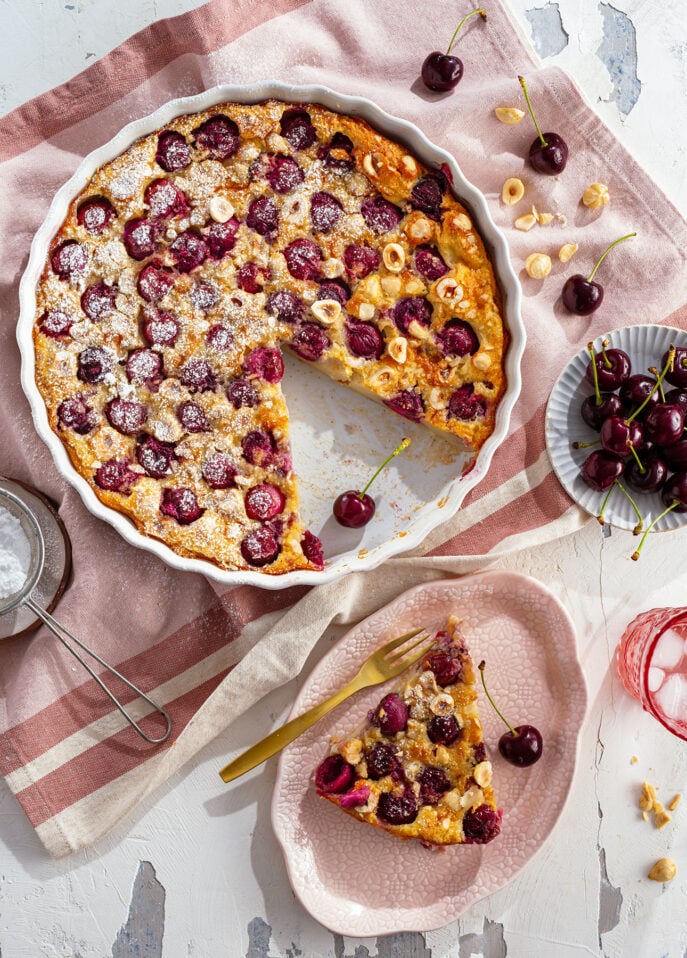
A good cherry clafoutis should be soft and custardy through the center, with golden, slightly firmer edges. It will puff as it bakes and then settle somewhat as it cools. This is exactly what you want.
Juicy cherries should remain distinct, while the surrounding batter should be gently sweet rather than dessert-cake sweet. In my version, brown butter brings a subtle toasted flavor, maple syrup adds a little complexity, and the optional roasted hazelnuts provide contrast against the soft custard.
My version of clafoutis also uses a small amount of baking powder. It isn’t enough to turn the clafoutis into cake, but it helps the batter puff and gives the finished dessert a slightly lighter texture.
The most important thing is not to overbake it. The clafoutis is ready when it is well puffed and golden around the edges, and the center looks set rather than wet. It should still be tender, not completely firm. Remember that the custard continues to settle as it rests.

Why brown butter makes this cherry clafoutis better
Browning butter is one of those small extra steps that pays off particularly well in a recipe with such a short ingredient list.
As butter cooks, its milk solids toast until golden brown, developing the warm, nutty aroma the French call beurre noisette. If you’ve never made it before, my guide to how to brown butter explains exactly what to watch and smell for as the butter changes.
In cherry clafoutis, brown butter works beautifully because it adds complexity without taking attention away from the cherries. The flavor is subtle, but it makes the custard surrounding the fruit much more interesting.
Pro Tip: When you transfer the brown butter from the saucepan, scrape in every golden-brown speck at the bottom. Those toasted milk solids contain much of the flavor.
You’ll find the same technique at the heart of my Classic French Financiers, where beurre noisette is one of the ingredients that gives those little almond cakes their characteristic flavor.
Helpful Tips for Making Cherry Clafoutis
Start with really good cherries
With a recipe this simple, the fruit matters. I like dark, ripe sweet cherries that are flavorful enough to eat straight from the bowl.
I recommend pitting the cherries before adding them to the clafoutis. The pits are traditionally said to contribute a subtle almond flavor as the clafoutis bakes, but I prefer to pit the cherries. It makes the dessert much easier—and much more pleasant—to eat.
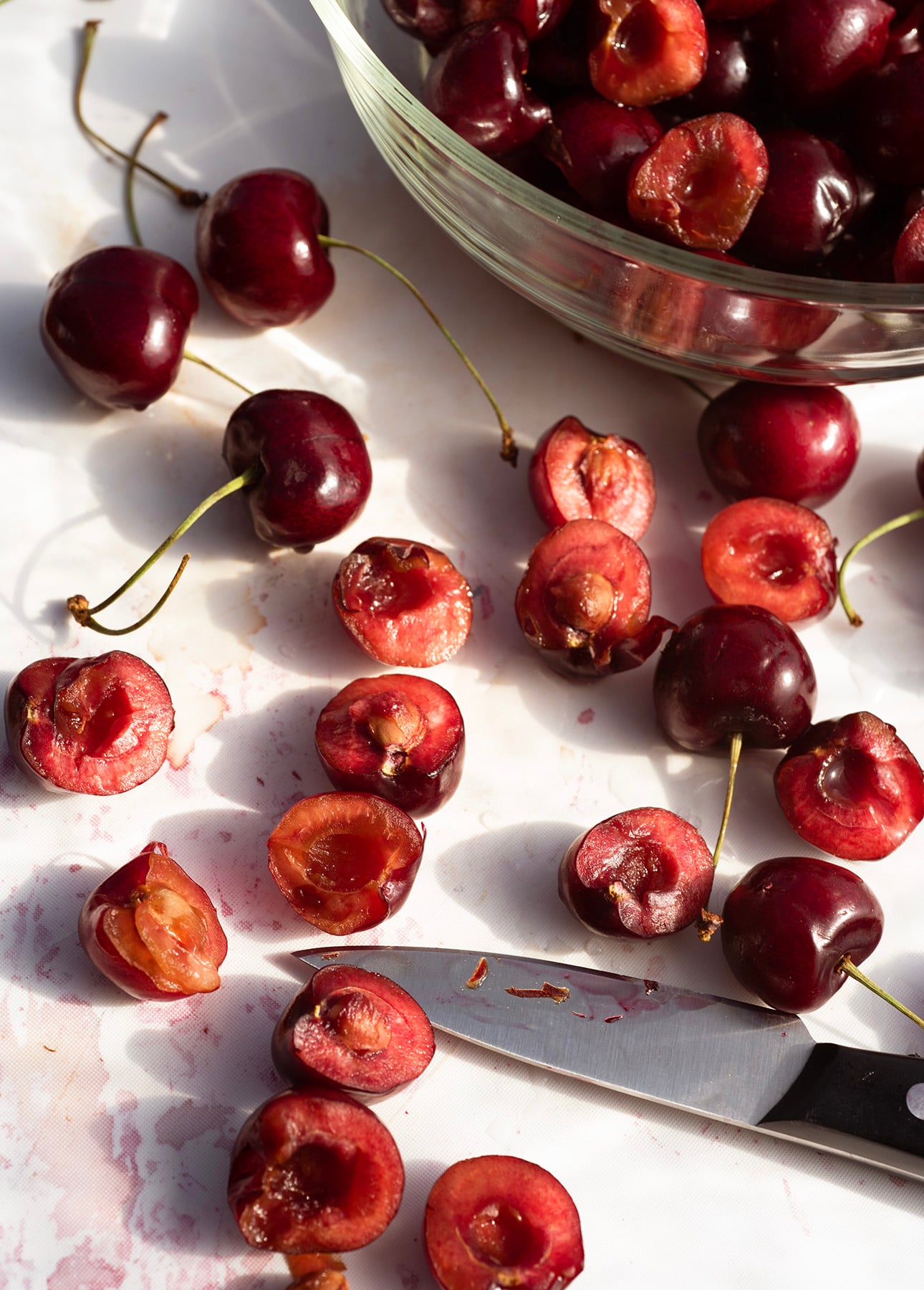
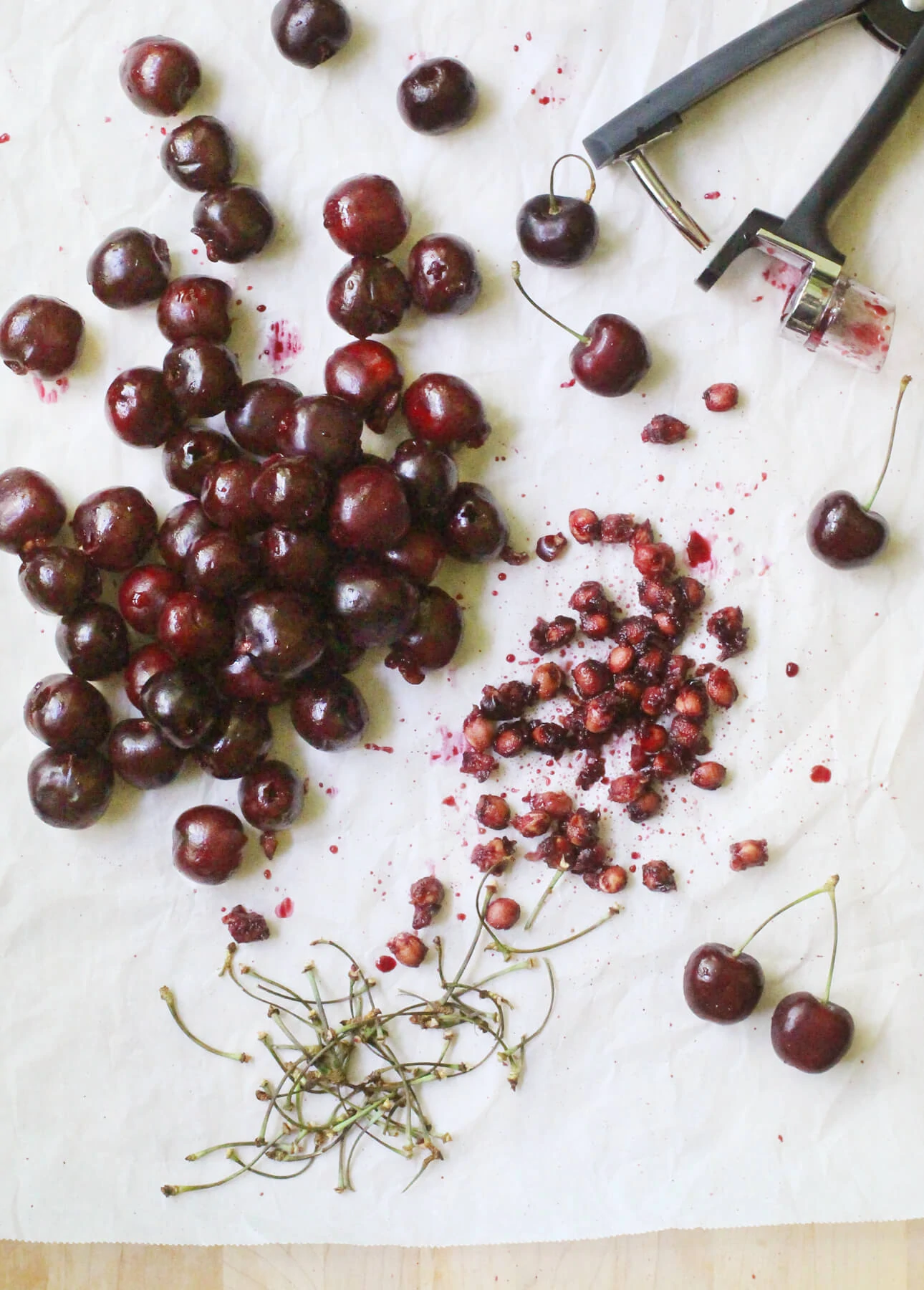
To pit the cherries, run a sharp paring knife around each cherry, twist it open, then use the tip of the knife to pop out the pit. Or treat yourself to a cherry pitter: it makes the job incredibly quick and easy and lets you keep the cherries mostly whole, which looks especially nice in the finished clafoutis.
If cherry season has left you with more fruit than you know what to do with, my Cherry Gelato is another favorite way to put them to good use.
Brown the butter carefully—and keep all the toasted bits
Butter can spend several minutes looking as though not much is happening and then turn from golden to too dark very quickly.
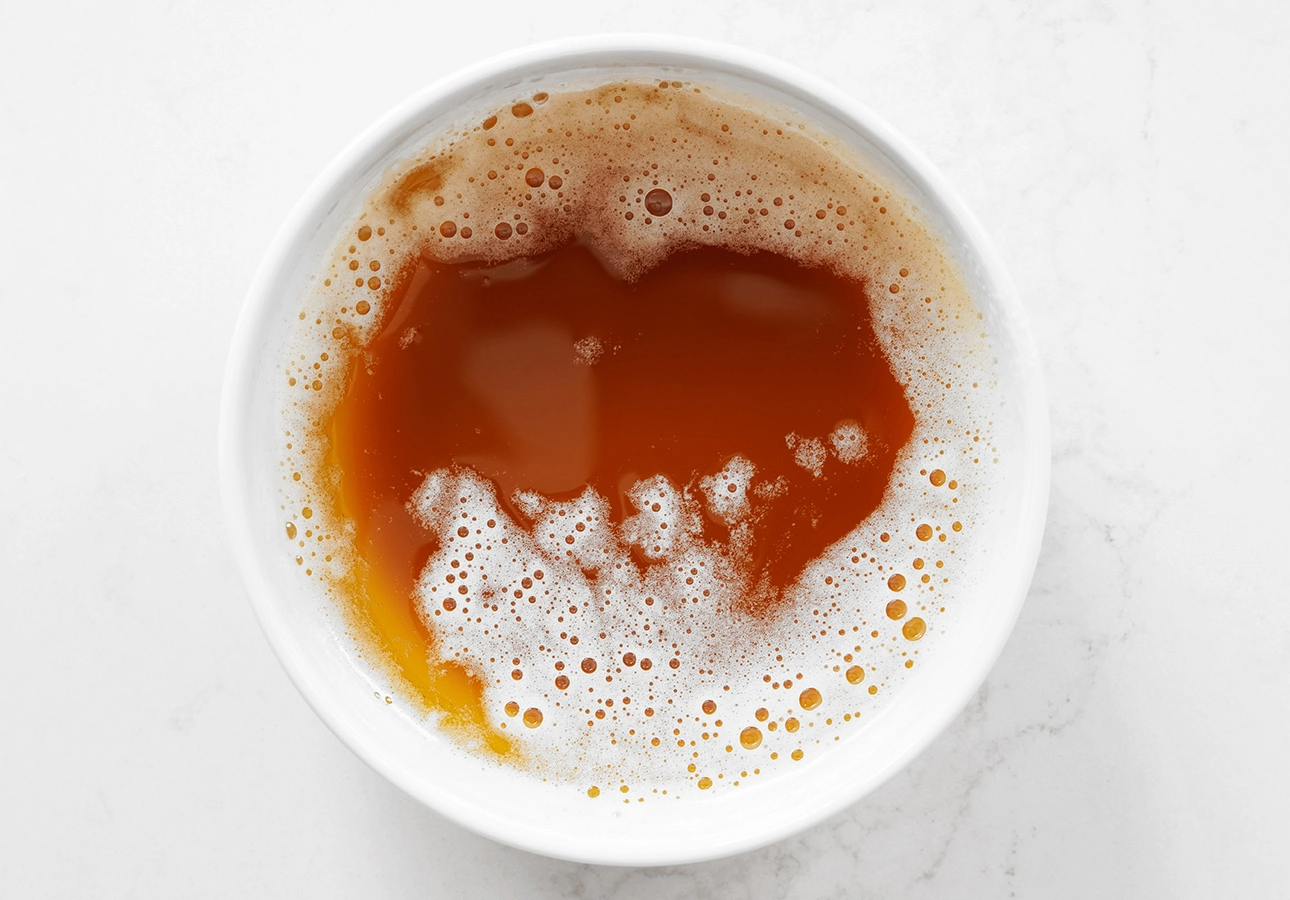
Once it starts foaming and the milk solids begin to color, stay close to the stove. You want the butter to smell distinctly nutty and the solids at the bottom of the pan to turn deep golden brown, not black.
As soon as it reaches that point, transfer it to another container so the residual heat of the saucepan doesn’t keep cooking it.
Maple syrup or sugar both work
I like making this clafoutis with pure maple syrup because its subtle caramelized flavor works particularly well with cherries and brown butter.
That said, this isn’t meant to be a maple-forward dessert. Granulated sugar works perfectly well if that’s what you have or if you want the flavor to remain more neutral.
Add the hazelnuts—or don’t
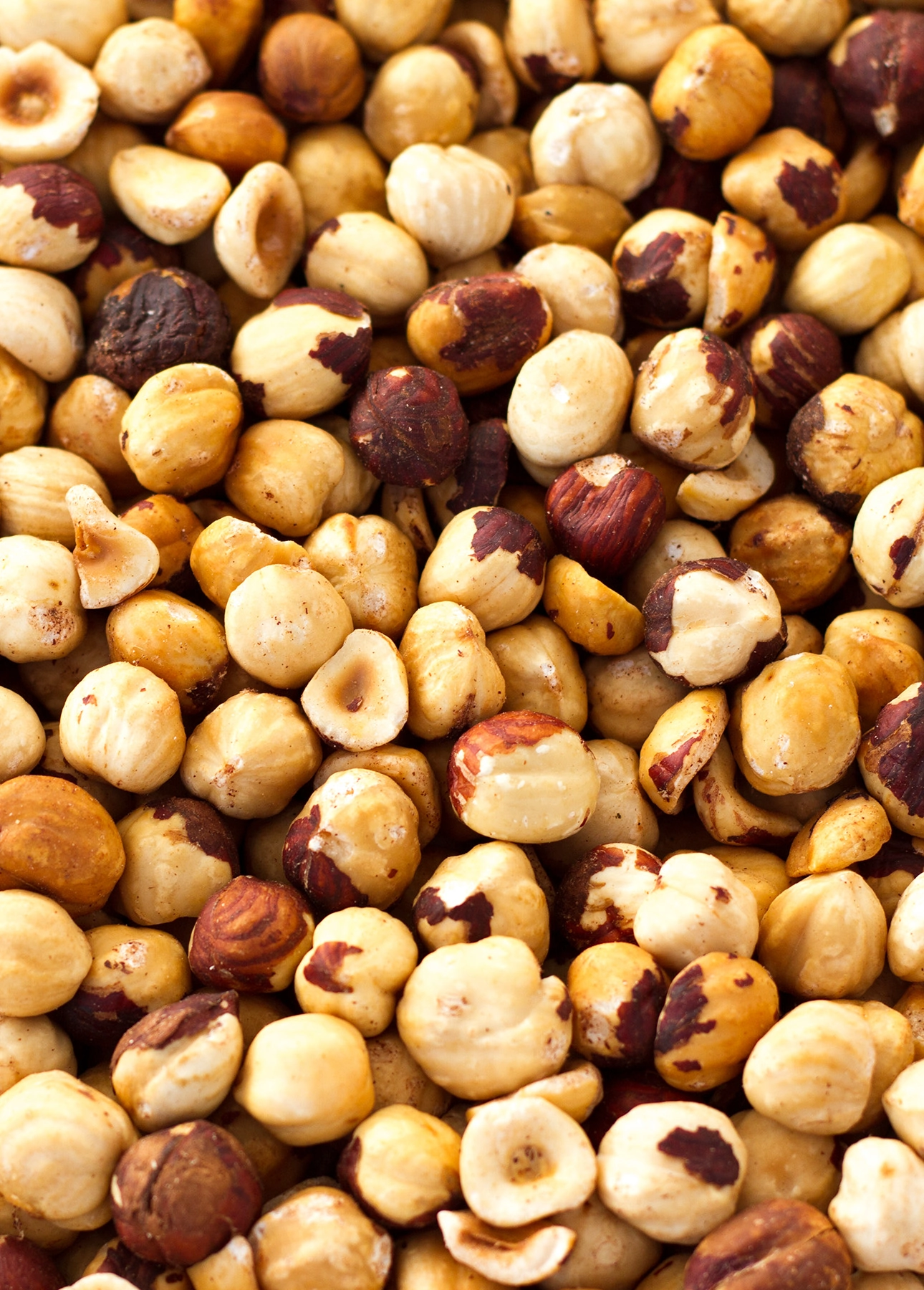
Roasted hazelnuts give the clafoutis a little crunch and their flavor naturally echoes the nuttiness of the brown butter.
They’re completely optional. Leave them out for a simpler, more traditional finish, or substitute toasted almonds or pecans.
Use a shallow baking dish of similar size
I bake this cherry clafoutis in a 10-inch fluted pie plate. A 10-inch round baking dish or a similarly sized shallow ovenproof skillet will work, too.
What matters most is keeping the depth of the batter reasonably similar. A smaller, deeper dish will take longer to bake, while batter spread in a wider dish will set more quickly.
Whenever you change baking dishes, use the visual doneness cues rather than relying solely on the clock.
Don’t wait for the center to become completely firm
This is the most important tip for getting the texture right.
Bake until the clafoutis is puffed and golden around the edges and the center is set rather than wet. It should still be tender when it comes out of the oven.
If you continue baking until the entire dessert seems very firm, the egg-rich custard can become dense or rubbery. It will continue setting as it rests, so give it those few minutes outside the oven before judging its final texture.

Let it settle before serving
Let the clafoutis rest for about 10 minutes after baking. This gives the custard time to settle and makes it easier to serve in wedges.
I like cherry clafoutis warm or at room temperature with a spoonful of full-fat vanilla Greek yogurt. The cool, creamy yogurt is especially good with the warm cherries and toasted hazelnuts.
Dust the clafoutis with powdered sugar only just before serving. If you add it too early, the sugar will gradually melt into the moist surface and disappear.
Serve it for dessert—or breakfast
Clafoutis may be a dessert, but this version is only lightly sweetened. With just 1/4 cup of maple syrup or sugar in the whole recipe, I think it’s just as suited to breakfast or brunch.
Serve it the way you might serve crêpes: slightly warm, with yogurt alongside and perhaps a few extra fresh cherries when they’re in season.
If you want to make it ahead
Cherry clafoutis is at its best on the day it is baked, and the batter takes so little time to prepare that I don’t think there’s much advantage to assembling the whole dessert far in advance.
If you’re serving it after dinner, bake it earlier in the day and let it cool to room temperature. You can also gently warm individual portions before serving if you prefer.
You can brown the butter and pit the cherries ahead of time to make assembly even quicker.
Try it with other summer fruit
Cherries are traditional, but the same batter works beautifully with other summer fruit. Peaches, nectarines, apricots, and raspberries are especially good, and combinations such as cherries and blackberries or apricots and blueberries work wonderfully, too.
Technically, once the cherries are replaced with another fruit, the dessert is traditionally called a flaugnarde rather than a clafoutis—but there’s no need to let terminology get in the way of a good summer dessert.
Cherry Clafoutis FAQ
What’s the difference between clafoutis and flaugnarde?
Traditionally, clafoutis refers specifically to the version made with cherries. When the same type of batter is baked with another fruit, such as pears, plums, peaches, or apricots, the dessert is called a flaugnarde. Today, however, “clafoutis” is commonly used more broadly in English-language recipes.
What’s the difference between cherry clafoutis and cherry cobbler?
Both are baked fruit desserts, but their structures are completely different. Cherry clafoutis surrounds the fruit with a thin, egg-rich batter that sets into a soft custard. Cherry cobbler generally has a juicier fruit filling topped with biscuit dough, batter, or another thicker baked topping.
Why is my clafoutis rubbery?
Overbaking is the most likely culprit. Clafoutis contains several large eggs, and prolonged baking makes those egg proteins increasingly firm, just as they would in an overcooked custard. Remove the clafoutis once the center is set but still tender, then let it finish settling as it cools.

Cherry Clafoutis Recipe with Brown Butter
Ingredients
- ¼ cup unsalted butter, plus more for the baking dish
- ½ cup all-purpose flour
- ½ tsp baking powder
- ¼ tsp kosher salt or fine sea salt
- ¾ cup milk
- 3 large eggs
- ¼ cup pure maple syrup or ¼ cup (50 g) granulated sugar
- 1 tsp pure vanilla extract
- 10 ½ oz pitted cherries
- ¼ cup coarsely chopped, roasted hazelnuts (optional)
For serving (optional)
- Powdered sugar
- Full-fat vanilla Greek yogurt
Instructions
- Preheat the oven to 350°F (175°C).
- Melt the butter in a small saucepan over medium heat. Continue cooking, swirling the pan occasionally, until the butter foams, the milk solids at the bottom turn deep golden brown, and the butter smells distinctly nutty. Watch it carefully toward the end, as brown butter can go from golden to burned quickly. Immediately pour the brown butter into a heatproof bowl or measuring cup, scraping in all the toasted milk solids. Let cool for a few minutes.
- Generously butter a 10-inch (25 cm) fluted pie plate. You can also use a 10-inch round baking dish, a shallow 10-inch ovenproof skillet, or another shallow baking dish of similar capacity.
- In a small bowl, whisk together the flour, baking powder, and salt. Set aside.
- In a large bowl, whisk together the milk, eggs, maple syrup, and vanilla. Slowly whisk in the brown butter. Add the flour mixture and whisk until the batter is smooth.
- Arrange the cherries in a single layer over the bottom of the prepared baking dish. Pour the batter over the cherries, then sprinkle with the hazelnuts, if using.
- Bake for 40 to 45 minutes, or until the clafoutis is well puffed and golden around the edges and the center is set but still tender. Transfer to a wire rack and let cool for about 10 minutes before serving.
- VARIATIONS: Cherries are the classic choice, but you can use other summer fruit in their place. Peaches and apricots are especially delicious, or try combinations such as cherries and blackberries or apricots and blueberries.You can also replace the hazelnuts with toasted almonds or pecans, or omit the nuts altogether for a simpler, more traditional finish.
- SERVING: Serve the cherry clafoutis warm or at room temperature. Dust it lightly with powdered sugar just before serving; if you add the sugar too far in advance, it will gradually melt into the moist surface of the clafoutis.I especially like serving it with a spoonful of full-fat vanilla Greek yogurt.Because the batter is only lightly sweetened, cherry clafoutis also works beautifully for breakfast or brunch, much like crêpes or a Dutch baby.
- STORAGE: Let leftover clafoutis cool completely, then cover and refrigerate for up to 3 days. Enjoy it chilled, bring it back to room temperature before serving, or warm individual portions gently. Avoid overheating the clafoutis, which can make the custard firmer.
Did you make this?
Tell me how you liked it! Leave a comment or take a picture and tag it with @foodnouveau on Instagram.
This site participates in the Amazon Associates Program, an affiliate advertising program designed to provide a means for the site to earn fees by linking to Amazon and affiliated sites.
If you click on an affiliate link, I may earn advertising or referral fees if you make a purchase through such links, at no extra cost to you. This helps me create new content for the blog–so thank you! Learn more about advertising on this site by reading my Disclosure Policy.
Author: Marie Asselin
WHAT DID YOU THINK OF THIS RECIPE?
Rate + Review