- V
- GF
- NS
- DF
- View Recipe Key
How to Make Classic Quiche Lorraine (VIDEO)
How to Make Classic Quiche Lorraine (VIDEO)

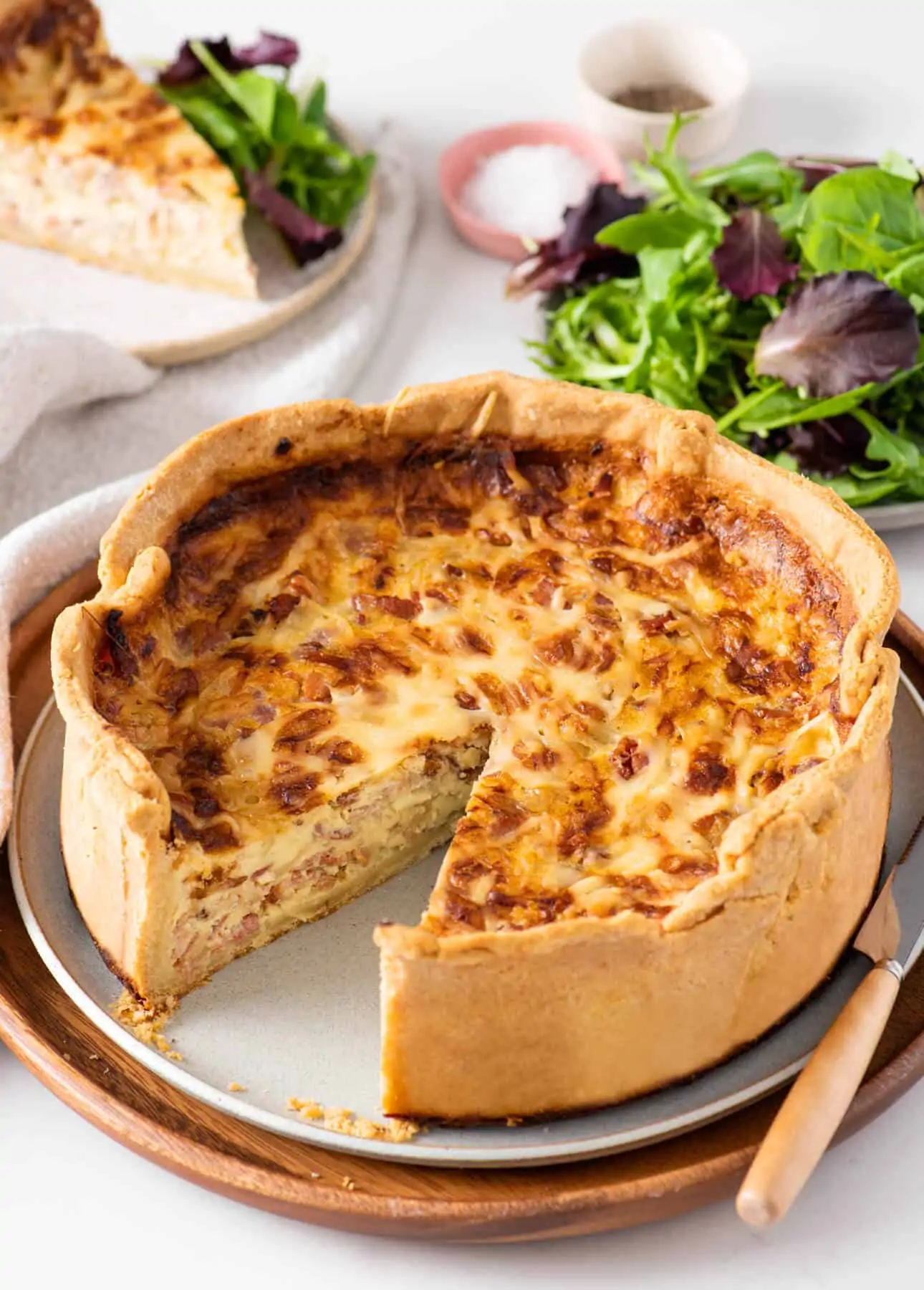
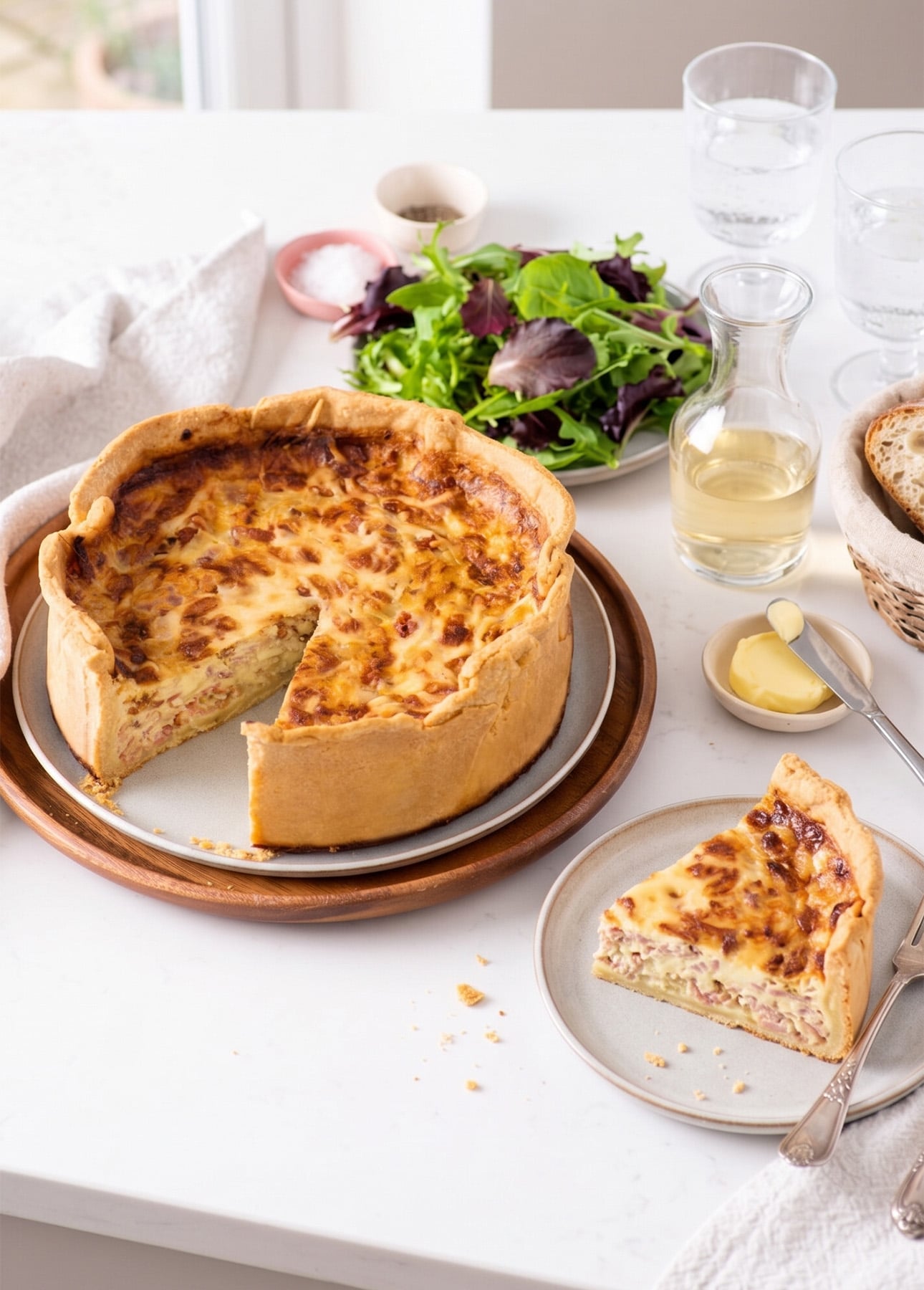
Inspired by the tall, generous slices sold in French bakeries and cafés, this deep-dish Quiche Lorraine is rich, creamy, elegant, and a wonderful make-ahead dish to have on hand.
This post contains affiliate links. Full disclosure is at the bottom of the article.
Quiche Lorraine is one of those dishes I never get tired of making. It has everything I love in a savory tart: a crisp crust, a rich and silky custard, savory bacon, sweet onions, and just enough cheese to make the whole thing feel especially satisfying. It’s classic French cooking in a very approachable form: elegant enough for a brunch table, but practical enough to make for lunch, dinner, or a few very lucky leftovers.
I’ve long had a soft spot for quiche in general, but Quiche Lorraine is the queen of savory tarts in my kitchen. There’s something about serving a generous slice with a lightly dressed green salad—and maybe a glass of wine—that instantly makes the meal feel a little more polished. It’s the kind of dish that looks impressive, but once you understand the method, is completely doable at home.
I also think quiche is one of the smartest make-ahead brunch dishes you can have in your repertoire. When I’m hosting, I always appreciate recipes that can be made in stages, baked ahead, and served without any last-minute stress. Quiche Lorraine does all of that beautifully. In fact, I think it’s often even better after it has had time to rest and fully set.
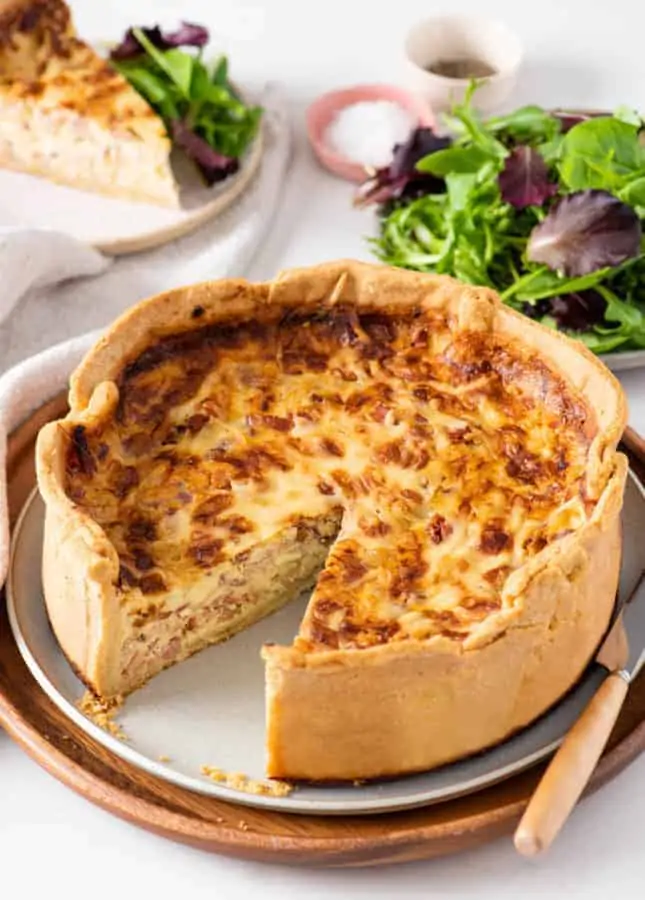
One important thing to know about this recipe is that I’m making a deep-dish Quiche Lorraine on purpose. It’s the style I most strongly associate with French bakeries and cafés—the kind of quiche you see baked tall, displayed in generous rounds, and sold by the slice. That fuller, more substantial format, with its silky custard and savory bacon lardons, is the one I’ve most often encountered in Paris, and it’s the version I wanted to recreate here.
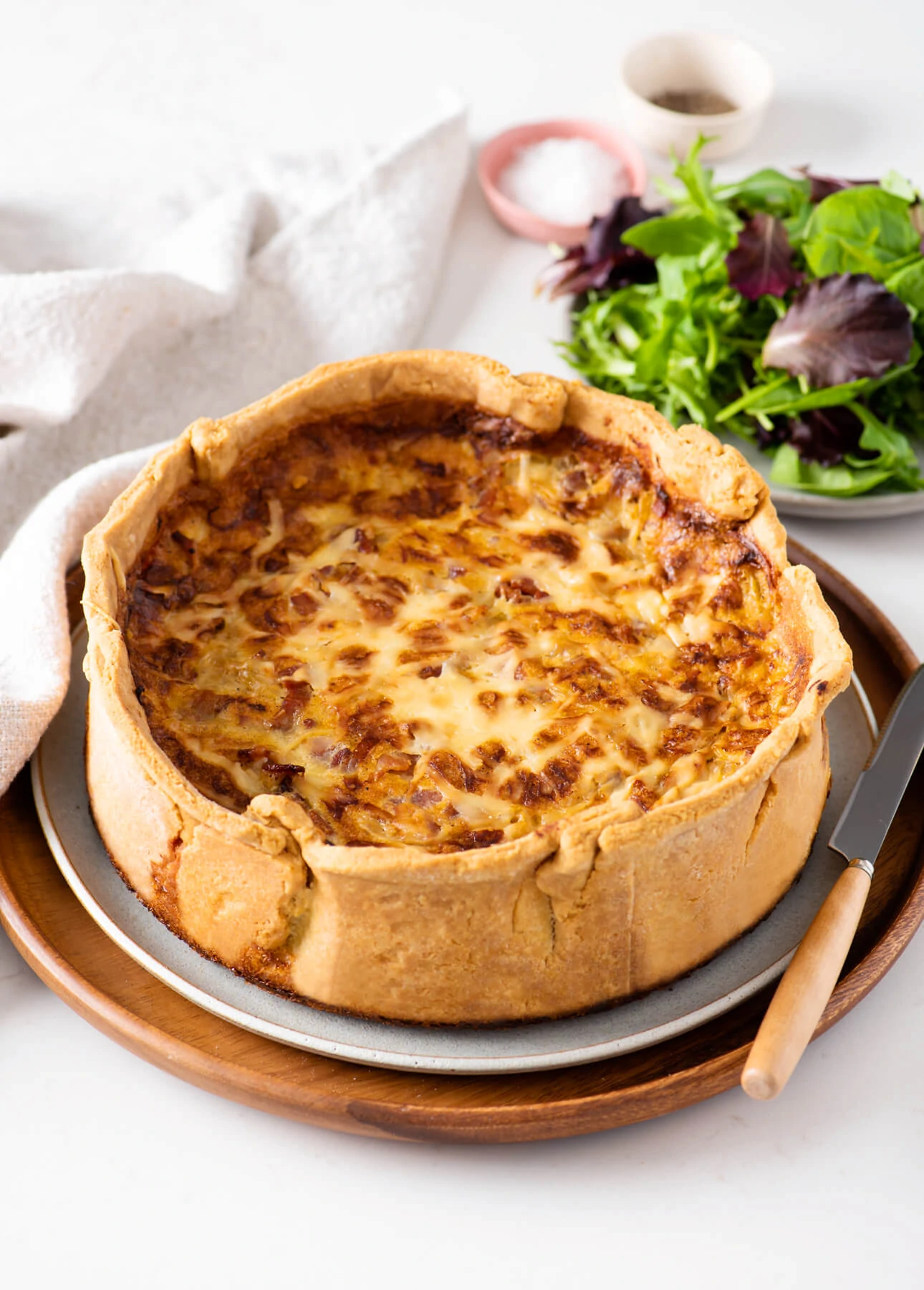
There are, of course, different ways to make Quiche Lorraine. The most basic versions rely on eggs, bacon, milk, and cream. I love the addition of caramelized onions and Comté cheese, which is one of the most common variations and, to me, one of the most delicious. Those ingredients make the filling deeper, sweeter, and more rounded, while still keeping the spirit of the classic intact.
Quick Summary
Quiche Lorraine is a classic French quiche made with a savory egg custard, bacon, and a crisp pastry shell. It’s one of my favorite make-ahead brunch recipes because it can be prepared in stages, slices beautifully, and tastes just as good warm as it does at room temperature.
VIDEO: How to Make Classic Quiche Lorraine
Watch the video below to see exactly how I make this deep-dish Quiche Lorraine, from the easy shortcrust pastry to the rich, custardy filling. It’s a great way to get a feel for the process before you start.
Helpful Tips for Making Classic Quiche Lorraine
What makes Quiche Lorraine a classic?
Quiche Lorraine is the most iconic of French quiches, and at its core, it’s a savory custard tart made with eggs, cream, and pork—most often bacon or lardons. Many modern versions, including mine, also include onions and cheese, which make the filling even more flavorful and satisfying. If you’ve ever wondered what separates Quiche Lorraine from other quiches, that bacon-and-custard base is really the key.
Why I love Quiche Lorraine as a make-ahead brunch dish
Quiche Lorraine is not a last-minute recipe, but that’s exactly part of its appeal. You can make the pastry ahead, blind-bake the shell, and even bake the full quiche in advance. Once chilled, it slices more neatly, the custard sets into that perfect rich texture, and reheating is easy. For brunches, showers, holiday mornings, or relaxed lunches with friends, it’s a real time-saver.
If you like this kind of elegant, make-ahead savory dish, you might also enjoy browsing my savory brunch recipes with eggs.
The ingredients you need
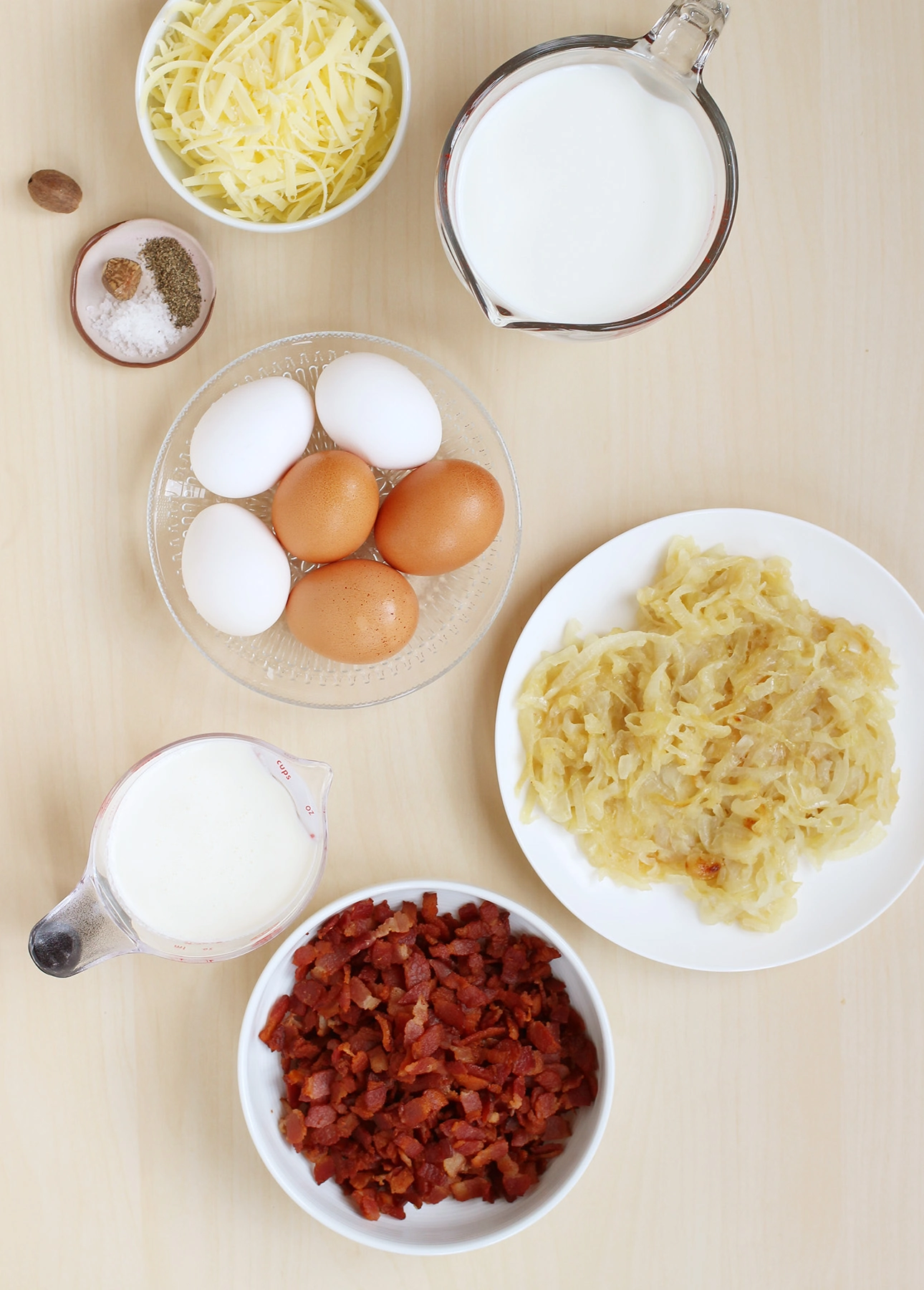
Here are the staple ingredients you need to make Quiche Lorraine:
- shortcrust pastry
- large yellow onions
- bacon or lardons
- milk
- cream
- eggs
- salt, black pepper, and nutmeg
- grated cheese, such as Comté or Gruyère
Each ingredient has a role to play: the bacon brings the salty, savory backbone; the onions soften into sweetness; the milk and cream create that custardy texture; and the nutmeg gives the filling its classic warmth.
Bacon or lardons: what to use
In French recipes, Quiche Lorraine is often made with lardons, which are small strips or cubes of cured pork. If you can find lardons, use them. If not, thick-cut unsmoked bacon, cut into small pieces, works very well and yields a very similar result. You could also use baked ham cut into small cubes, but I don’t recommend smoked bacon for this recipe, though, as its stronger flavor can easily overpower the delicate flavor of the cheese custard.
Homemade pastry is easier than it looks
If homemade pastry has ever made you hesitate, this is a very good place to change your mind. My foolproof shortcrust pastry made in the food processor comes together incredibly quickly and makes this quiche recipe feel even more special. I kept the method simple on purpose because I really do want this to be a recipe you feel comfortable making from scratch, including the flaky pie crust.
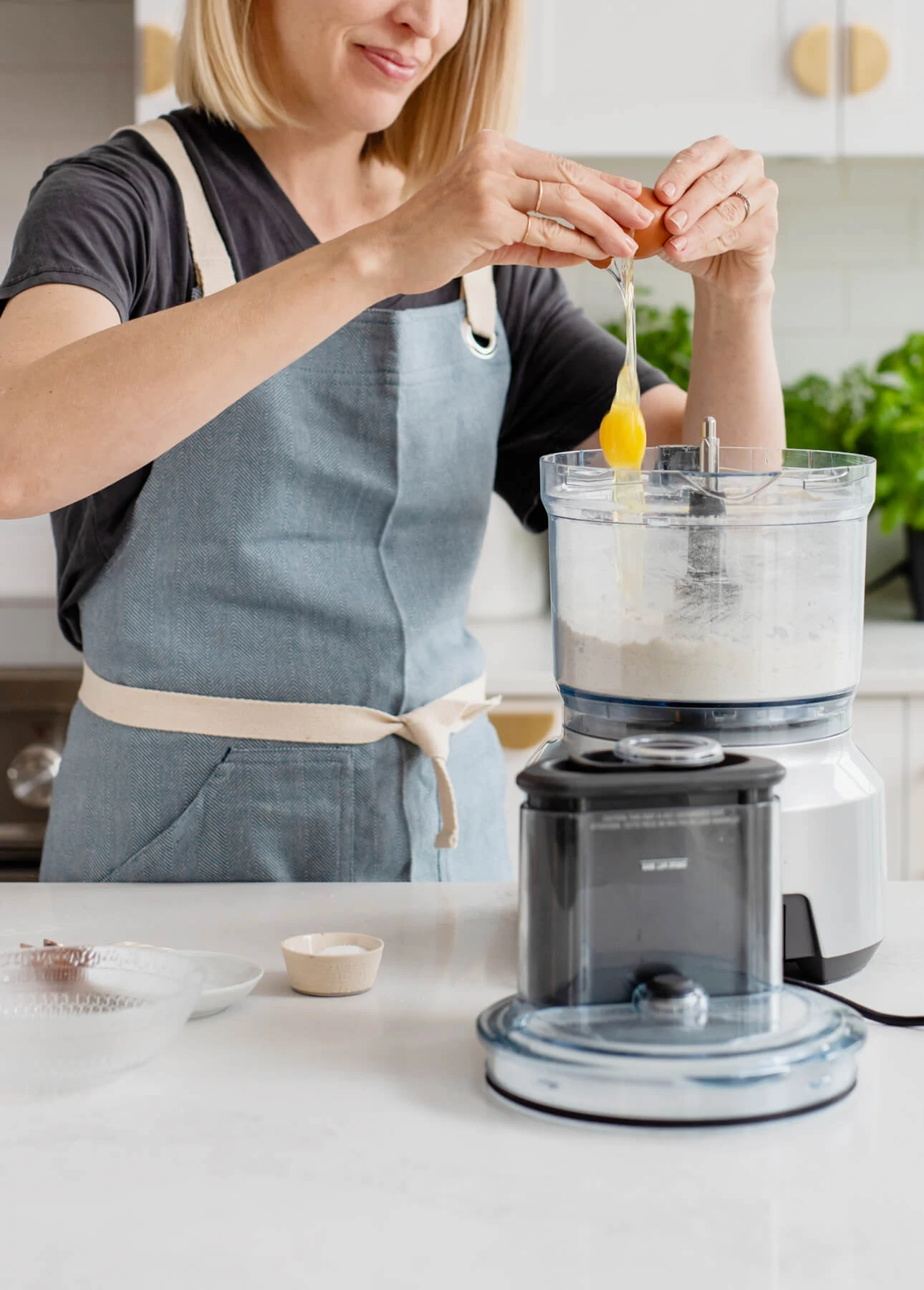
VIDEO: Watch how to make shortcrust pastry IN SECONDS using your food processor
Watch my Shortcrust Pastry recipe video to discover how easily you could be making shortcrust pastry from scratch, too!
Can I make Quiche Lorraine ahead of time?
Yes—and I highly recommend it. Quiche Lorraine comes together in several steps, so making it ahead is not just convenient, it’s the best strategy. You can blind-bake the crust in advance, refrigerate the baked quiche overnight, then gently reheat it before serving, or serve it at room temperature. It’s one of those dishes that feels almost designed for entertaining.
How to pick the right pan for making Quiche Lorraine
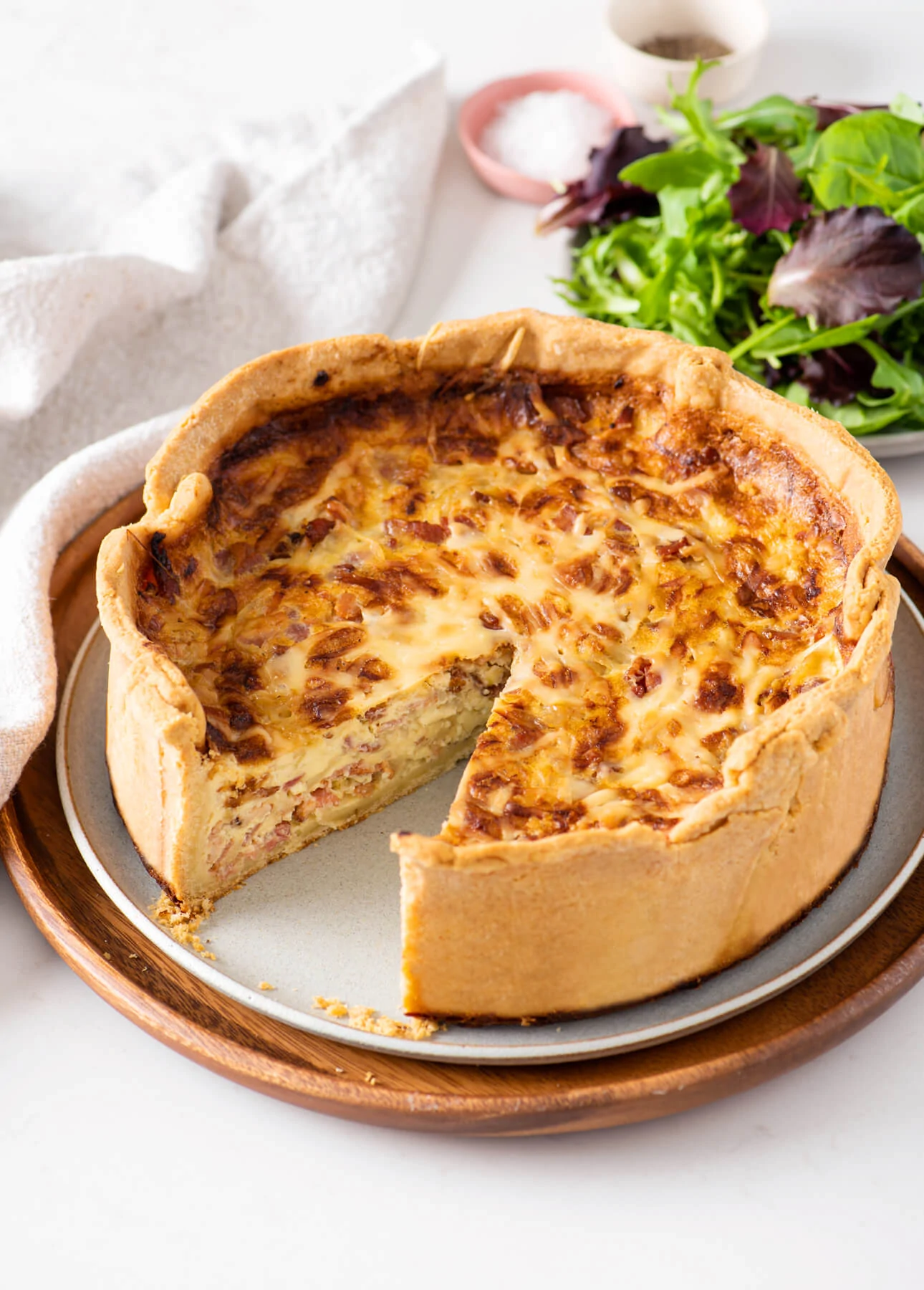
This version is a deep-dish quiche recipe, and that’s intentional. It’s the style I most strongly associate with French bakeries and cafés, where quiche is often baked tall and sold by the slice rather than made as a flatter tart. That generous format, with its silky custard and savory lardons, is the version I most wanted to capture here.
To get that bakery-style look and texture, I use a 9-inch springform pan with a removable bottom and 3-inch sides. That pan gives the quiche enough depth to feel substantial and dramatic, while still allowing the custard to bake evenly.

If you don’t have a springform pan, you can divide the recipe between two standard pie plates instead. The result will be a little less tall and striking, but still absolutely delicious. Refer to the notes in my recipe below for instructions on baking Quiche Lorraine in two separate 9-inch (23 cm) pie plates.
How much shortcrust pastry do I need?
Because this is a deep-dish quiche, you need a double batch of pastry to line the pan properly. I recommend making the two batches separately, then gathering and rolling them together. It’s easier on the food processor and helps preserve the texture of the dough.
Do I really need to blind bake the crust?
Yes. Because quiche filling is very wet, blind baking is the best way to keep the crust from turning pale, soft, or soggy underneath the custard. It gives the pastry a head start, so it stays crisp even after the filling is added.
Pro Tip: Freeze the shaped crust before blind baking. That extra chill helps it keep its shape, especially in a straight-sided pan.
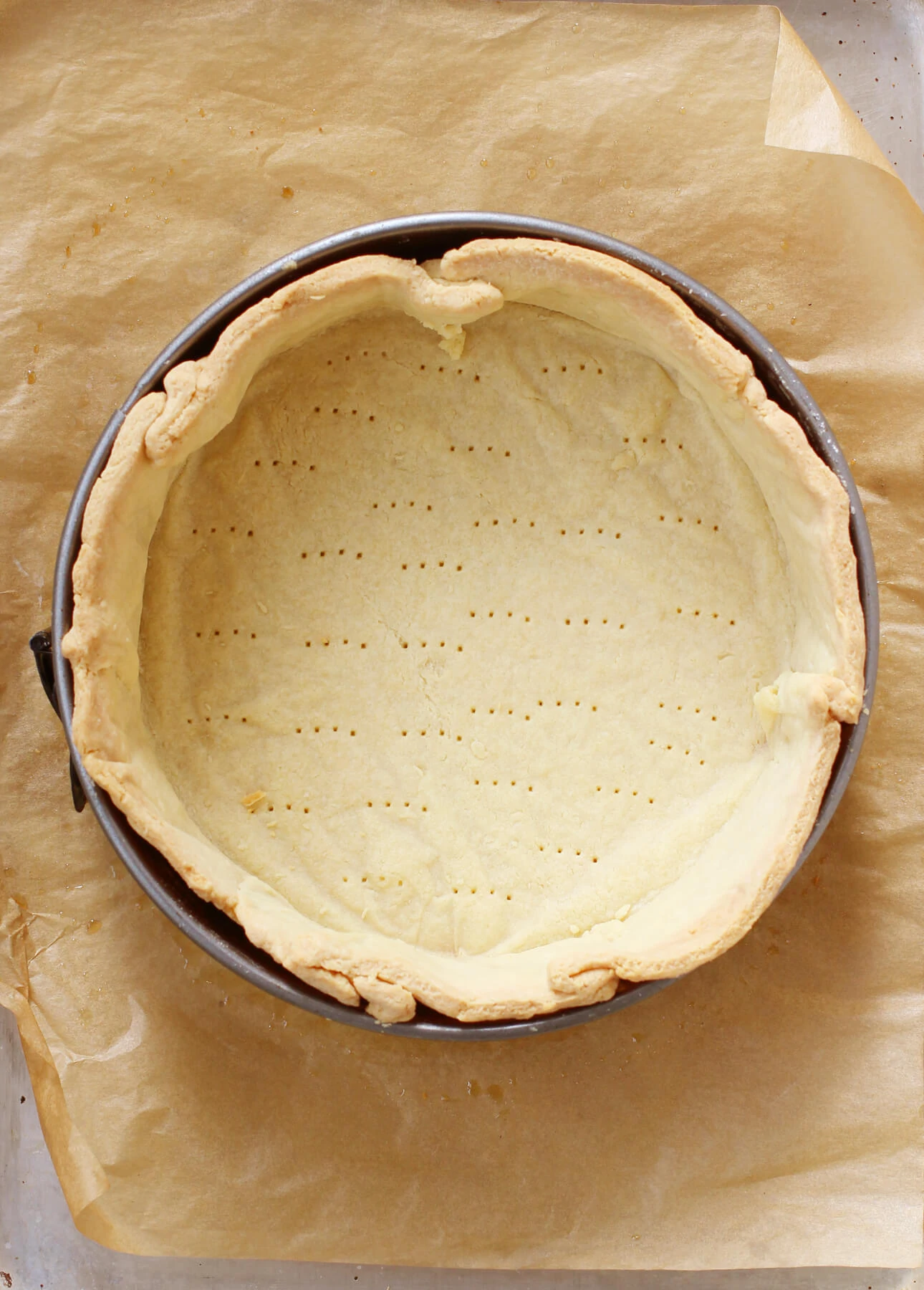
How to keep the pastry from shrinking or slumping
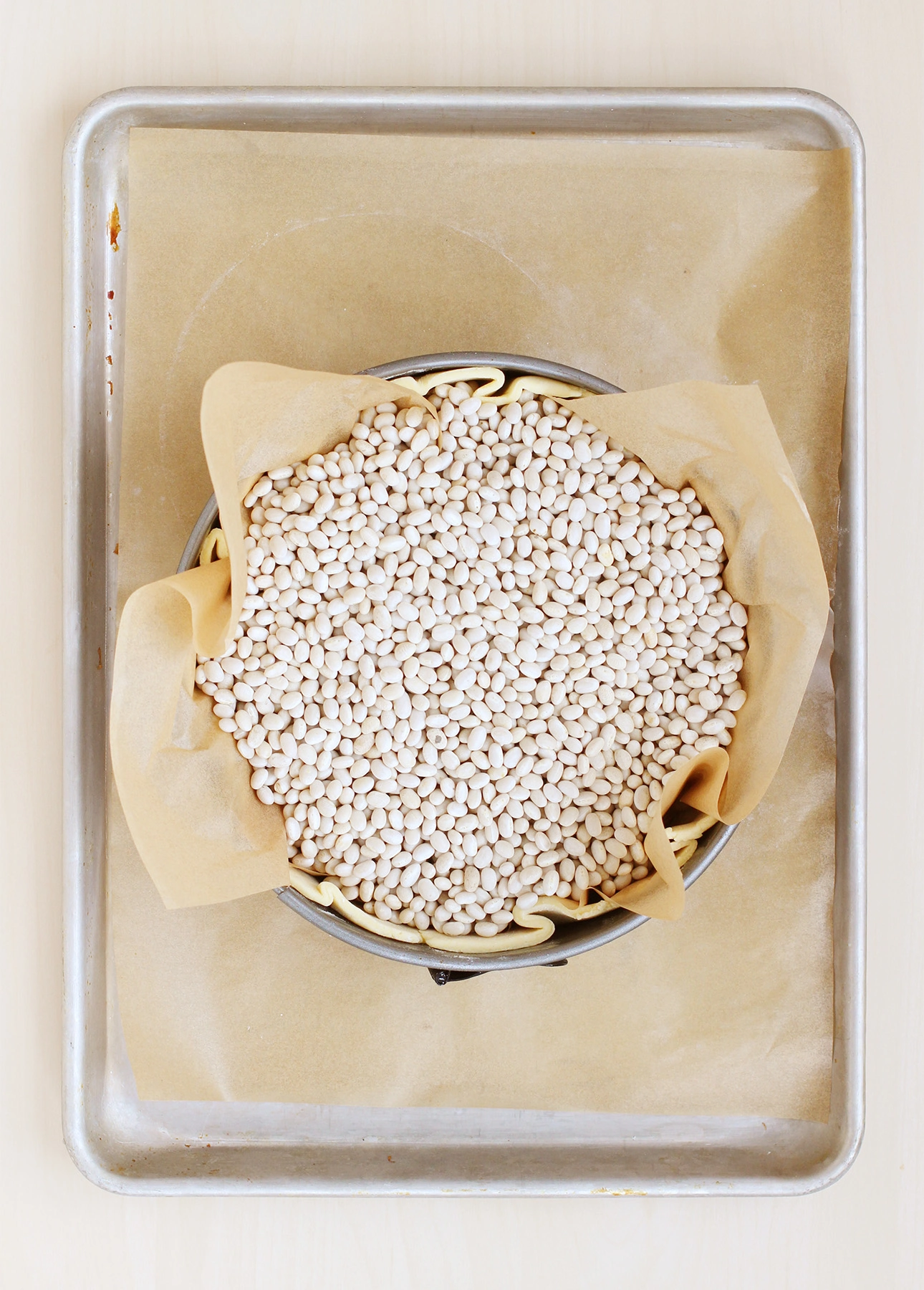
Since this recipe uses a straight-edged pan, it’s essential to line the chilled crust with parchment and fill it right up to the top with pie weights or dry peas. If the crust isn’t properly supported, it can slide down or crumple during baking. That one small step makes a huge difference in the final look of the quiche.
How to blind bake shortcrust pastry if you don’t have pie weights
No pie weights? No problem. Dry peas work perfectly well. I keep some on hand just for blind baking. They’re inexpensive, easy to use, and ideal for pressing the pastry into place. Note that you won’t be able to cook those peas after they’ve been used as pie weights, but you can let them cool, store them in a zip-top bag, and reuse them over and over again. (I’ve been using the same bag of dry peas for years!)
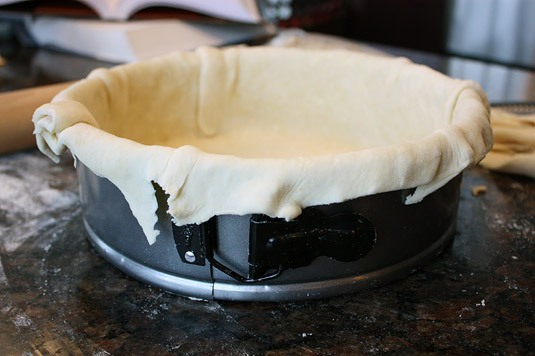
What to do if you have no pie weights, and no dry peas either
Overhang the pastry. If you don’t have pie weights or dry peas to keep the pastry in place, you can let the pastry hang over the sides of the pan and blind-bake it as-is. The pastry will hold up nicely, so you can then fill the quiche and keep baking.
For a neat presentation, use a serrated knife to cut out the extra pastry before unmolding and serving the quiche.
The secret to preventing filling ingredients from sinking to the bottom
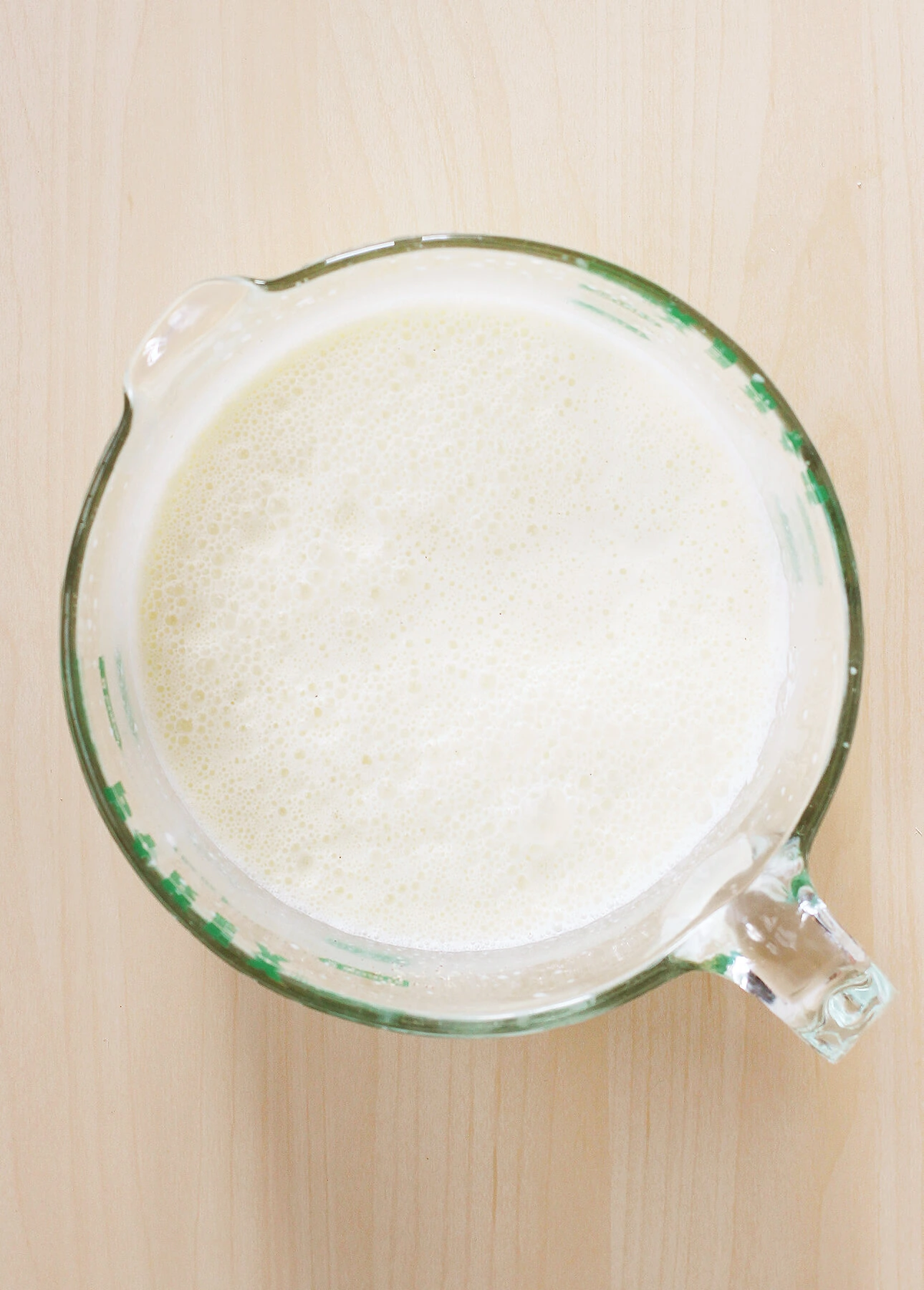
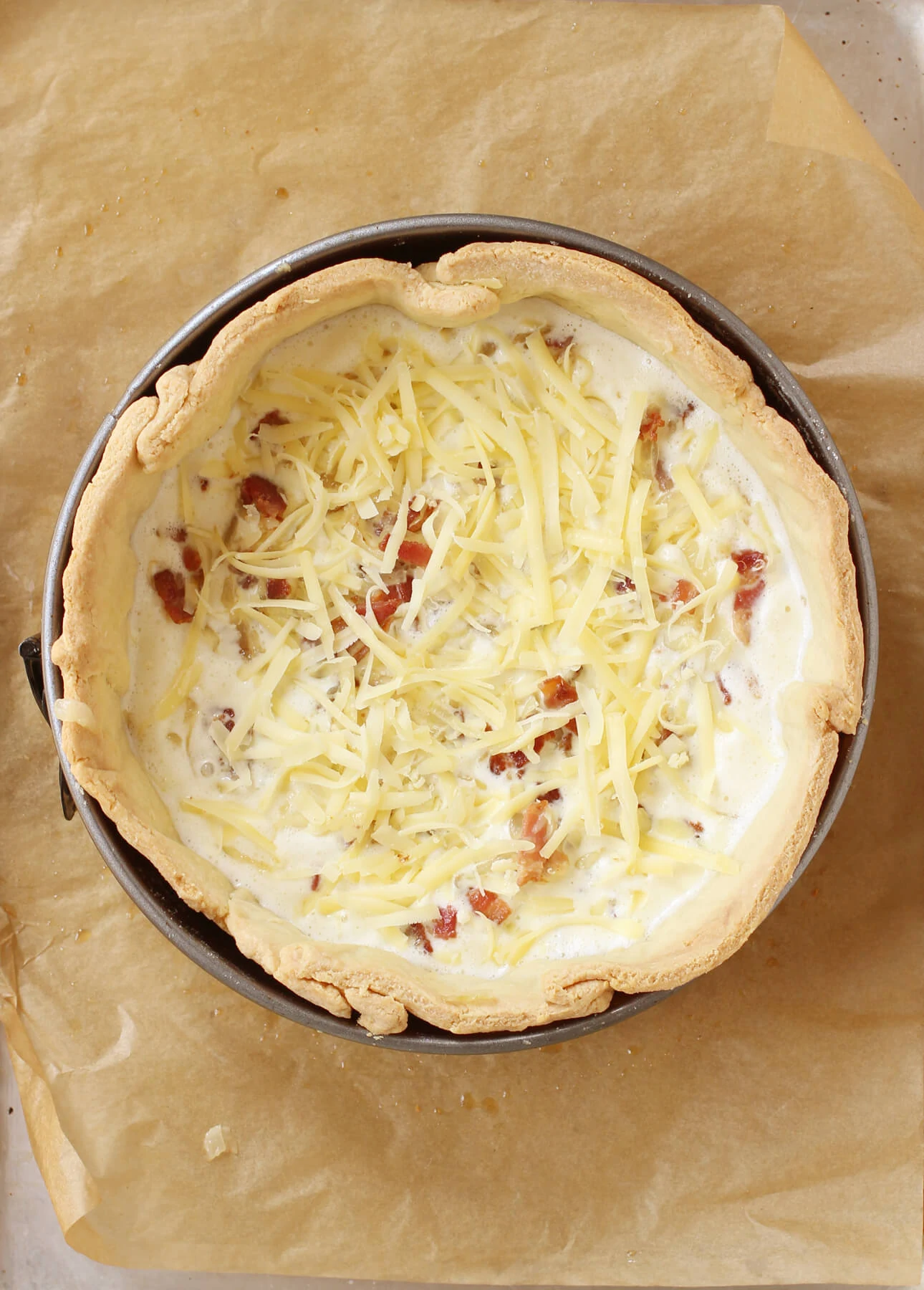
The secret to keeping the filling ingredients—the bacon, onions, and cheese—from sinking to the bottom of this deep-dish Quiche Lorraine is to beat the liquid ingredients until the egg mixture gets extra-frothy using a hand mixer or a stand blender. As you layer the caramelized onions, bacon, and cheese with the frothy custard, the air bubbles will “hold” the solids and keep them evenly distributed throughout the quiche during baking.
Use a hand mixer or a blender to make the quiche mixture extra-frothy:
Layer the filling ingredients with the quiche mixture to distribute them evenly:
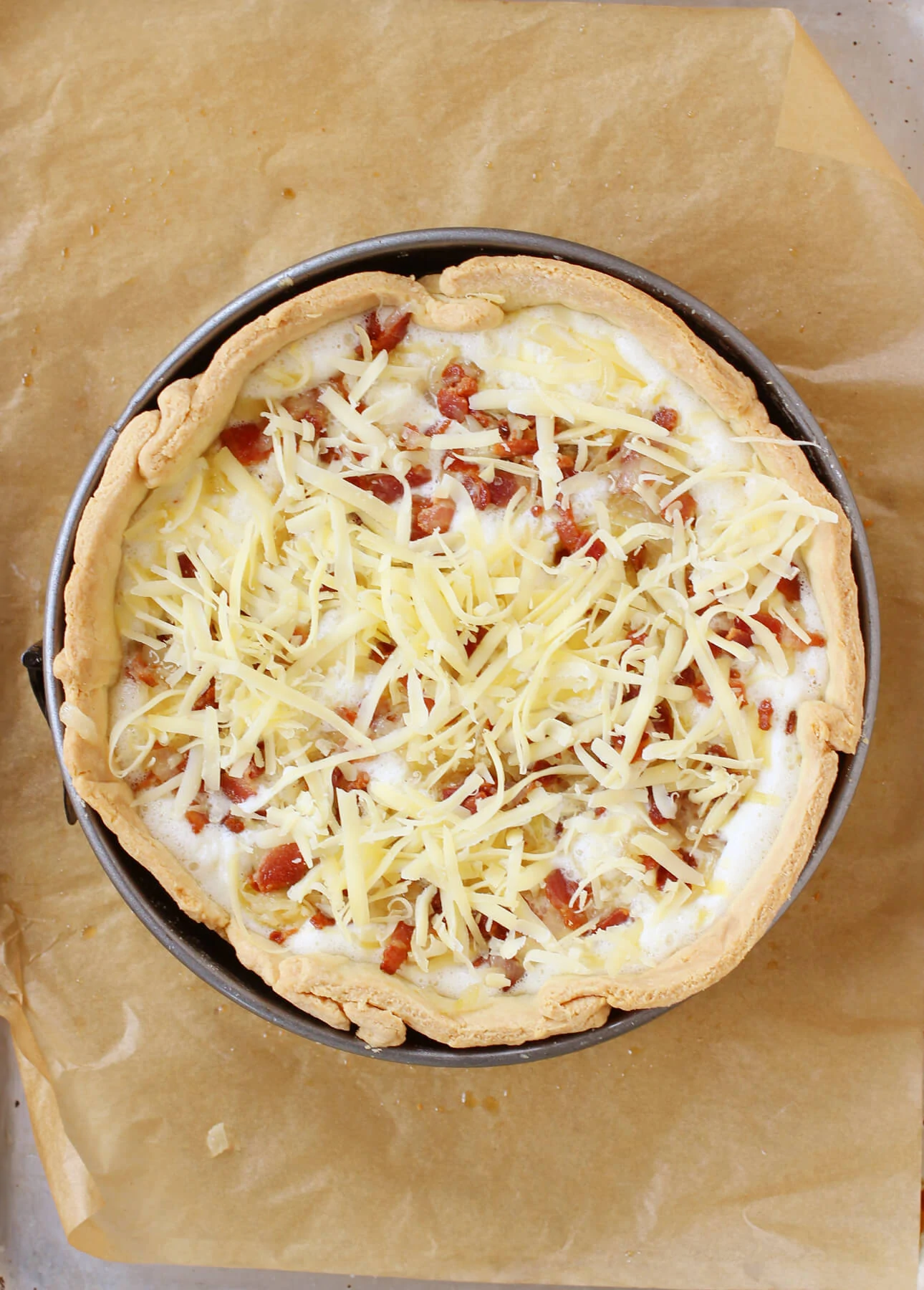
The extra-frothy quiche lorraine mixture will hold the filling ingredients throughout the baking process, preventing them from sinking to the bottom of the crust:
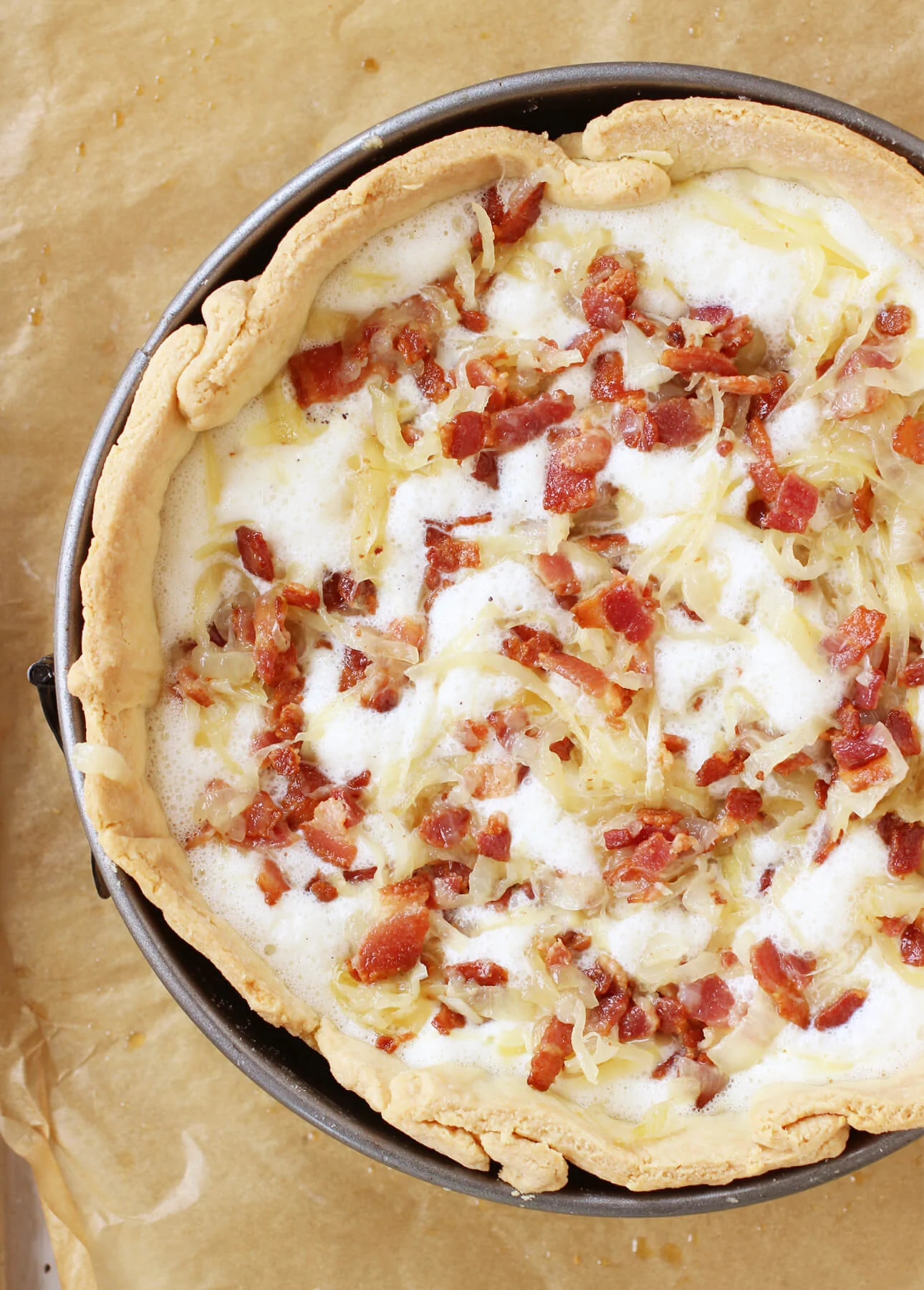
How to keep the filling creamy, not watery
A good quiche should be rich and custardy, never rubbery or wet. There are a few things that help: fully cook the onions so they don’t release too much moisture later, blind-bake the crust properly, and bake the quiche until the edges are set, but the center still has the slightest wobble. It will continue to set as it cools.
Pro Tip: Don’t slice the quiche too soon. Letting it rest gives the custard time to settle and makes for much cleaner slices.
Can I freeze Quiche Lorraine?
Yes. Once baked and cooled, Quiche Lorraine freezes very well. You can freeze the whole quiche or individual slices, wrapped well, then reheat in the oven until warmed through. For the best texture, I still prefer making it a day ahead and refrigerating it, but freezing is a good option if you want to plan further in advance.
What to serve with Quiche Lorraine
Quiche Lorraine doesn’t need much alongside it. A crisp green salad with a sharp vinaigrette is my favorite pairing because it cuts through the richness so nicely. For brunch, you could add fruit, a simple soup, or roasted potatoes. For lunch or supper, a salad alone is often enough.
If You Love Quiche, Try These Recipes Next
If this recipe puts you in a quiche mood, my Asparagus Quiche with Gruyère and Dijon and Cumin and Caramelized Onion Quiche are both worth a look.
FAQ
Can Quiche Lorraine be made the day before?
Yes. In fact, it’s one of the best reasons to make Quiche Lorraine. As the quiche rests, the flavor settles, the custard firms up beautifully, and reheating is easy.
Is Quiche Lorraine served hot or cold?
Either works. I like it best warm or at room temperature, but it’s also excellent cold straight from the fridge.
What is the difference between quiche and Quiche Lorraine?
Quiche is the broad category; Quiche Lorraine is the classic bacon-based version. It usually includes an egg-and-cream custard and often cheese, depending on the version.
Why is my Quiche Lorraine watery?
Usually, because the crust wasn’t blind-baked long enough, the filling held too much moisture, or the quiche was underbaked or sliced before it had time to rest.
Can I use store-bought pastry?
Absolutely. Homemade pastry is wonderful here, but store-bought crust is a perfectly good shortcut if you want to save time.
Classic Quiche Lorraine Recipe
Ingredients
For the crust
- 2 batches Foolproof Shortcrust Pastry (see method below for rolling and blind baking instructions)
For the quiche
- 1 ½ lbs large yellow onions, (about 2) also called Spanish onions, trimmed, peeled, and thinly sliced
- 2 tbsp extra-virgin olive oil
- 2 tsp kosher salt, or fine sea salt, divided
- ½ lb unsmoked bacon slices
- 2 cups whole milk (3.25% m.f.), or partly skimmed milk (2% m.f.)
- 1 cup heavy cream (35% m.f.)
- 6 large eggs
- ½ tsp freshly ground black pepper
- ¼ tsp freshly grated nutmeg
- ¾ cup grated Comté, Gruyère, or Emmenthal cheese
Instructions
- Lightly grease a 9-in (23 cm) springform pan with 3-in (7.5 cm) sides. Set aside.
PREPARE THE CRUST
- Make the two batches of Foolproof Shortcrust Pastry, one after the other.When the first one is done, dump it on a floured working surface, and make the second batch right away. Dump it over the first batch, then, using your hands, gather the whole thing into a loose, flattened ball. Sprinkle the dough with flour, then roll out to a 16-in (40 cm) circle. (Sprinkle with more flour as needed to prevent sticking.) The pastry should be about ¼ inch (6 mm) thick.
- Carefully fold the dough in half, then drape it over one half of the prepared springform pan. Unfold it, then gently ease the dough into the pan, pressing it onto the bottom and creasing the dough to flatten it against the sides of the pan. Using a fork, prick the bottom pastry all over.
- If blind baking with pie weights or dry peas, cut off the overhanging pastry so the pastry is flush with the top of the pan.If blind baking without pie weights or dry peas, let the pastry hang over the sides of the pan. Freeze the pastry-lined pan for at least 30 minutes, or until ready to blind bake.
BLIND-BAKE THE CRUST
- If blind baking with pie weights or dry peas, preheat the oven to 400°F (200°C). Cut out a large piece of parchment paper and ease it into the pastry to line it. Fill the pan with pie weights or dry peas. Bake for 30 minutes, then remove from the oven. Carefully lift the parchment with the weights or peas out of the pan (transfer these into a large bowl to let cool completely before storing), then lower the oven temperature to 350°F (175°C) and return the pan to the oven. Bake the crust for an additional 15 minutes, or until it looks dry and light golden brown. Set aside on a cooling rack.
- If blind baking without pie weights or dry peas, preheat the oven to 350°F (175°C). Transfer the pan with the overhanging pastry straight from the freezer to the oven. Bake for 45 minutes, or until the crust looks dry and is light golden brown. Set aside on a cooling rack.
PREPARE THE FILLING
- Cook the bacon: Arrange the bacon slices on a lined baking sheet and bake in a 400°F (200°C) oven until crisp. Transfer to paper towels to drain off the excess fat, then let cool completely. Once cooled, cut into strips and set aside.
- Cook the onions: Set a large saute pan or Dutch oven over medium heat, then add the olive oil and heat until shimmering. Add the sliced onions, sprinkle with 1 tsp (5 ml) of the salt, then stir to combine. Cover and cook for 15 minutes. Uncover, stir, reduce the heat to low, and continue cooking, uncovered, until the onions are tender and lightly browned, 15 to 25 minutes more. Stir every 5 minutes to ensure the onions cook evenly. Transfer the cooked onions to a large bowl and let cool completely.
- Make the custard: In a large bowl or an 8-cup measuring cup, combine the milk, cream, eggs, remaining salt, pepper, and nutmeg and, using a hand mixer, blend until very frothy (you can add the ingredients to a stand blender instead.)
BAKE THE QUICHE LORRAINE
- Preheat the oven to 325°F (160°C).
- Place the springform pan with the blind-baked crust on a rimmed baking sheet to catch any leaks. Combine the cooked onions and bacon, then spread a third of this mixture over the bottom of the crust. Pour a third of the custard over top, then sprinkle with a third of the grated cheese. Blend the remaining custard again to make it frothy, then repeat these layers twice more, ending with the cheese.
- Bake for about 90 minutes, or until the top of the quiche is golden brown and the edges are set, while the center still has a slight jiggle. The quiche will fully set as it cools.
- Transfer the Quiche Lorraine to a wire rack and let cool to room temperature, at least 2 hours. If you blind-baked the crust without pie weights or dry peas, use a sharp knife to trim the excess crust along the rim.Refrigerate until the quiche is fully chilled, at least 2 more hours, or ideally overnight. Refrigerating the quiche will allow it to fully set and slice more cleanly. You can keep the quiche refrigerated for up to 3 days.
- SERVING: To unmold the Quiche Lorraine, slide a sharp knife along the inside edge of the springform pan to loosen the quiche, then release the springform and remove the outer ring.
- Slice the Quiche Lorraine into portions, then serve cold or room temperature. You can also reheat portions in a 350°F (175°C) oven for 10 minutes. Serve the quiche with a lightly dressed green salad.
- STORAGE: Refrigerate leftover Quiche Lorraine in an airtight container for up to 3 days.
Video
Notes
Did you make this?
Tell me how you liked it! Leave a comment or take a picture and tag it with @foodnouveau on Instagram.
This site participates in the Amazon Associates Program, an affiliate advertising program designed to provide a means for the site to earn fees by linking to Amazon and affiliated sites.
If you click on an affiliate link, I may earn advertising or referral fees if you make a purchase through such links, at no extra cost to you. This helps me create new content for the blog–so thank you! Learn more about advertising on this site by reading my Disclosure Policy.
Author: Marie Asselin
My mother was from Nancy in Lorraine, and she never put bacon or ham in her quiches. But I like the addition of ham! And I use white pepper.
Thanks for your feedback Mimi! Using white pepper is a nice touch.
I would love to make this for Christmas but only have a 12” springform pan. Do you think this recipie would work out ok?
A 12″ springform will work, but if you make the recipe as written the quiche will be quite thin and may overbake. For a normal thickness, increase everything to about 1¾x, set the pan on a rimmed sheet, and start checking a little early—pull it when the center is still slightly wobbly.
I’m planning to make this for an upcoming Christmas luncheon. Like others, I’m trying to recreate a spectacular quiche I had in France, which was incredibly light and creamy and about 4 inches tall. I assumed achieving that meant separating the eggs and whipping the whites before folding them into the rest of the custard ingredients, or is this overkill?
That super-tall, extra-light quiche you had in France was almost certainly baked in a deep dish (and often with a higher cream-to-egg ratio), not made by folding in whipped egg whites. Whipped whites tend to make the filling more soufflé-like and a bit unstable as it cools, so I wouldn’t recommend it for a classic Quiche Lorraine.
If you want a taller quiche, the simplest fix is to use a deeper pan (or a smaller diameter pan) and keep the custard smooth. Prepare the quiche filling as indicated, then bake until the edges are set and the center is still slightly wobbly.
This is delicious. I was trying to recreate the Quiche Lorraine I had in Burgundy and this one is perfect. Thank you for sharing it
So happy you loved the quiche! This is a very traditional recipe you’d find in French bakeries and cafés. Enjoying a slice is the perfect way to travel without leaving your home!
Can I freeze the quiche after baking?
Also pricking crust before baking will that let liquid go through crust after it’s baked?
Yes you can freeze the quiche, although I prefer slicing it into portions before freezing. I find it reheats better this way.
Pricking the crust shouldn’t let liquid go through if you do it with a fork in a light handed way. The “holes” will closeup during the blind baking process. However, you should always set your quiche pan over a baking sheet to prevent any leaks, just in case (cracks can always happen!)
this was amazing and the instructions so helpful
one glitch – when i poured the egg mix into the quiche it seeped some out of the bottom … can i line the pan with something first inside or outside?
it was securely locked
this recipe is so well written making a gourmet dish easy….. i made with leeks spinach and mushroom and sharp cheddar
loved the advice on the cheese on bottom
thank you :)
Hey Beverly! So happy you loved the quiche. You definitely need to take a super close look at your crust before you pour in the egg mixture. I usually keep my shortcrust scraps just for this purpose: If the crust cracked while blind baking, you can patch up the cracks with a bit of raw shortcrust (use the scraps like you would playdoh!) Simply pour in the egg mixture and your ingredients over the patched crust and it should do the trick. You can roll out your pastry a bit thicker than you would for a pie. The crust needs to be sturdy to hold all that filling in! I also always always set my quiche over a baking sheet to catch any drips! Hope these tips help. Let me know how it goes the next time you bake a quiche!
Love this recipe. I have made it several times. I am struggling with getting the cook time right. I live at 7000 feet so this may be the problem. No matter what I do the center is never cooked completely. I have added time but I worry about over cooking the rest of the quiche…suggestions?
Hello Deanna! I can’t really comment on baking at high altitude because I don’t have experience with it, but I do know that it does indeed influence cooking times. However, it’s difficult to overbake this quiche; if the crust seems golden brown and the center of the quiche still isn’t done, cover it with aluminum foil and keep baking until the center is set. You can also set the quiche over a baking sheet to avoid burning the bottom. Hope these tips help!
Tasted great. I substituted spinach for the onions and it came out awesome
Sounds like a delicious substitution! Happy you enjoyed the quiche, Laura!
I’d like to make this ahead of time to serve at a baby shower. Is there a way to reheat the entire quiche without doing it by individual slices? With a lot of guests, individually reheating seems time consuming. If not, how do you reheat individual slices! Thx!!
Hey Aileen! If you’re making the quiche ahead of time and not simply reheating leftovers, you can (and should!) definitely reheat the whole quiche, it’s much more efficient that way. You don’t want the quiche to be hot, just warm. I would put it in a low oven (300°F/150°C) for 15 minutes, then turn the oven off and leave the quiche in for 15 minutes more. This will allow the heat to spread to the whole quiche evenly. Remove from the oven, let rest for 5-10 minutes, then unmold, slice, and enjoy!
I love this recipe. I have used this recipe about 8 times now, I follow the recipe to the tee and it always comes out perfect. It is well worth the time it takes. It is elegant and the taste is amazing. I freeze some individually wrapped slices for later. . They come out great. I thaw a slice in the as I need it refrigerator and reheat in toaster oven or air fryer . Thank you for this wonderful recipe. It is the only one i will ever use!
Your message made my day Antoinette, thank you so much for taking the time to write it! I absolutely love your tip to freeze individual slices and reheat them later. Nobody would ever complain about such luxurious leftovers! 😍