- V
- GF
- NS
- DF
- View Recipe Key
How to Make an Authentic Bolognese Sauce (VIDEO)
How to Make an Authentic Bolognese Sauce (VIDEO)

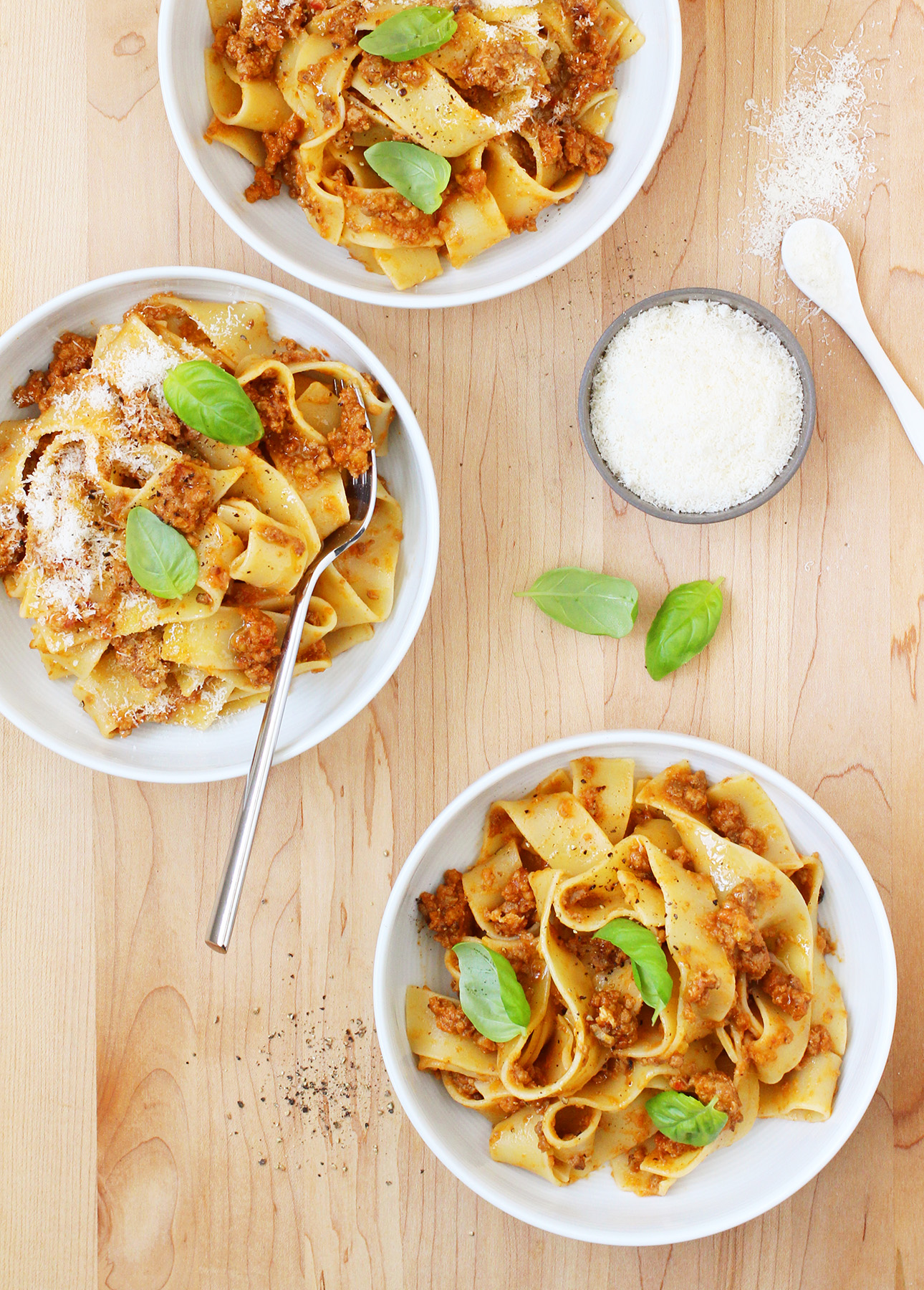
This authentic Bolognese Sauce is based on a registered Italian recipe for Ragù Bolognese, which is a meat-centric, creamy, and incredibly aromatic pasta sauce. Learn how to make and serve THE BEST version of this classic Italian sauce!
This post contains affiliate links. Full disclosure is at the bottom of the article.
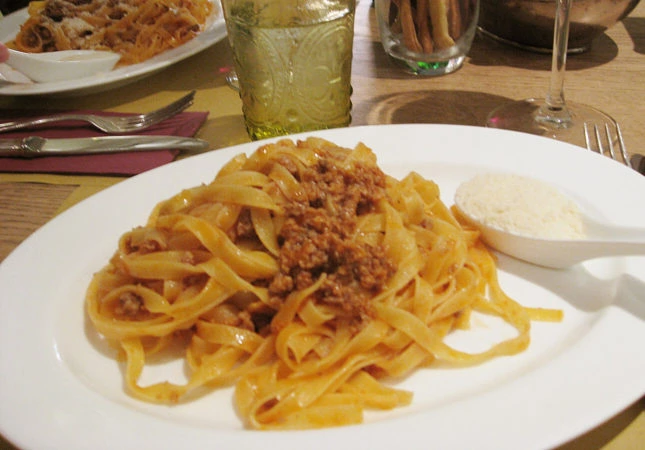
Bolognese sauce has long been the generic name for a meat and tomato pasta sauce in North America. Tasting Bolognese sauce in Italy reveals a surprisingly different experience: my first encounter with an authentic Bolognese sauce was in Modena, Italy. I was walking around that friendly university town and was attracted by a cute café to grab a bite for lunch. It was a trendy spot: the decor was all white, the music was loungy, and comfy couches littered the back of the restaurant. The place was filled with students hanging out or working on their computers. The friendly owner described his very short daily menu, but after learning we’d arrived in the region just the day before, he warmly recommended that we taste his Pappardelle Bolognese. His slow-simmered sauce was made daily, using only fresh ingredients, of course. He was so proud to know his sauce would the first authentic Bolognese sauce we’d ever tasted—and the experience revealed itself to be unforgettable indeed. The Bolognese sauce was meaty but surprisingly delicate in flavor, aromatic, and creamy. I’d never tasted a pasta dish that married so well with a sprinkle of freshly grated Parmigiano-Reggiano.
The first Ragù Bolognese I ever tasted was in Modena, Italy, back in 2007. (Hence the blurry photo!)
I enjoyed several other bowls of that magnificent yet simple dish over the course of my trip and came back home determined to recreate the delightful Bolognese Sauce I’d had in Italy, or Ragù Bolognese as it is called in its country of origin.
I knew that Italians take their culinary heritage seriously, but it turns out Italians really aren’t messing around when it comes to Bolognese: in 1982, the Academia Italiana della Cucina officially registered the recipe with the Bologna Chamber of Commerce. The registered recipe states that authentic Bolognese sauce must contain onions, celery, carrots, pancetta, ground beef, tomatoes, milk, and white wine.
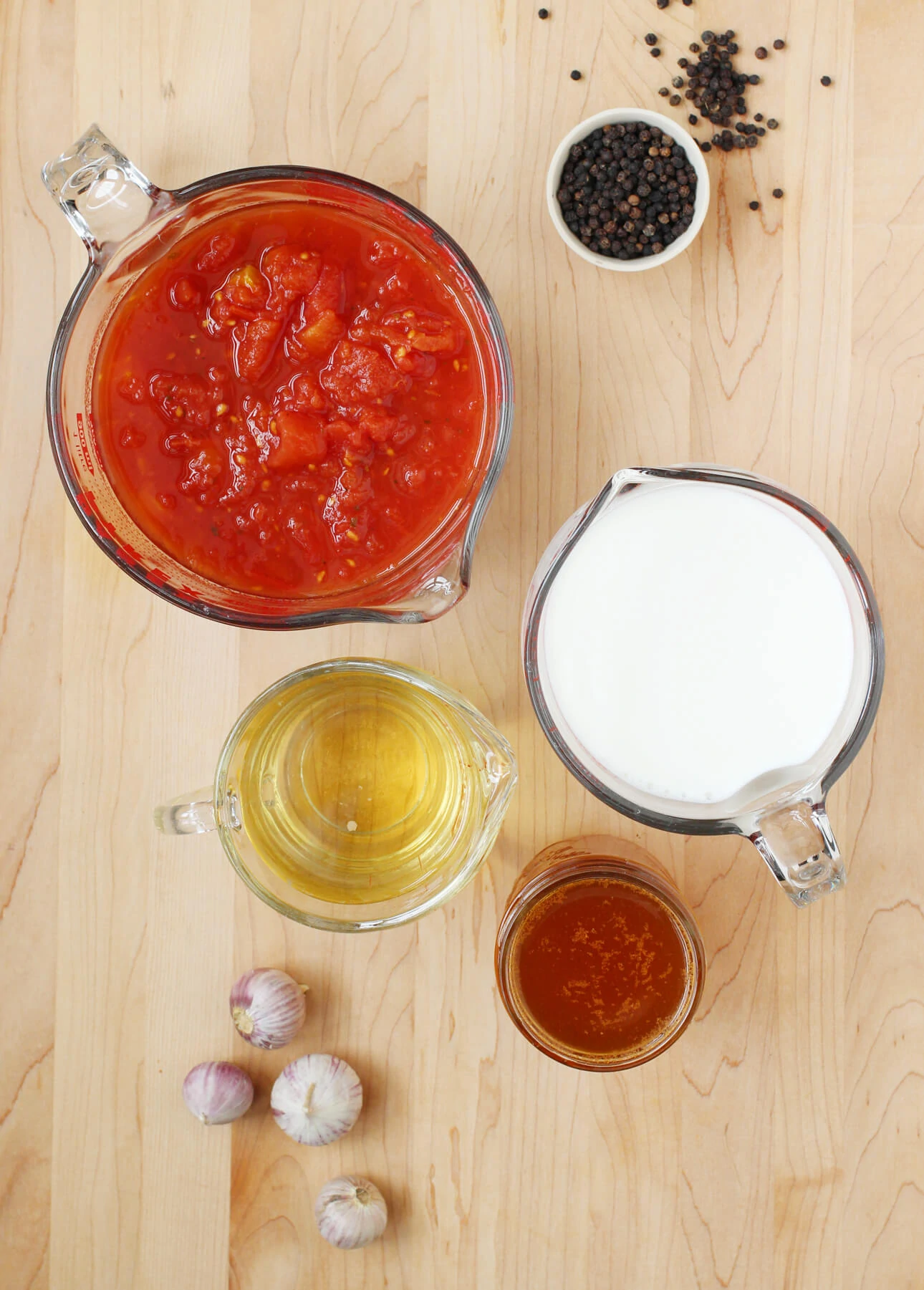
Of course, there is no single recipe for Italian Bolognese sauce; the ratios vary, but the basic ingredients remain the same. After extensive research and countless tests, I came up with what I think is the closest to the sauce I tasted in and around Bologna.
I hope you fall in love with this Italian Bolognese sauce as hard as my family has. It’s an evergreen classic at my house, and it has been my son’s favorite dish ever since he’s been able to hold a spoon. If so, please tell me about it in the comment section below. It’s always a pleasure for me to read you!
VIDEO: How to Make Authentic Bolognese Sauce
Watch this video to learn how to make THE BEST authentic Bolognese sauce by following key steps—properly chopping the veggies and caramelizing the meat—and see how best to serve it to impress your family and your guests!
Printable Bolognese Recipe
This article first breaks down the recipe into detailed steps with helpful pictures, but you can also skip it all and jump straight to a printable version of the recipe if this is what you’re looking for.
Key Ingredients to Make Bolognese Sauce
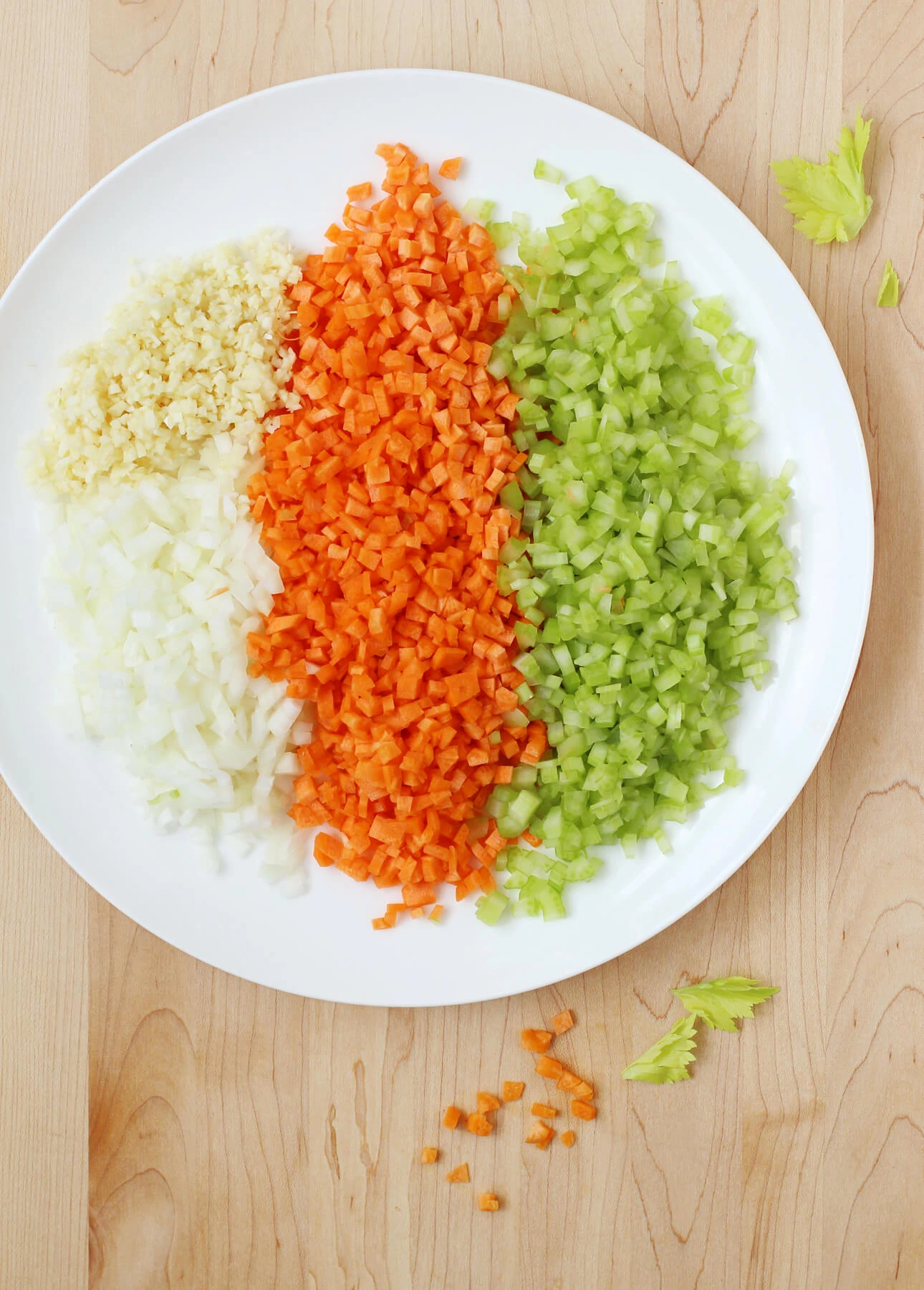
Onion, celery, carrots—a.k.a. soffritto
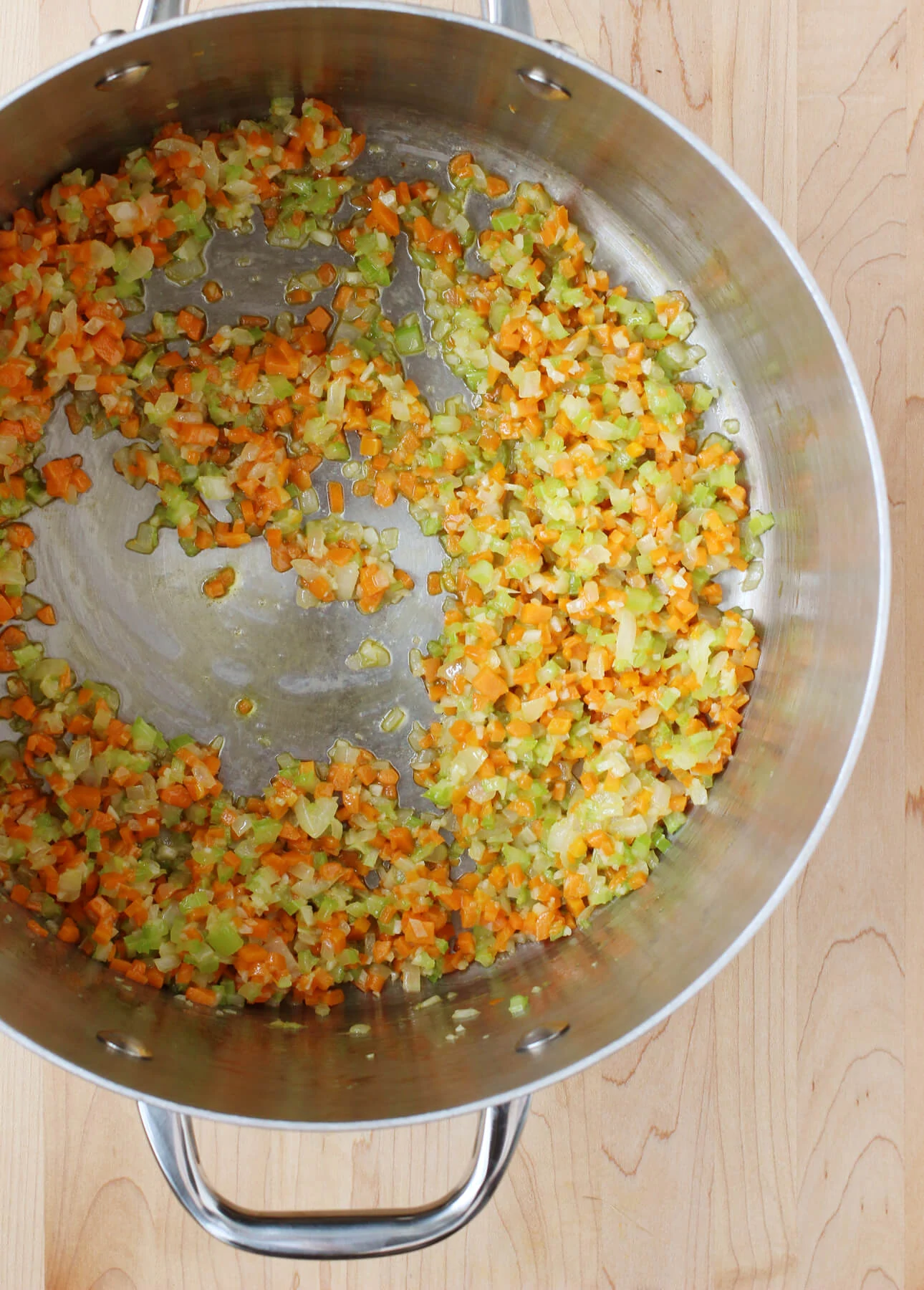
The combination of diced onion, celery, and carrots cooked in olive oil and seasoned with salt and pepper is called a soffritto in Italian cuisine. It is the base of many Italian dishes, including Bolognese sauce. This is the step that will require the most hands-on work, and knife skills matter! You need to dice everything evenly into small ¼-inch (0.5-cm) pieces. Take a few minutes to really apply yourself because the uniformity of the soffrito means the ingredients will cook evenly and produce a more enjoyable texture.
A note on garlic: Classic Bolognese sauce does not contain garlic. In many Italian pasta recipe, the garlic debate rages on—some like to use it, some don’t and say it’s blasphemy to do so. Me? I do add garlic to my Bolognese because I think it adds an extra flavor dimension I really enjoy. So, garlic or no garlic: in the end, the choice is yours!
Tomatoes
You may be surprised to learn that tomatoes are NOT the main ingredient in Italian Bolognese sauce. Authentic Italian Bolognese is very different from the bright red, tomato-based sauce most of us grew up eating. It is, rather, a meat-centric, rich, creamy sauce. Italian Bolognese sauce contains a small quantity (relative to volume) of tomatoes for taste, but it remains a meat sauce, first and foremost. You can use diced tomatoes—I perfect using petite diced tomatoes because I think the texture blends better with the rest of the ingredients—or crushed tomatoes if you prefer a smooth sauce. No need to buy fancy San Marzano tomatoes, although if you have those on hand, feel free to use them in this sauce. If the canned tomatoes you have on hand are whole, simply puree them using a hand mixer, blender, or food processor.
Ground Meat
Use lean ground meat. I like to use a combination of half beef and half veal, but you can use one or the other or both.
Pancetta
You need diced pancetta for this recipe. You’ll usually find pre-packaged, thinly sliced pancetta in grocery stores, but that won’t work in Bolognese sauce because you’re looking for not only the added flavor but texture too. Some brands sell diced pancetta, but if you can’t find it, ask for it at the deli counter, or buy it from a specialty store. I promise pancetta is worth seeking out!
Milk
Everyone’s surprised when I mention that this authentic Bolognese sauce contains milk. Indeed, most of us aren’t used to adding milk to meat sauces, yet in Bolognese, it is the surprise, miraculous ingredient that gives a rich body to the sauce and makes the meat so tender. It also produces a sauce that is more orange than red. Use whole milk (3.25% m.f.) or partly skimmed milk (2% m.f.). You can use either regular or lactose-free milk. I’ve never tried using vegan milk (soy, rice, or nut), but if you do, make sure to pick one that can sustain boiling for an extended period. Most plant milk will curdle and produce an unappealing look and texture upon boiling. Do not use cream.
Broth
The registered 1982 recipe doesn’t include broth, but most recipes I’ve encountered add water to the sauce to allow for the long simmering process. Using beef stock is a substitute I quickly adopted because it adds a bit of depth to the sauce. You can use vegetable broth or water instead.
Seasonings
This recipe (perhaps surprisingly) does not contain any aromatic herbs or spices. It is frowned upon to add bay leaves or red pepper flakes to Italian Bolognese sauce. The only flavorings in this recipe are sea salt and black pepper. I highly recommend using sea salt or kosher salt because it seasons with better flavor and more subtlety than regular table salt.
Pasta
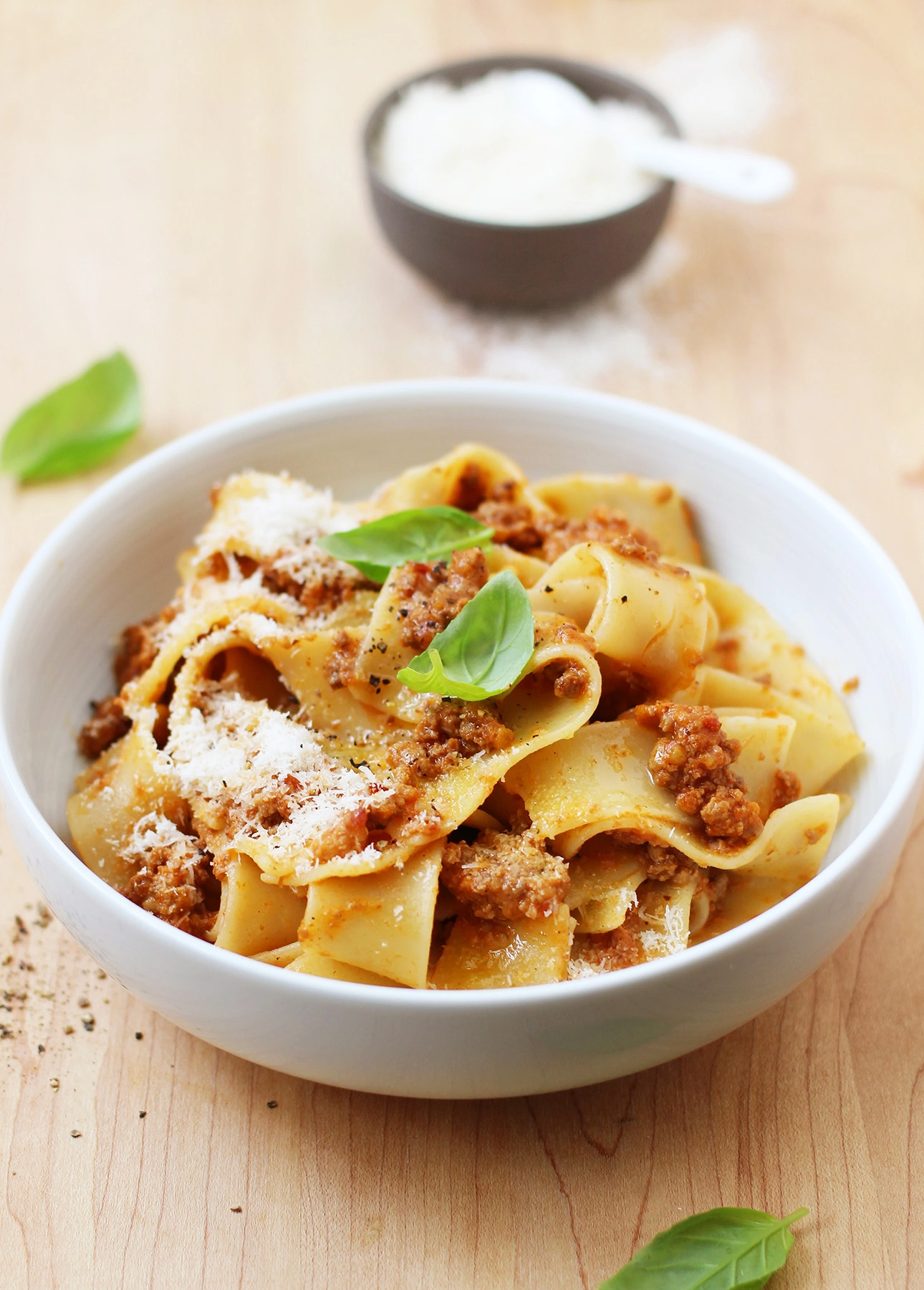
This is a hearty sauce that should be combined with pasta that can support its weight. In Italy, it is often served with pappardelle pasta—I especially like the super-wide kind I used in the pictures. You can also serve the sauce with tagliatelle, linguine, or spaghetti. Always make sure to mix the hot sauce with the hot pasta before you divide it between serving bowls—as opposed to dividing the pasta and then ladling some sauce over the pasta. This allows the sauce to coat the pasta and absorb into it, which makes for a much more enjoyable and delicious experience. Watch my Bolognese recipe video to see exactly how to serve Bolognese sauce to impress your family and friends!
Cheese
Use only freshly grated Parmigiano-Reggiano. The sharp, salty flavor of the Italian cheese has no substitute and is a perfect match to the meaty sauce—unsurprisingly so since both Bolognese sauce and Parmigiano-Reggiano come from the same Italian province, Emilia-Romagna.
Stovetop Cooking Method for Bolognese Sauce
This sauce doesn’t like to be rushed. The only way for the sauce to become so rich in texture and flavor is a slow, long-simmering—and I mean a two- to a three-hour simmer. You first need to cook the soffritto and then brown the meat, both of which will require about 20 minutes of active time. The rest of the cooking process is hands-off, safe from a quick stir every half hour or so. If you’re gonna make authentic Italian Bolognese sauce, it’s worth making it right.
SLOW COOKER METHOD for Bolognese Sauce
Over the years, I’ve so often been asked whether this sauce can be made in the slow cooker that I decided to test it to come up with a method to do so. My recipe now includes slow cooker instructions: you’ll find them in the printable recipe at the bottom of the post.
When making Bolognese sauce in a slow cooker, you need to decrease the quantity of some of the liquids used in the recipe:
1 cup (250 ml) whole (3.25%) or partly skimmed (2%) milk
1 can (14 oz/398 g) diced tomatoes, or crushed tomatoes
1/2 cup (125 ml) beef broth
You also need to add the following ingredient: 1/4 cup (60 ml) tomato paste. Tomato paste is required in the slow cooker method to help add body to the sauce, which won’t benefit from the same simmering and thickening process as the stovetop method.
All the remaining ingredients stay the same.
Cook the onion, carrot, celery, garlic, pancetta, and ground meat following the instructions provided above. Deglaze the pan using the white wine, as instructed, then transfer the mixture to the bowl of a slow cooker. Stir in the milk, tomatoes, beef broth, tomato paste, and some ground black pepper. (Do not add more salt at this point; wait until the end of the cooking process to taste and adjust seasoning if needed.) Cover and cook on the LOW setting for about 6 hours. If the sauce still seems soupy and runny after that period of time, keep cooking for about 2 hours, or remove the lid and simmer, uncovered, for about 30 minutes, or until you reach the desired consistency. If the sauce seems a bit dry, you can stir in a bit of beef broth to make it right. Taste the sauce and adjust seasoning if needed.
STEP-BY-STEP Recipe for Ragù Bolognese: Italian Bolognese Sauce
Makes 16 servings.
PRINTABLE VERSION
NEW: WATCH MY BOLOGNESE RECIPE VIDEO
INGREDIENTS
- 2 tbsp (30 ml) extra-virgin olive oil
- 1/4 cup (60 ml) butter
- 1 medium-sized yellow onion, diced
- 4 small, or 2 large, carrots, peeled and diced
- 2 celery stalks, diced
- 4 garlic cloves, minced
- 1 cup (250 ml) diced pancetta (about 4.5 oz/125 g)
- 1 tsp (5 ml) kosher salt, or fine sea salt
- Freshly ground black pepper
- 2 lb (1 kg) lean ground meat (beef, veal, or a combination)
- 1 cup (250 ml) dry white wine (such as Chardonnay)
- 2 cups (500 ml) whole (3.25%) or partly skimmed (2%) milk
- 1 can (28 oz/794 g) diced tomatoes, or crushed tomatoes
- 1 cup (250 ml) beef stock
To serve
- Freshly grated Parmigiano-Reggiano
- Dried pappardelle, tagliatelle, linguine, or spaghetti
- Fresh basil (optional)
METHOD
In a stockpot set over medium heat, add the butter and the oil and stir until the butter is melted. Add the onion, carrot, celery, garlic, and half of the salt (½ tsp/2 ml) and sauté for 5 minutes, stirring often, until the vegetables are soft.
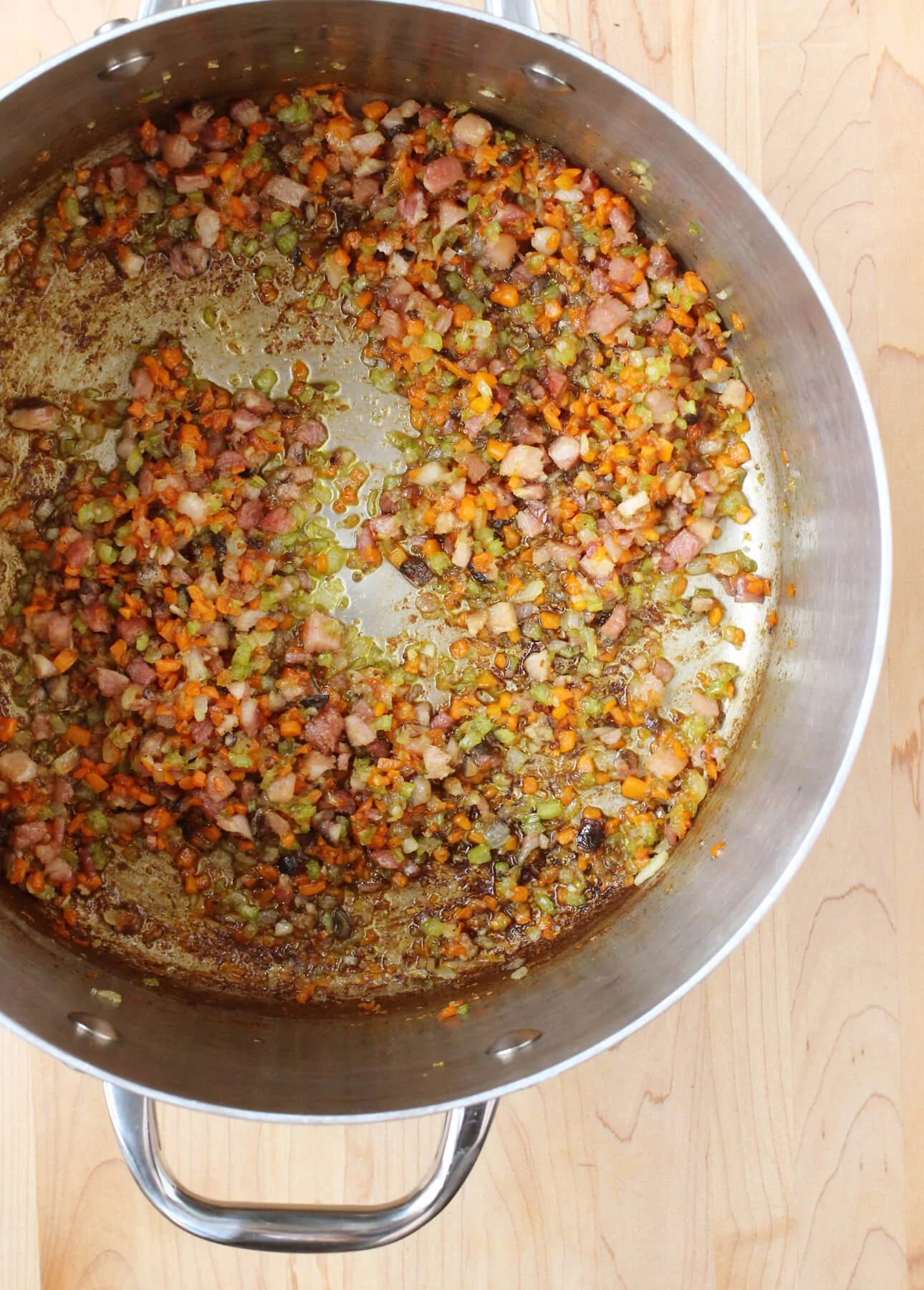
Add the diced pancetta and cook for a further 10 minutes, until the pancetta is golden and crisp.
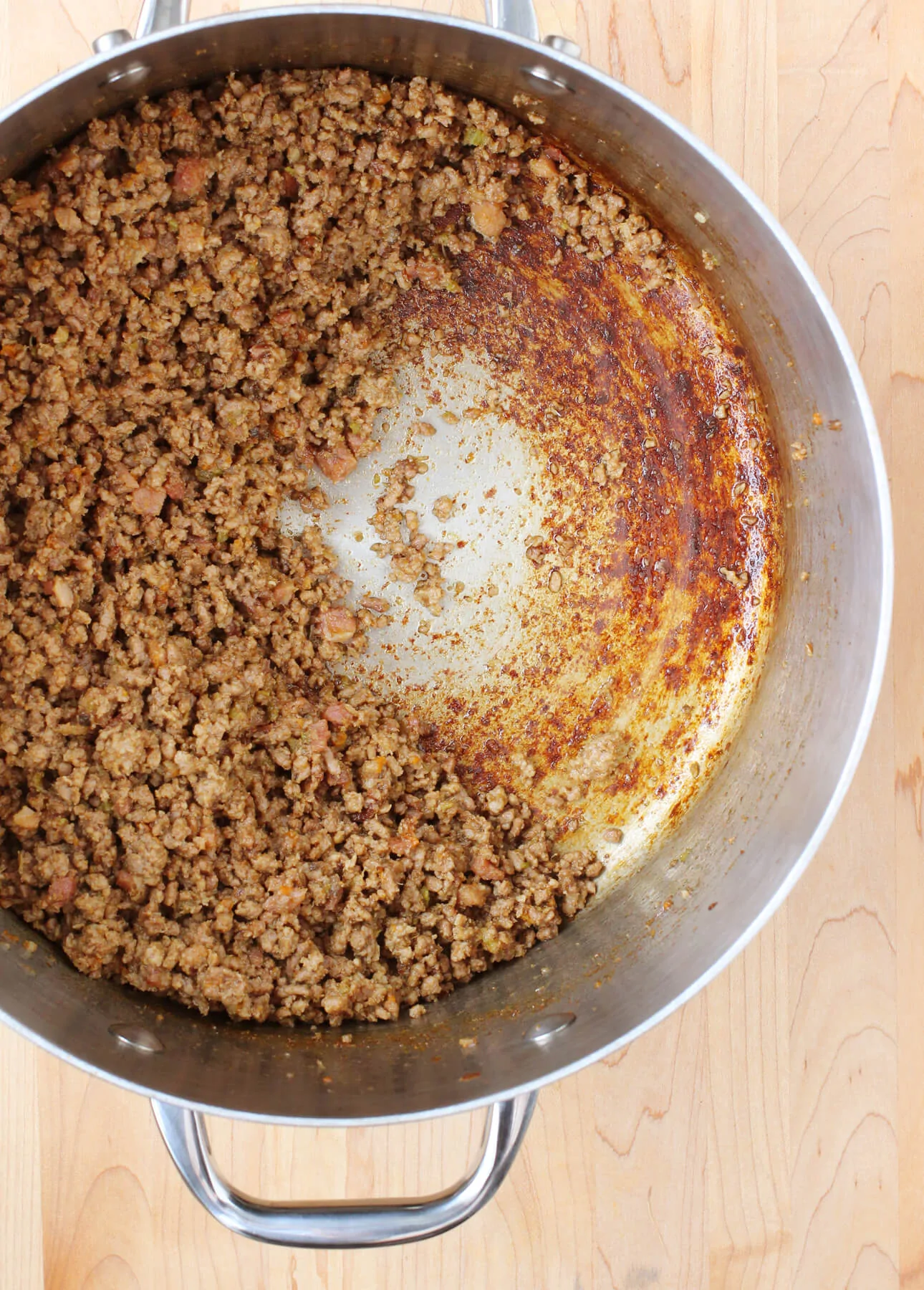
Add a third of the ground meat, stirring and breaking lumps with a wooden spoon between each addition. Adding the meat gradually allows the excess water and liquid to evaporate, which is key for the meat to caramelize properly. Once the meat is cooked, add a third more of the meat, stirring and breaking lumps as you go. Repeat with the remaining meat. When the meat is cooked and no lumps remain, set a timer to 10 minutes and keep cooking the meat, stirring from time to time. You want the meat to caramelize and even become crispy in spots. Golden bits of meat will stick to the bottom of the pot, which you will deglaze with white wine later. Watch over the pan at all times as you don’t want the meat to burn.
Add the white wine into the pot. With the wooden spoon, scrape all the brown bits stuck to the bottom of the pot. Push the meat all around to make sure you scrape it all off. By the time you’re finished, the wine will be evaporated (2 to 3 minutes). Be careful not to let the meat stick to the pot again—lower the heat if necessary.
Add the milk, tomatoes, beef broth, remaining salt (½ tsp/2 ml) and a generous grinding of black pepper. Bring to a boil and then lower to the lowest heat setting.
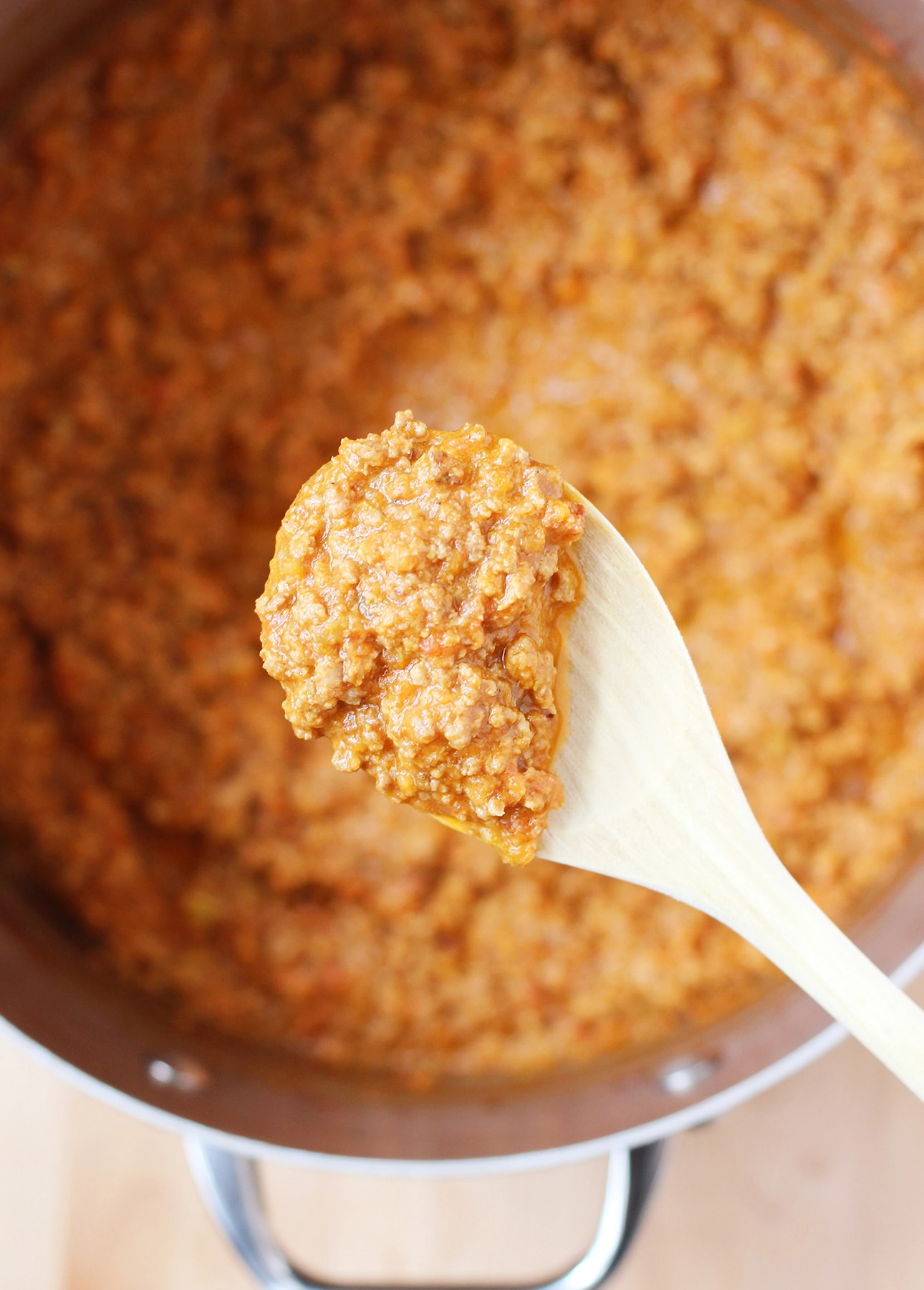
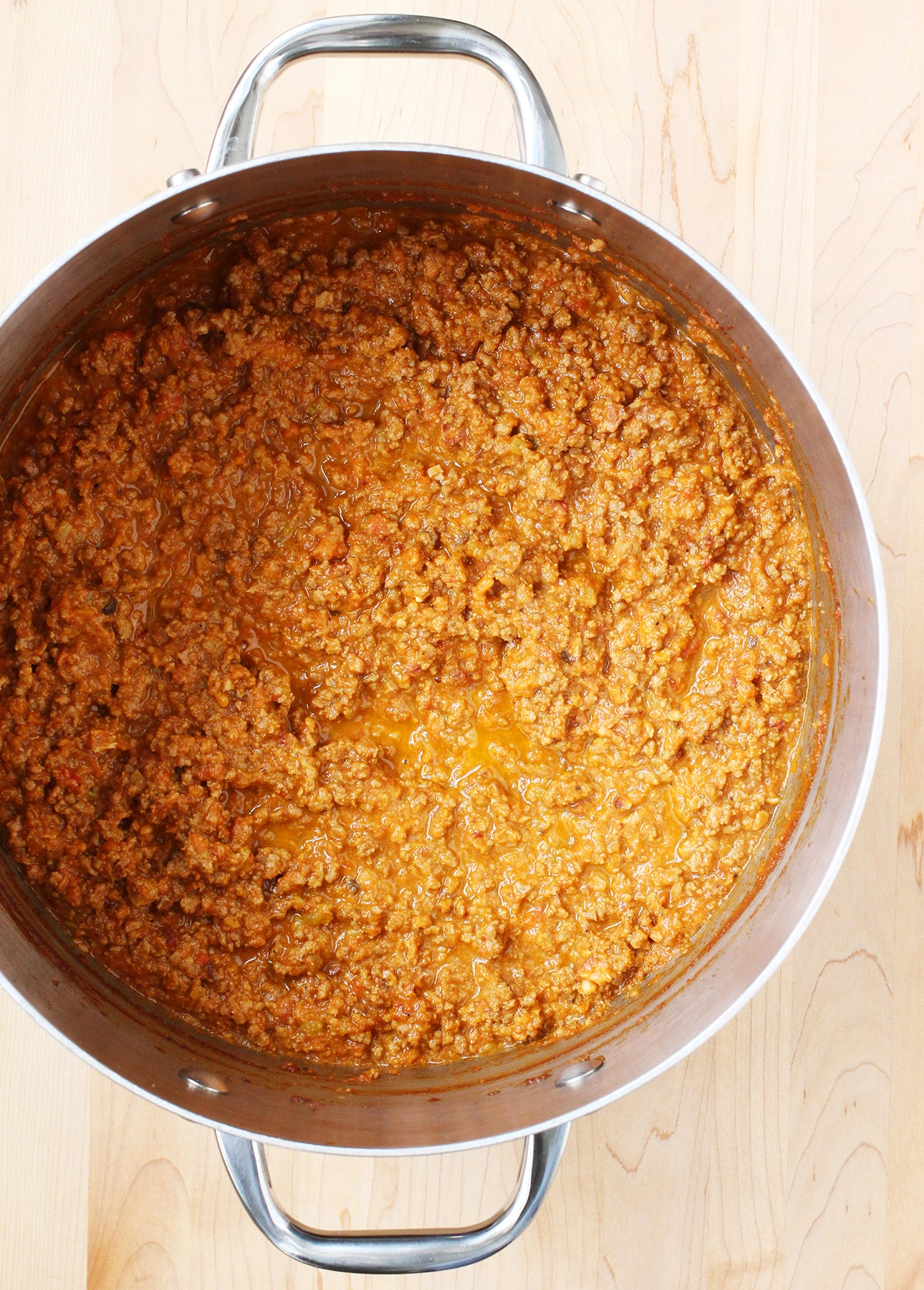
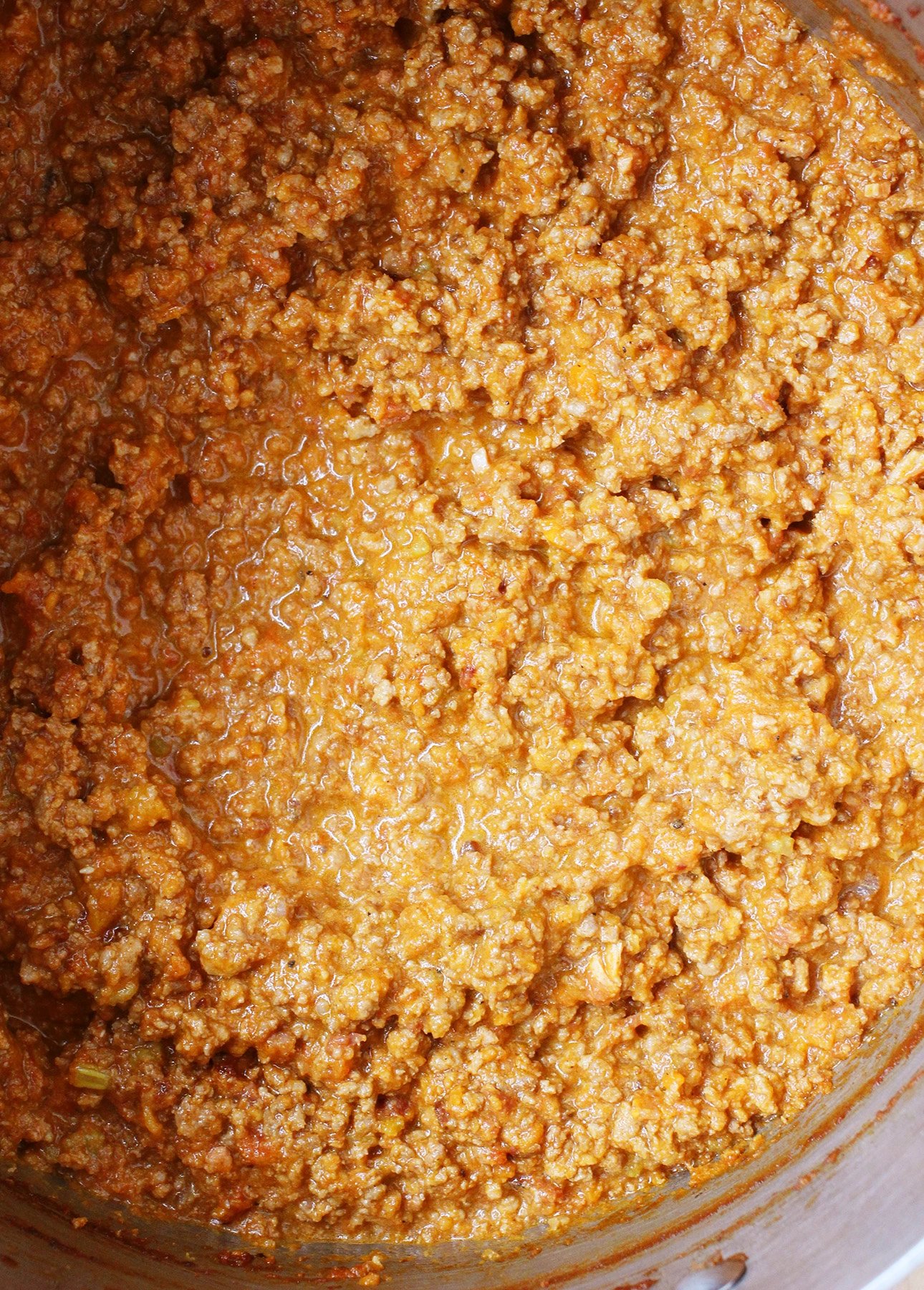
Half-cover and simmer gently for about 2 hours, setting yourself a timer to give the sauce a stir every 30 minutes. The sauce is ready when it looks rich and creamy, and the texture is thick like oatmeal. No liquid should separate from the sauce when you push the sauce to one side. Taste and adjust the seasoning if needed.
How to Serve Bolognese Sauce
The pasta to Bolognese sauce serving ratio for 1 person is about 3 oz (85 g) dry pasta to 1/2 cup (125 ml) Bolognese sauce. Multiply this ratio according to the number of people you’re feeding.
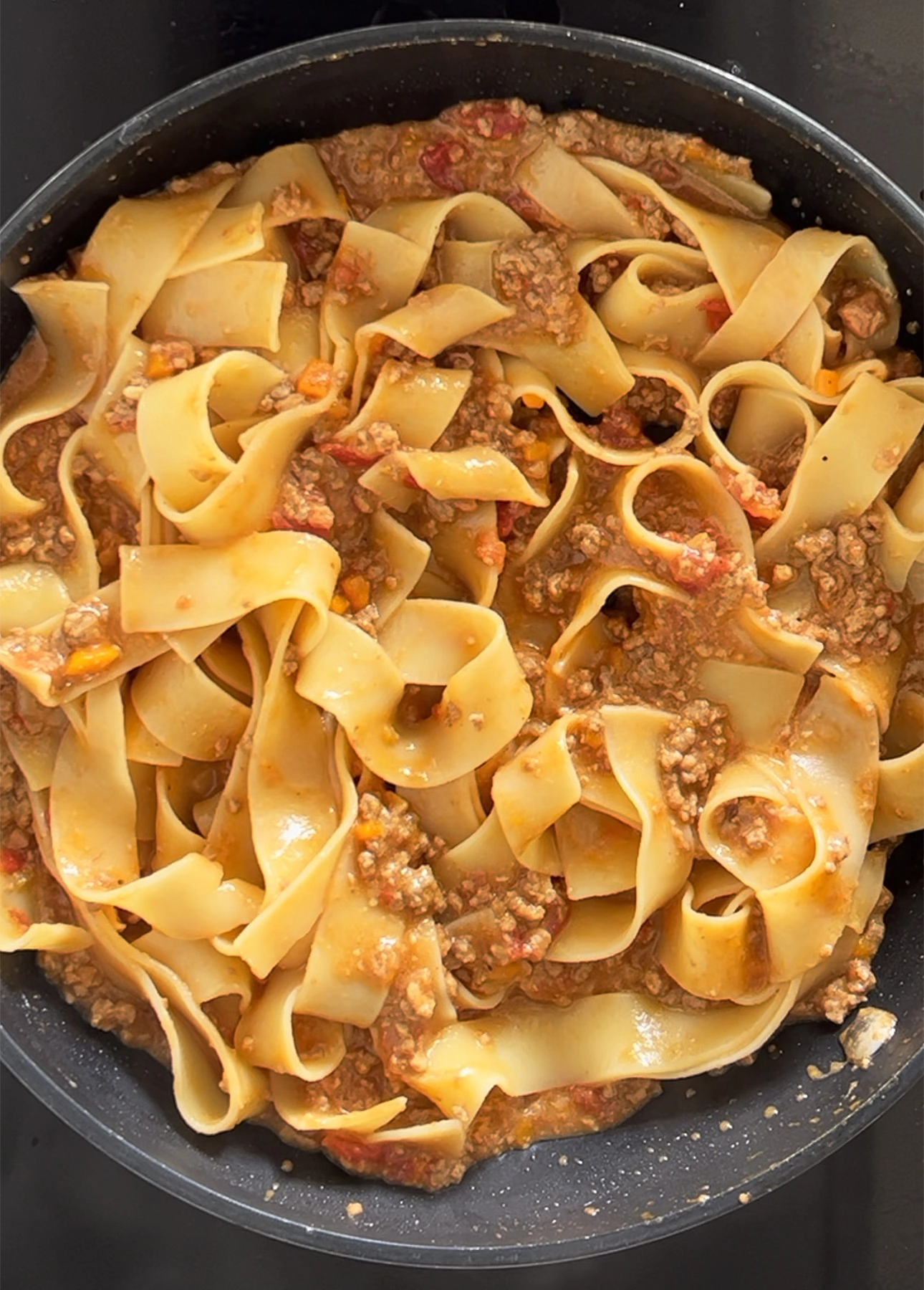
Serving method: Warm the Bolognese sauce in a nonstick skillet. Add 1 tablespoon (15 ml) of finely grated Parmigiano-Reggiano *per serving* straight into the sauce, stirring to melt and incorporate the cheese. This addition will boost the flavor of the sauce and produce an incredibly creamy result.
Cook the pasta of your choice in generously salted water for 1 minute less than the recommended cooking time. Once the pasta is cooked, use kitchen tongs to transfer the pasta straight into the skillet with the sauce. Do not discard the pasta cooking water! Add 2 tbsp (30 ml) of the pasta cooking water *per serving* to the skillet and mix to incorporate. Bring to a simmer and stir, using a spatula, to evenly distribute the sauce and coat the pasta with it.
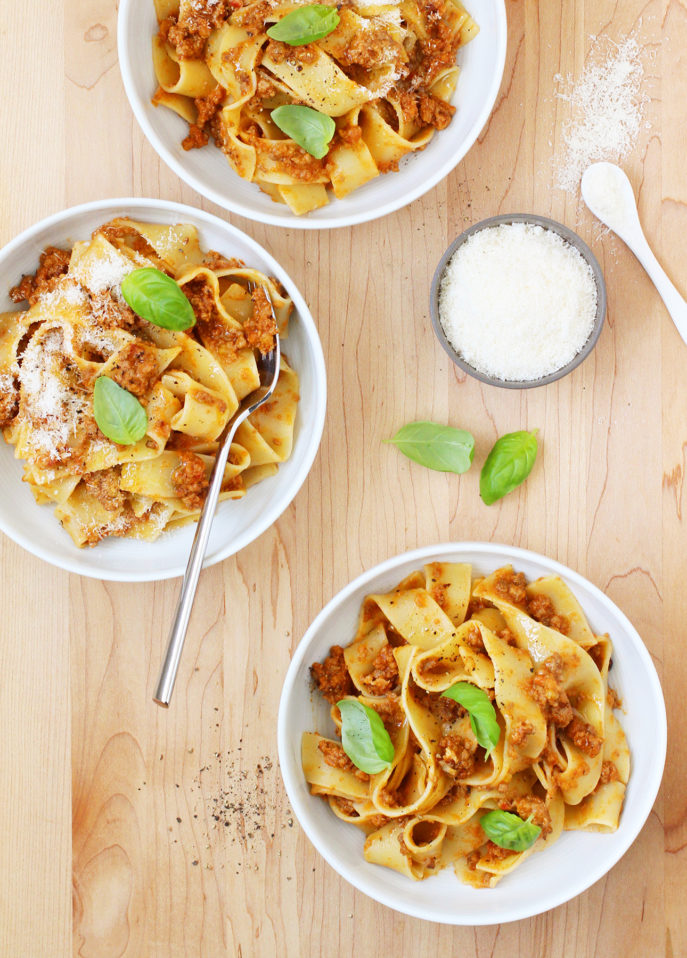
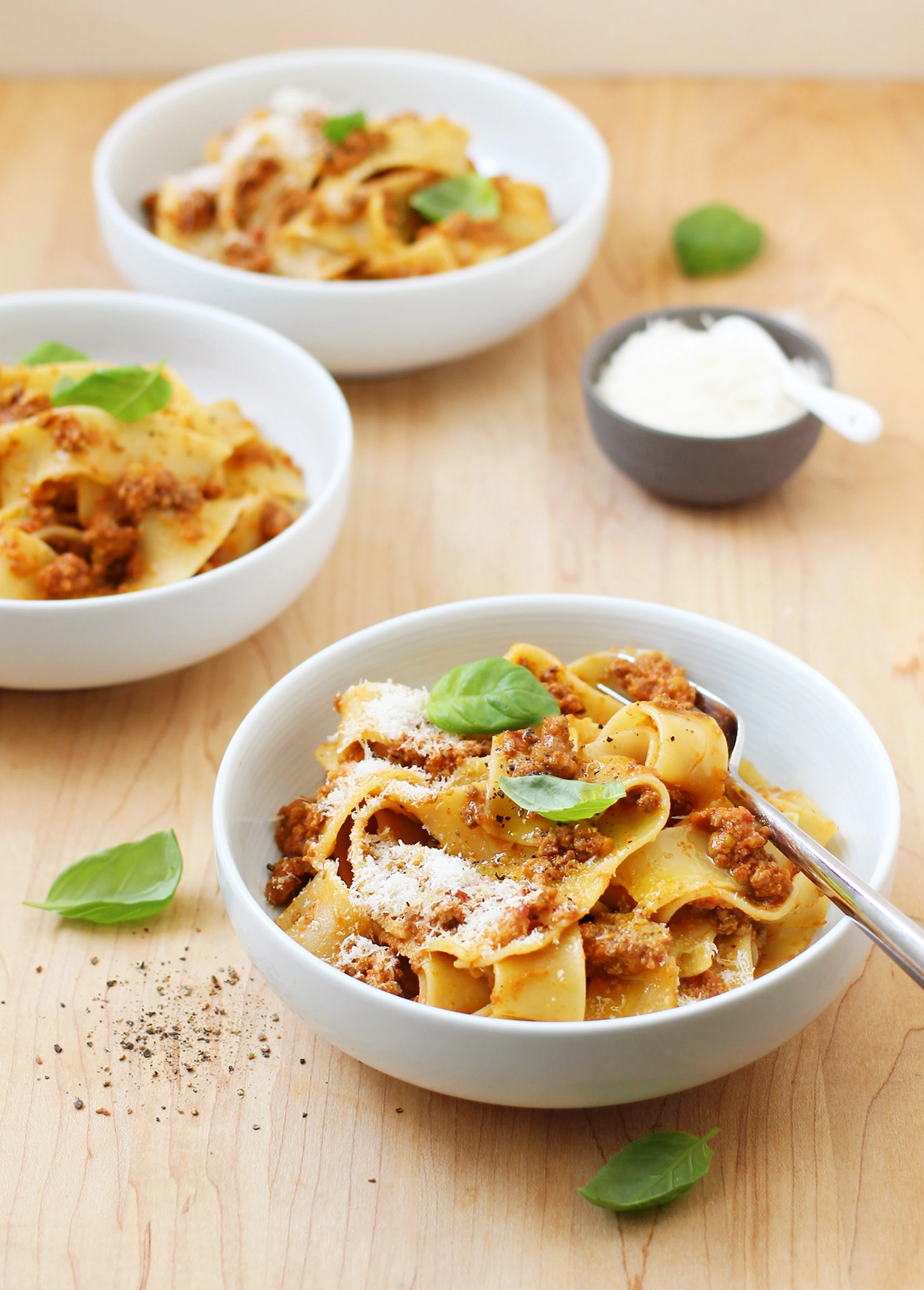
Divide between warm bowls. Garnish with fresh basil leaves, if desired, and more Parmigiano-Reggiano, to taste.
Watch my Bolognese recipe video to see exactly how to serve Bolognese sauce to impress your family and friends!
How to Store Bolognese Sauce
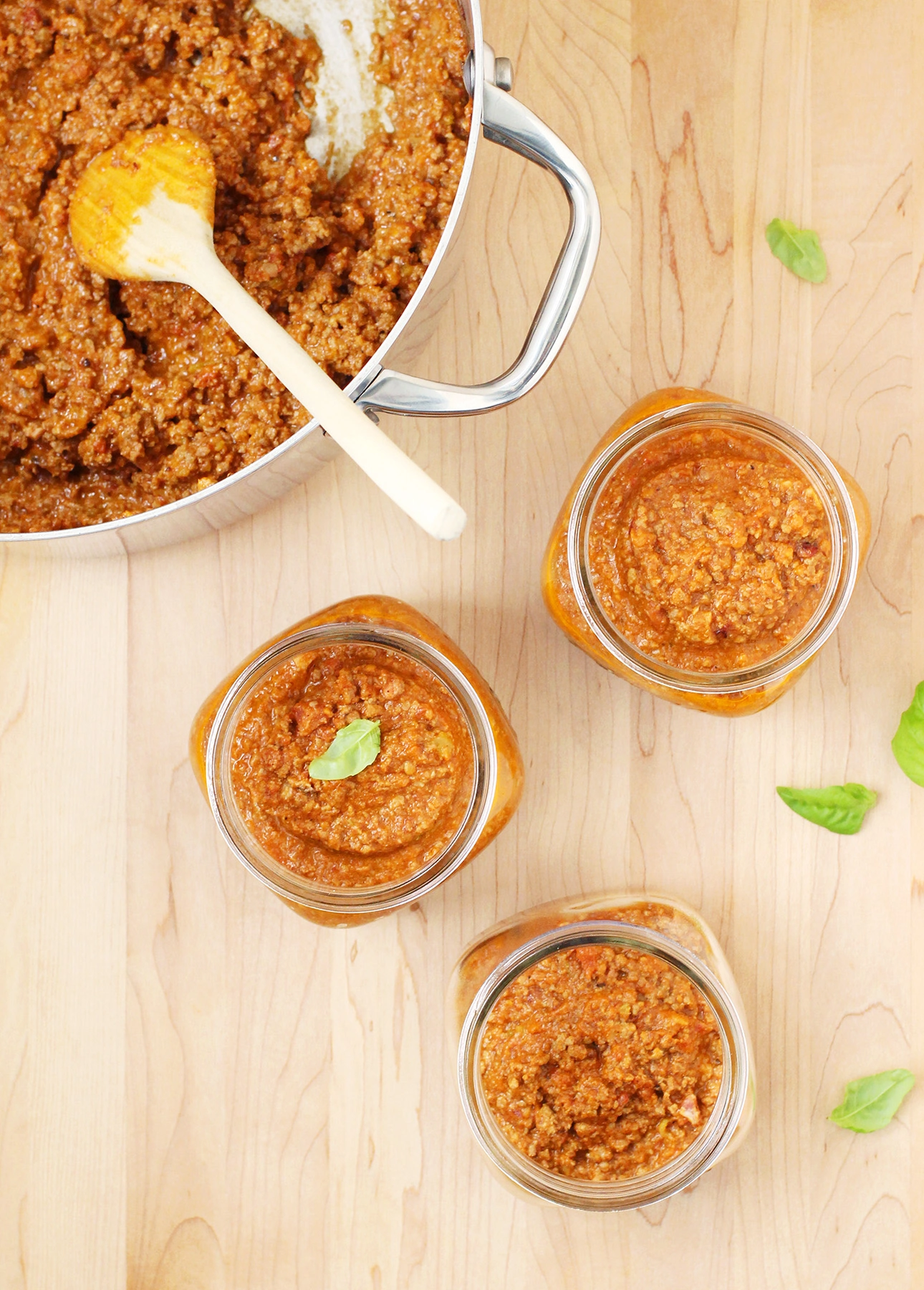
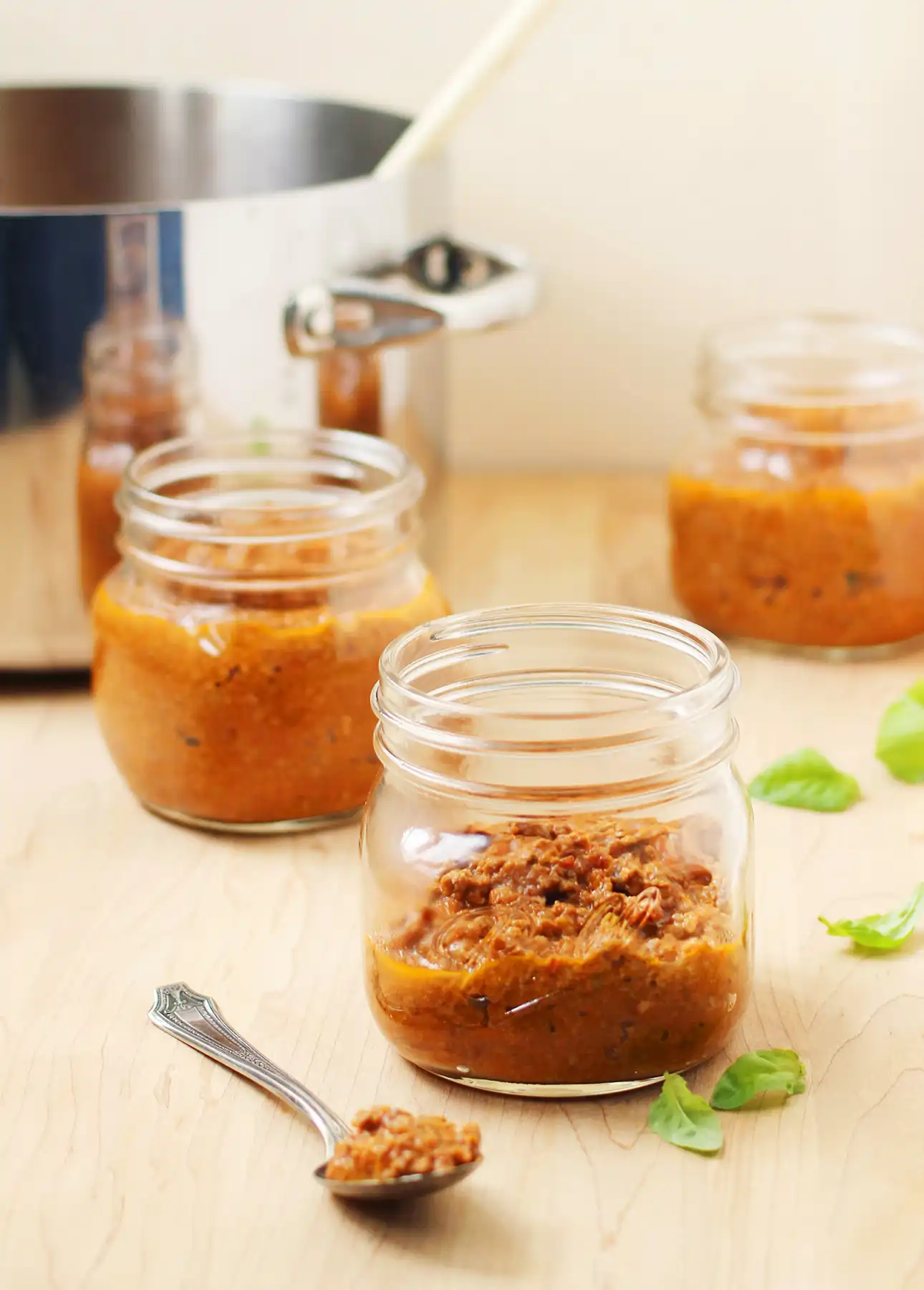
Let the sauce cool completely to room temperature. Divide the Bolognese Sauce into portions—keeping in mind that 1 serving of Bolognese sauce is 1/2 cup (125 ml)—and store in airtight containers or glass jars. Refrigerate for up to a week, or freeze for up to 6 months.
RECIPE: Authentic Bolognese Sauce
Ingredients
- 2 tbsp extra-virgin olive oil
- ¼ cup butter
- 1 medium-sized yellow onion, diced
- 4 small or 2 large, carrots, peeled and diced
- 2 celery stalks, diced
- 4 garlic cloves, minced
- 4.5 oz diced pancetta (about 1 cup)
- 1 tsp kosher salt, or fine sea salt
- Freshly ground black pepper
- 2 lb lean ground meat (beef, veal, or a combination)
- 1 cup crisp, dry white wine (such as Pinot Grigio)
- 2 cups whole milk (3.25% m.f.) or partly skimmed milk (2% m.f.)
- 1 can (28 oz/794 g) diced tomatoes, or crushed tomatoes
- 1 cup beef stock
To serve
- Freshly grated Parmigiano-Reggiano
- Dry pappardelle, tagliatelle, linguine, or spaghetti
- Fresh basil (optional)
Instructions
- In a large stainless steel pot set over medium heat, add the butter and the oil and stir until the butter is melted. Add the onion, carrot, celery, garlic, and half of the salt (½ tsp/2 ml) and sauté for 5 minutes, stirring often, until the vegetables are soft. Add the diced pancetta and cook for a further 10 minutes, until the pancetta is golden and crisp.
- Add a third of the ground meat, stirring and breaking lumps with a wooden spoon between each addition. Adding the meat gradually allows the excess water and liquid to evaporate, which is key for the meat to caramelize properly. Once the meat is cooked, add a third more of the meat, stirring and breaking lumps as you go. Repeat with the remaining meat.
- When the meat is cooked and no lumps remain, set a timer to 10 minutes and keep cooking the meat, stirring from time to time. You want the meat to caramelize and even become crispy in spots. Golden bits of meat will stick to the bottom of the pot, which you will deglaze with white wine later. Watch over the pan at all times as you don’t want the meat to burn.
- Add the white wine into the saucepan. With the wooden spoon, scrape all the brown bits stuck to the bottom of the pot. Push the meat all around to make sure you scrape it all off. By the time you’re finished, the wine will be evaporated (2 to 3 minutes). Be careful not to let the meat stick to the bottom of the pot again—lower the heat if necessary.
- Add the milk, tomatoes, beef broth, remaining salt (½ tsp/2 ml) and a generous grinding of black pepper. Bring to a boil and then lower to the lowest heat setting.
- Half-cover and simmer gently for about 2 hours, setting yourself a timer to give the sauce a stir every 30 minutes. The sauce is ready when it looks rich and creamy, and the texture is thick like oatmeal. No liquid should separate from the sauce when you push the sauce to one side. Taste and adjust the seasoning if needed.
- HOW TO MAKE BOLOGNESE SAUCE IN A SLOW COOKERIf making the sauce in a slow cooker, you need to decrease the quantity of some of the liquids used in the recipe:1 cup (250 ml) whole (3.25%) or partly skimmed (2%) milk1 can (14 oz/398 g) diced tomatoes, or crushed tomatoes1/2 cup (125 ml) beef brothYou also need to add the following ingredient: 1/4 cup (60 ml) tomato paste. Tomato paste is required in the slow cooker method to help add body to the sauce, which won’t benefit from the same simmering and thickening process as the stovetop method.All the remaining ingredients stay the same.Cook the onion, carrot, celery, garlic, pancetta, and ground meat following the instructions provided above. Deglaze the pan using the white wine, as instructed, then transfer the mixture to the bowl of a slow cooker. Stir in the milk, tomatoes, beef broth, tomato paste, and some ground black pepper. (Do not add more salt at this point; wait until the end of the cooking process to taste and adjust seasoning if needed.) Cover and cook on the LOW setting for about 6 hours. If the sauce still seems soupy and runny after that period of time, keep cooking for about 2 hours, or remove the lid and simmer, uncovered, for about 30 minutes, or until you reach the desired consistency. If the sauce seems a bit dry, you can stir in a bit of beef broth to make it right. Taste the sauce and adjust seasoning if needed.
- HOW TO SERVE AUTHENTIC BOLOGNESE SAUCEThe pasta to Bolognese sauce serving ratio for 1 person is about 3 oz (85 g) dry pasta to 1/2 cup (125 ml) Bolognese sauce. Multiply this ratio according to the number of people you're feeding. Serving method: Warm the Bolognese sauce in a nonstick skillet. Add 1 tablespoon (15 ml) of finely grated Parmigiano-Reggiano *per serving* straight into the sauce, stirring to melt and incorporate the cheese. This addition will boost the flavor of the sauce and produce an incredibly creamy result.Cook the pasta of your choice in generously salted water for 1 minute less than the recommended cooking time. Once the pasta is cooked, use kitchen tongs to transfer the pasta straight into the skillet with the sauce. Do not discard the pasta cooking water! Add 2 tbsp (30 ml) of the pasta cooking water *per serving* to the skillet and mix to incorporate. Bring to a simmer and stir, using a spatula, to evenly distribute the sauce and coat the pasta with it.Divide between warm bowls. Garnish with fresh basil leaves, if desired, and more Parmigiano-Reggiano, to taste.
- HOW TO STORE AUTHENTIC BOLOGNESE SAUCELet the sauce cool completely to room temperature. Divide the Bolognese Sauce into portions—keeping in mind 1 serving of Bolognese sauce is 1/2 cup (125 ml)—and store in airtight containers or glass jars. Refrigerate for up to a week, or freeze for up to 6 months.
Video
Did you make this?
Tell me how you liked it! Leave a comment or take a picture and tag it with @foodnouveau on Instagram.
This site is a participant in the Amazon Associates Program, an affiliate advertising program designed to provide a means for the site to earn fees by linking to Amazon and affiliated sites.
If you click on an affiliate link, I may earn advertising or referral fees if you make a purchase through such links, at no extra cost to you. This helps me create new content for the blog–so thank you! Learn more about advertising on this site by reading my Disclosure Policy.
Author: Marie Asselin
I’ve made this several times , it’s delicious.
I’ve been using this recipe for at least 10 years. I swear by it with my own small modifications, including using different types of ground meat, much of which I grind myself.
The best part is that I use the leftovers to make moussaka, which is at least as popular as the original Bolognese with homemade pasta.
Thanks so much for the kind comment Steven! That my sauce has been part of your family’s culinary tradition for so much is truly an honor. I’ve never used this sauce to make moussaka, but now I’m obsessed with the idea!!
So so so good!
Do you ever chop onion, carrots, and celery in food processor.
I love your website and your recipes are great. Thank you so much for sharing your knowledge.
You can absolutely use the food processor to fast-track the chopping step. I’m a bit of a nerd and I feel like I better control the dicing size and texture of the sauce when I use a knife, but I absolutely wouldn’t want you to shy away from making this delicious sauce because you’re wary of the prep involved. Just make sure to scrape down your food processor bowl several times to get a uniform texture.
The best bolognese recipe ever, it’s been my go to for many years now and nothing beats it! Comes
Out consistently every time I make it and is a real favourite here.
2024 Yes another Christmas! Merry to you and big thanks! This time, I hope to pull this off, the bolognese will be for 14 adults! Yeks! Mezza Rigatoni this time! MC & happy new year Marie! xx
2021 Another Christmas & another making of your Bolognese Sauce! This has become a Christmas staple for our family! Since veal is hard to find I’ve used ground pork: 2/3 beef & 1/3 pork. This will be the 8th or 9th year of making exactly as you’ve taught me. A very big thank you & Merry Christmas & safe & healthy New Year!
I’ve been using this recipe for years, with a few alterations along the way. This bolognese has been my comfort during the cold winters in the European north. After long days of medicine lectures, coming home to heat it up and enjoy it was a real treat. This recipe is a 10/10! I highly recommend it to everyone. Thank you from the bottom of my heart.
– Justas
Thank you so much for taking the time to write a note Justas! I really appreciate it. I’d love to read more about how you made the recipe your own over time!
Awesome recipe. Used 1 pound each of beef, veal and pork. Dynamite! Great recipe and directions were spot-on!
Thanks for the great feedback James!
From South Africa. Cold and wet weather out on our small holding in the Swartland. Howling wind and rain for days. Needed some hot homely food that sticks to my ribs. Decided to try make a real Italian meat sauce. Took me more than an hour to prep and get to the simmer stage, what with a massive power outage, choping by paraffin lamps, sipping on a warming bourbon. The smell from my farmhouse kitchen is amazing. Have snuck a taste, sooo good. Awesome recipe.
Oh wow I can just picture you preparing this sauce Ilana! Bolognese is the perfect remedy for the unkind weather you’ve been having. This sauce does require a bit of prep time, but the flavor is so incredibly rewarding. Thank you so much for taking the time to leave a note!
Our family has been enjoying your recipe for years! It tastes just like our Nana’s from southern Italy in the Basilcata region♥️ She would “pour” the wine in, however much you like. Red or white, whatever you have on hand! She was so easy about it. Thank you for keeping us connected through food and soul!
This the kind of message that keeps me going! Thank you so much for taking a minute to write Dreama, it was such a pleasure to read you ❤️